
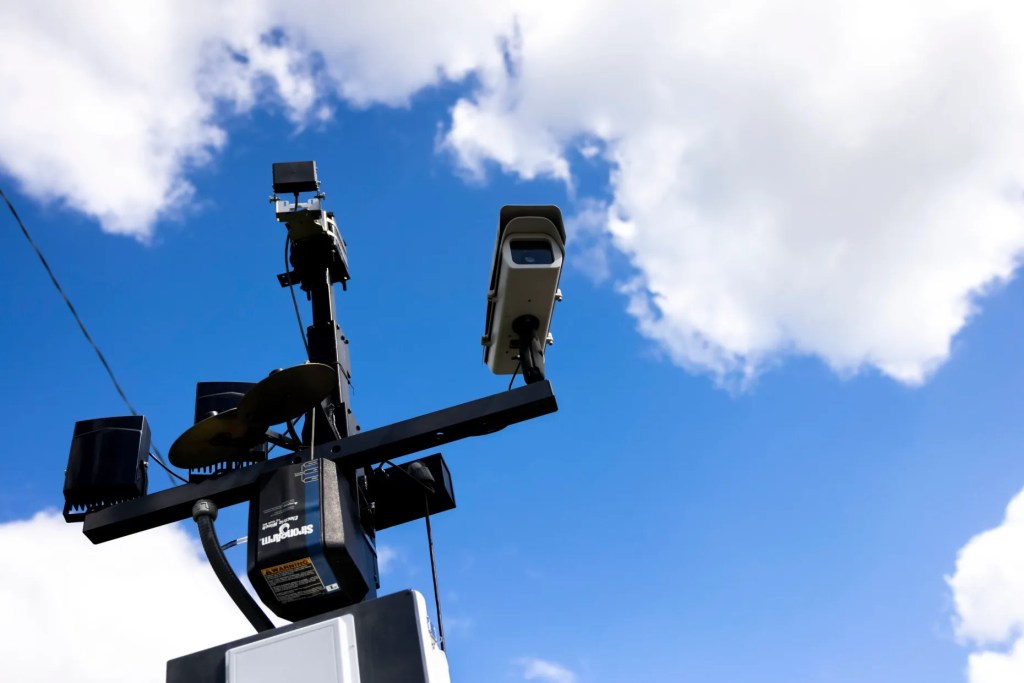
Nearly two years after a state law authorized Los Angeles and five other cities to implement a street safety program, the Los Angeles City Council on Tuesday finalized the process to begin participating in the initiative — making it the last municipality to do so.
In a 14-0 vote, the council authorized the Los Angeles Department of Transportation to move forward with the program, which is expected to cost the city nearly $8.5 million. The council also approved a policy and impact report on the matter.
City Councilwoman Imelda Padilla was absent during the vote.
Additionally, the council instructed LADOT to expand its Community Assistance Parking Program to allow for low-income or unhoused individuals to perform community service in lieu of paying a penalty for the duration of the program. LADOT will be expected to provide annual reports on the efficiency of its initiative to assist low-income individuals.
“LA is the last to implement it, and frankly, that’s embarrassing and unfortunate,” Councilwoman Katy Yaroslavsky said. “This pilot is limited to five years, and we’re already well into that five-year period.”
Yaroslavsky noted revenue generated from citations will serve to support traffic-calming and street improvements.
“Speeding, as we know, is one of the most serious threats on our streets. Cars are the leading causes of death for children in Los Angeles and the rest of the country,” Yaroslavsky said. “This program gives us a tool to prevent those deaths and protect people in every neighborhood.”
City workers are expected to install speed cameras and test them between April and July, followed by a 60-day public information campaign prior to activation. Between July and September, the city will institute a 60-day warning period to inform drivers, according to a tentative timeline from LADOT.
The department is expected to provide warnings for first-time violations throughout the duration of the pilot program.
Los Angeles delayed implementation of the program in part due to a community engagement process to develop a use policy, and partly due to the procurement process of the speed cameras themselves. Up to 125 cameras are expected to be installed across the city. Most council districts will receive eight cameras, with districts 4, 6, 8, 9 and 10 getting an additional camera.
In October 2023, Gov. Gavin Newsom signed AB 645, authored by Assemblywoman Laura Friedman, D-Burbank. The law went into effect Jan. 1, 2024.
The bill authorized Los Angeles, Long Beach and Glendale, as well as San Jose, Oakland and the city and county of San Francisco to operate the speed safety system pilot program through Jan. 1, 2032, unless extended by legislation. A final evaluation report is required on or before March 1 of the final year of the pilot.
Safety advocates have criticized the city for not implementing the program sooner. They argued the street safety pilot can make a difference in saving lives and reducing speeding by drivers.
In 2025, 290 people died in traffic incidents in the city, according to the Los Angeles Police Department’s most recent data. There were more traffic-related deaths than homicides last year as well.
Critics have argued that the program will further serve to “criminalize” low-income communities and people of color.