
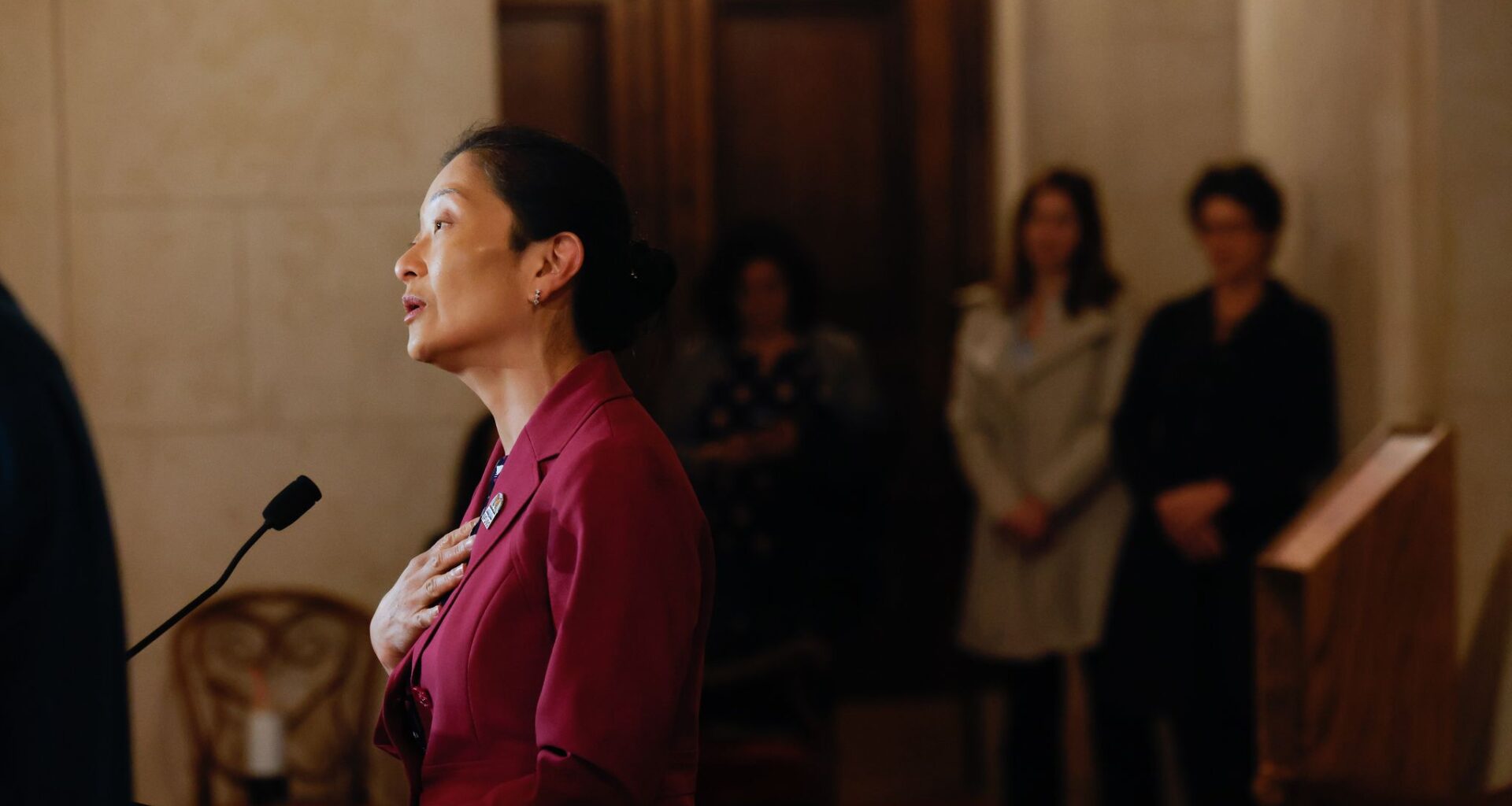
Maria Su, superintendent SFUSD, speaks at press conference announcing a tentative agreement to end the SFUSD teachers strike on Friday February 13, 2026, in San Francisco.
Lea Suzuki/S.F. Chronicle
Summer break will start a week later this year for San Francisco students, possibly delaying family vacations or other plans as officials try to make up for school days lost during last month’s teachers strike.
The Board of Education voted 6-1 Tuesday night to add five days to the academic calendar. Schools will now be out on June 10, instead of June 3, to make up for the strike that closed schools for a week in February.
Board member Supryia Ray voted against adding the extra days, saying she had heard “a lot of concern that many students won’t even show up and a lot of concern over what instruction will be provided in this extra time.”
Article continues below this ad
“This is fundamentally not family and student friendly,” Ray said, shortly before the vote was cast just before midnight.
A calendar committee, which included labor leaders, recommended the board extend the school year rather than spread the five days across multiple years.
San Francisco Chronicle Logo
Make us a Preferred Source to get more of our news when you search.
Add Preferred Source
The approach, according to the district, “ensures that students receive their full instructional time without delay, minimizes financial impact to the District, limits disruption to a single school year and provides clarity so that students, families and staff can plan for Summer 2026.”
Even some commissioners who voted for the plan said they did not believe the proposal was family-friendly, but supported it to avoid financial repercussions for the district. SFUSD is funded primarily based on average daily attendance.
Article continues below this ad
The district would “lose a lot of money” if the board did not approve the recommended plan, Commissioner Parag Gupta said, calling the situation “unfortunate.”
“We do not want more cuts than we already have,” he said.
The board also voted 4-3 to approve a new plan to bring algebra back into all middle schools — the result of a decade-long push by parents and families to do so.
“Tonight really marks a major milestone,” Superintendent Maria Su said. “I know that the road to get to this place has not been easy, has not been simple. … [The policy change] continues to be rooted in equity, continues to be rooted in what is best for our students.”
Under the approved plan, all eighth-grade students will have the option to take Algebra I as an elective in addition to Math 8, a Common Core class that includes pre-algebra concepts.
Article continues below this ad
Students who meet certain academic eligibility criteria and meet with a school counselor can opt out of taking Math 8 and go straight to algebra.
Students who score high enough on standardized math tests in seventh grade and show they can take Algebra 1 without the risk of having to repeat it in the ninth grade can opt out, according to the new policy adopted Tuesday, but the details remained unclear.
The specific threshold was a point of contention among board members, with some arguing it should be a high bar and others advocating for a lower standard that would provide choice to more families. The district has not yet settled on exact criteria.
Initially, the district proposed that students must have a Level 4 score on the STAR test, which would have made the option possible for about 500 students, or 15% of eighth graders.
An earlier proposal would have only allowed about two dozen students the chance to opt out, which Su said she realized was “too restrictive.”
Article continues below this ad
“I know that we all think our child can do amazing things, but unfortunately it is going to be based on some level of proficiency,” she said. “We do not want to set them up to fail.”
Students who opt out must also get signed consent from a parent or guardian, and meet with a school counselor.
While many parents seemed happy that proficient students don’t need to double up on math, some educators and other community groups have advocated for concurrent enrollment for all students.
Virginia Marshall, who spoke during public comment on behalf of the San Francisco branch of the NAACP, said the board should make a decision centered on equity, and make sure every student takes both Math 8 and Algebra I.
“It’s not just for one ethnic group — it’s for every child in SFUSD,” she said of algebra. “But they will need support.”
Article continues below this ad
Stanford researchers who analyzed several models that San Francisco middle schools piloted over the past two years found that students who doubled up on Math 8 and Algebra I showed substantial learning gains that lasted into high school.
Meanwhile, there was no gain or loss in student performance for those who skipped over the common core class and jumped ahead to Algebra I in eighth grade. Researchers said nearly one in five students who skipped Math 8 had to repeat Algebra I in ninth grade.
Board member Lisa Weissman-Ward, whose son is currently taking Math 8 and Algebra 1 as an eighth grader, stressed the importance of educating parents about the data and research showing the benefits of the model.
“The idea of this informed consent seems so, so, so key,” she said. “Had I not read the report, I wouldn’t have known as much.”
Skipping out of Math 8 could also have implications for acceptance into Lowell High School, the competitive and prestigious school that requires an entrance exam, as researchers said students who doubled up on math showed higher test scores than those who did not.
Sara Meskin, president of the Parent Teacher Student Association at James Lick Middle School, said the algebra plan marks “a really good step in the right direction,” but expressed concern about the rollout and its impact on scheduling.
“The plan seems really convoluted, seems really complicated,” Meskin said. “I think it is going to be hard for people to access information and figure out what path they want to take — access to algebra in middle school should not be only for kids whose parents are able to navigate the system.”
The Board of Education and district staff raised questions about the challenges of rolling out the plan, noting there may be some operational challenges around scheduling, mandatory counselor meetings and the number of certified math teachers available to take on the expanded math course load.
Others raised concerns about the potential loss of electives like arts, music or languages.
“She would either have to choose choir or algebra,” Ray said of her daughter, a student at A.P. Giannini. “Pitting those two things against each other is really troubling to me.”
The district will also continue piloting a “compression” model for teaching middle school math at Herbert Hoover Middle School and Alice Fong Yu Alternative School, which administrators said they will continue to study.