
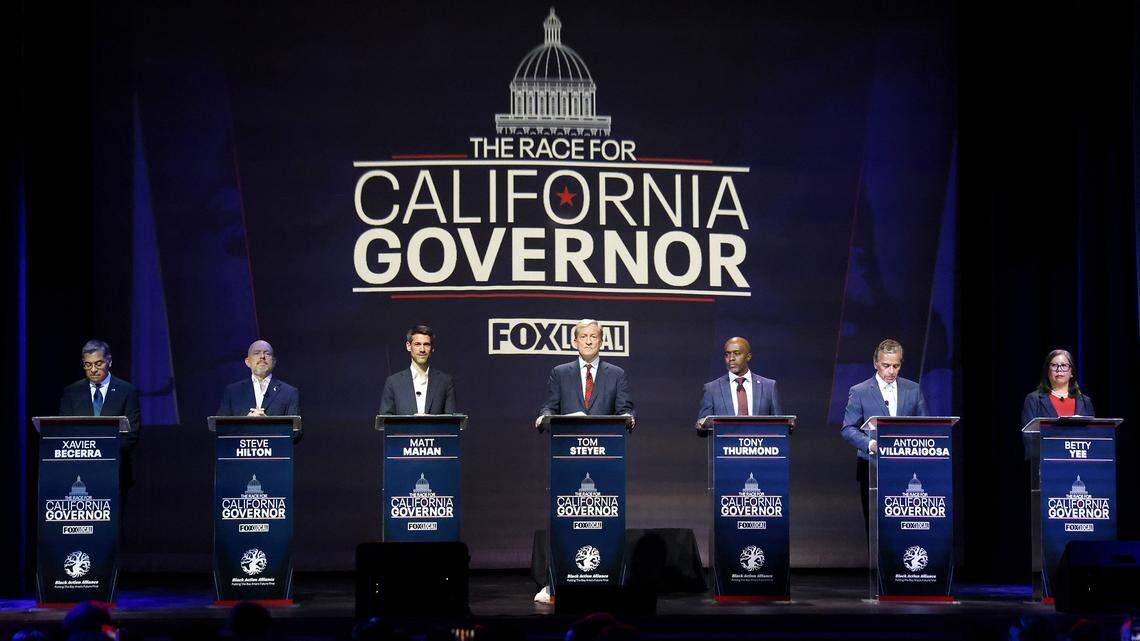
The California Democratic Party is now launching weekly polls after other tactics to winnow the field has not worked. Pictured in a February debate, from left, are Xavier Becerra, former U.S. Secretary of Health and Human Services and former attorney general of California; Steve Hilton, political commentator; Matt Mahan, San Jose mayor; Tom Steyer, entrepreneur; Tony Thurmond, California’s state superintendent of public instruction; Antonio Villaraigosa, former Los Angeles mayor; and Betty Yee, former California state controller.
Nhat V. Meyer
Bay Area News Group/TNS
The California Democratic Party has many roles for its faithful members, but what its job is decidedly not, is to conduct public opinion surveys, and especially not before the public is paying much attention to the race for governor, in the hopes that the massive herd of party candidates will suddenly thin.
These weekly surveys, which begin March 24 and will continue through April, are in reaction to heartburn within party leadership that no Democrat will make the runoff come November.
It’s mathematically possible. Based on the early polling to date, the two Republican candidates seeking the office, Steve Hilton and Chad Bianco, may get the most votes come June because of the crowded field of Democrats.
But first off, it’s a little undemocratic for any party to squelch participation in any election. And there is a far more effective way to ensure that a Democrat is on the ballot in November. It’s just that, so far, most of the leaders of the party (most notably Gov. Gavin Newsom) have shown little interest in getting active in succession planning.
This polling now represents the second attempt by party leader Rusty Hicks to gently suggest that some of the Democrats trailing in the polls would get out of the race, after he implied at the California Democratic Convention in February that the field would “naturally winnow.” (That hasn’t happened.)
So in their second attempt, Hicks and the party are about to roll out the “California Voter Index”; basically a traditional public opinion survey, commissioned by the state party and to be conducted by EVITARUS research firm in Los Angeles.
Why are the Democrats so nervous? Because the latest Los Angeles Times poll (in co-sponsorship with the UC Berkeley Institute of Governmental Studies) shows Congressman Eric Swalwell, former Rep. Katie Porter and Silicon Valley billionaire Tom Steyer with the most support, but none reaching higher than 13%.
Meanwhile, leading in the same poll is Republican commentator Steve Hilton (17%) with fellow Republican and Riverside County Sheriff Chad Bianco close on his heels (16%).
For the Democrats, consistently trailing in polls with support in the low single digits are former Los Angeles Mayor Antonio Villaraigosa, former state controller Betty Yee, former federal Health and Human Services Secretary Xavier Becerra, San Jose Mayor Matt Mahan and California Schools Superintendent Tony Thurmond. About 30% of California voters are either undecided or supporting one of these candidates — enough to ultimately move the needle.
The California Voter Index won’t work
California races for governor have no shortage of independent public opinion polls. There is no value in an institution with a vested interest in the election’s outcome to portray its surveys as somehow new and helpful. It seems doubtful that low-polling Democrats would care much about surveying from a Democratic Party that is not valuing their candidacy.
What’s been missing in this race — and what may reshape the race— are endorsements from party heavyweights.
This race has been stuck in low gear for several reasons: None of the Democrats have yet to catch fire with voters, and all are competing against an exceedingly-crowded news cycle, with President Donald Trump and Newsom sucking most of the air out of the proverbial room.
It’s hard to see how polls paid by the Democratic Party will change that dynamic. What would help are new and fresh reasons for influential leaders to coalesce around a candidate — and to explain why.
Former Gov. Jerry Brown, as one example, endorsed Newsom for governor in 2018. Granted, Newsom was the overwhelming favorite in the race. Newsom is silent so far, and likely to remain so this primary season unless he wants to anger many in his party, something that a would-be candidate for president is understandably reluctant to do. Likewise, former House Speaker Nancy Pelosi has yet to endorse anyone for governor.
Many sane Californians are paying attention to other things right now. (It’s not a bad coping mechanism, frankly.) So it’s really up to the candidates and their supporters to make a difference.
That’s the real problem in this race, not the two Republicans who, together, have nearly one-third of the vote.
Related Stories from Sacramento Bee
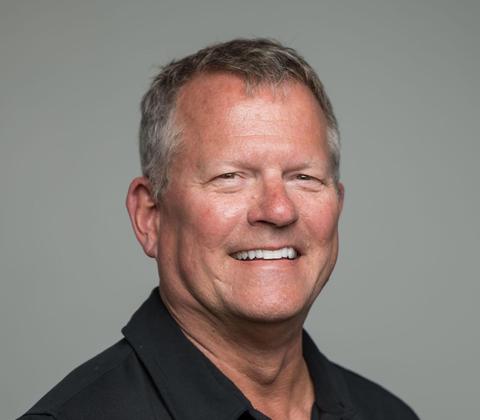
Tom Philp is a Pulitzer Prize-winning editorial writer and columnist who returned to The Sacramento Bee in 2023 after working in government for 16 years. Philp had previously written for The Bee from 1991 to 2007. He is a native Californian and a graduate of the Medill School of Journalism at Northwestern University.