
Read Mission Local often?
Help grow our newsroom, joining the 3,250 readers who support us by giving below.
Organizers of Sunday Streets, an 18-year-old neighborhood street fair in six San Francisco neighborhoods, have launched a fundraising drive and a letter-writing campaign to save the 2026 season.
The drives began soon after the Department of Public Health’s February announcement that it would cut its entire contribution of $215,758.
DPH, along with the San Francisco Municipal Transportation Agency, the Department of Public Works, and the Recreation and Parks Department, collaborated with Livable City, the nonprofit that runs the street fairs, to put the events on. Sunday Streets includes half a dozen Sundays of car-free streets each summer.

Want the latest on the Mission and San Francisco? Sign up for our free daily newsletter below.
“We don’t want this program to die,” said Sally Chen, deputy director of Livable City. “And we don’t want these partnerships that have been built over these 18 years to go to waste.”
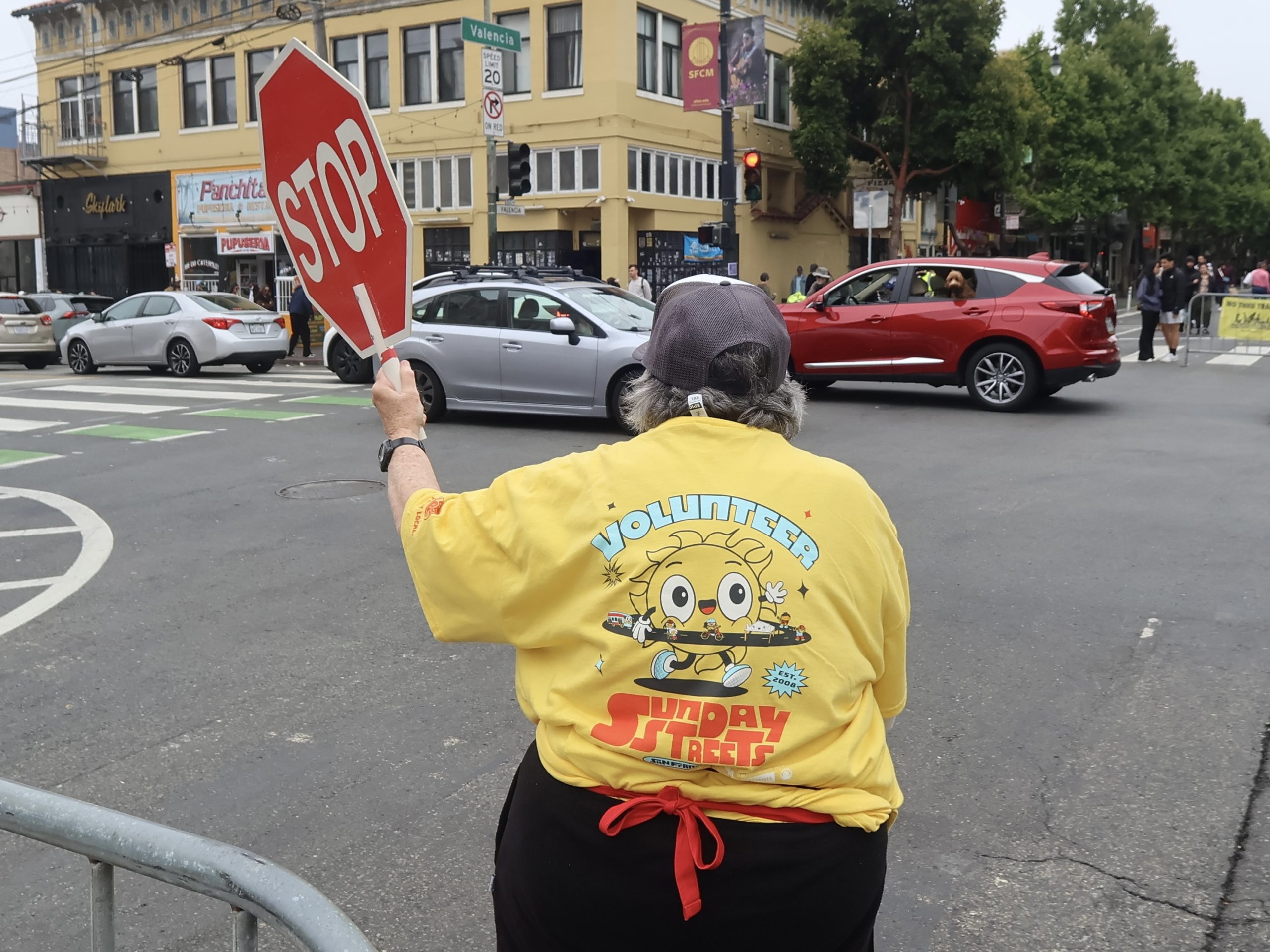 Keeping the streets safe and fun — a dedicated Sunday Streets volunteer directs traffic with a smile and a stop sign. Photo by Daniela Sandoval.
The events happen annually in the Tenderloin, Mission, Bayview, Western Addition, South of Market, and Excelsior. The city’s contribution paid salaries for the daylong festivals in which streets are blocked off and local community groups set up booths.
The cut represents 43 percent of the program’s $500,000 budget. The budget includes $150,000 from SFMTA for insurance and marketing on buses. Sunday Streets fundraises to cover all other costs, including permits from the San Francisco Fire Department, Department of Public Health and Recology.
So far, the program has received a match gift for up to $50,000 from a private donor and hopes to raise $50,000 by the end of March, equaling a contribution of $100,000 to organize half a season. They’ve raised $31,500 as of publication, according to Chen.
“Community voices need to be heard before you take away joy and connection for something that really means a lot to us,” said Lea Sabado, the co-owner of Excelsior Coffee at 4495 Mission St., who started collaborating with Sunday Streets in 2019.
During Sunday Streets, Sabado and her husband, Andre Higginbotham, give out free coffee and affogatos, and also promote Higginbotham’s auto-mechanic program at nearby June Jordan School For Equity.
“It’s basically just one big-ass block party to celebrate the neighborhood,” she said. “We don’t have a cultural parade like Chinatown does, we don’t have a night market like Valencia does, you know, at least give us Sunday Streets. There’s not a lot that we can cling onto.”
Neighborhood stakeholders see the Sunday events as important in generating local revenue, bringing residents out and attracting new visitors.
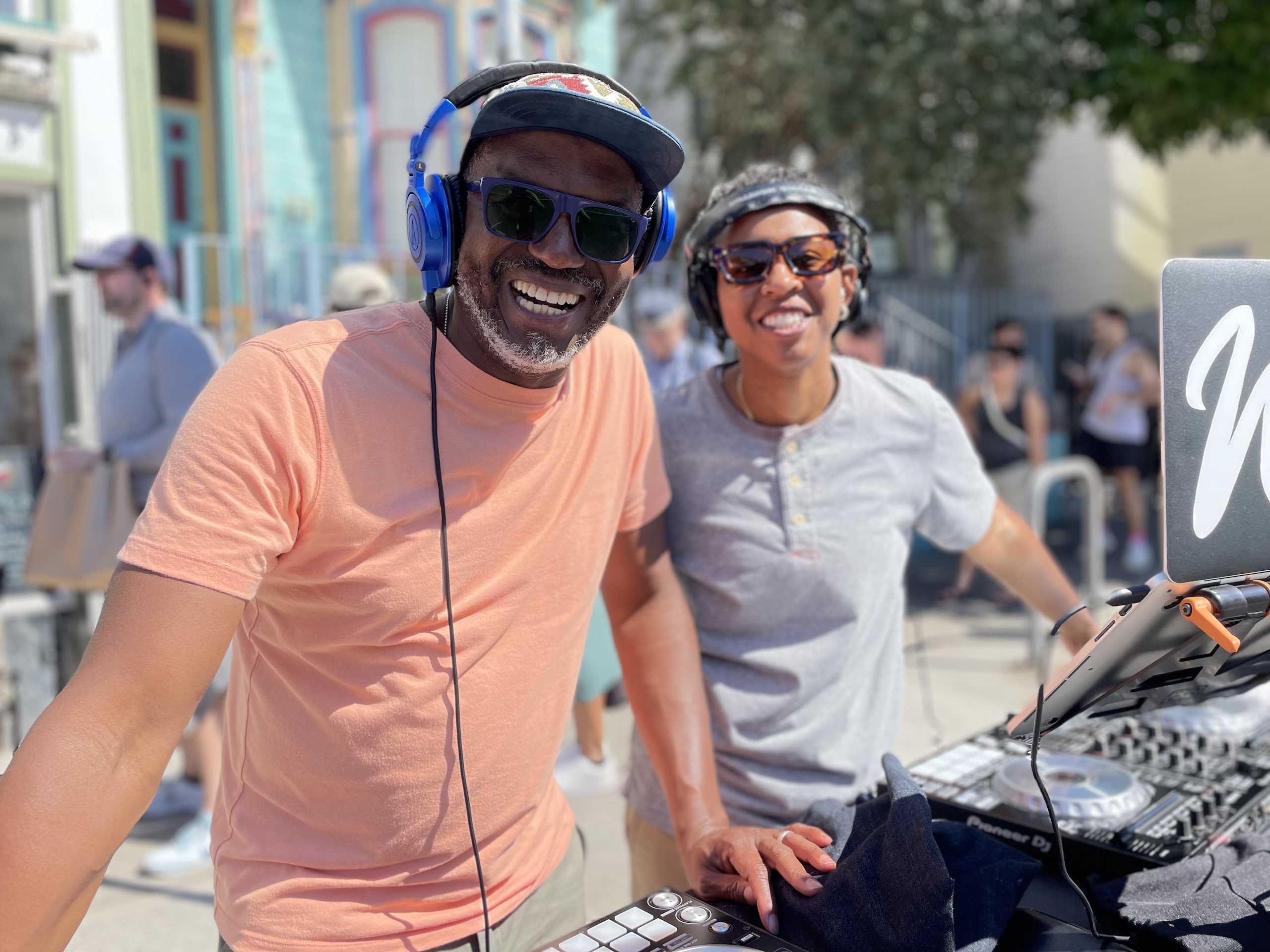 DJ Lamont and Whit the DJ play music in front of Hila Gelato Caffè at Sunday Streets on August 25, 2024. Photo by Io Yeh Gilman
Chen, who grew up in Nob Hill, said she would meet up with her friends at their respective neighborhood events and spend the day together.
“That was when I got to see Valencia Street for the first time,” she recalled. “That was actually more memorable than having my friends meet me near mine.”
Under pressure to reduce its $3.2 billion two-year budget by $17 million, the Department of Public Health decided in February to pull 100 percent of its funding from Sunday Streets.
According to a memo written by DPH director Daniel Tsai, the department is focused on “preserving direct health and clinical services.” Sunday Streets is not included in that definition.
Others see it differently.
“This is a public-health intervention at a different level,” said Tom Radulovich, senior policy lead of Livable City, “Part of the challenge of explaining this to city officials is that, to use Ezra Klein’s term, Sunday Streets is an ‘everything bagel.’”
Then-mayor Gavin Newsom launched Sunday Street in 2008 to create open-air street events in high-density neighborhoods with less access to open space. Radulovich said that mission is still intact.
“Newsom was a big fan of greening the city, beautification, all of that,” he said. “So civic pride is imbued in the project. And people get to enjoy themselves for the day, and they get to see each neighborhood in the best light.”
The events typically bring in crowds of families with children, neighbors, and community organizations to encourage attendees to shop locally, get outside and interact with their neighbors.
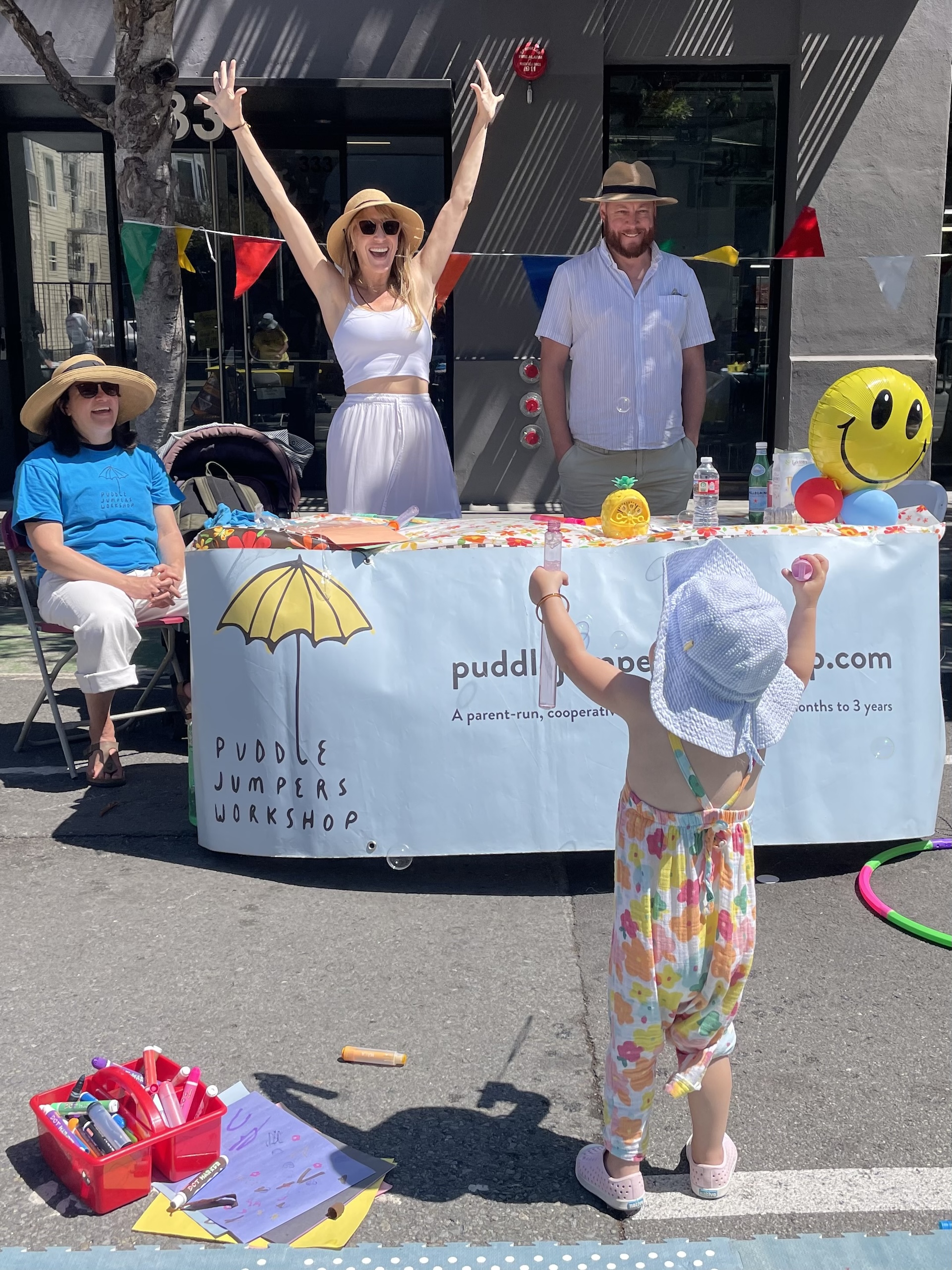 Rachel Eschelbach plays with a child at the Puddle Jumpers play station at Sunday Streets Mission on August 25, 2024. Photo by Io Yeh Gilman.
Dontaye Ball, president of the Bayview Merchants Association and head chef at Gumbo Social, said last year’s first-ever Sunday Streets event in Bayview provided the neighborhood an opportunity to showcase its offerings.
“It was a great amalgamation of all of these different communities,” he said. “People would come from the Sunset and talk to people from the Bayview and realize, ‘Oh, our kids go to the same school.’ Or people who had never been to Bayview would be like, ‘So this is what the sunny side of the city looks like.’”
Ball also went to Sunday Streets in the Excelsior and Fillmore.
“Going opened up a different purview for me,” he said. “We’re in the greatest city in the world and I saw that the Excelsior and the Fillmore are great too. It is overly important that we take these opportunities to celebrate our great neighborhoods.”
Sunday Streets is the only large open-air event that happens in the Excelsior regularly, said Chen. She added that the cuts are “devastating.”
“It’s such a stark disinvestment in a tradition that is so uniquely San Francisco,” she said. “People get married during Sunday Streets. People learn to ride their bikes during the event.”
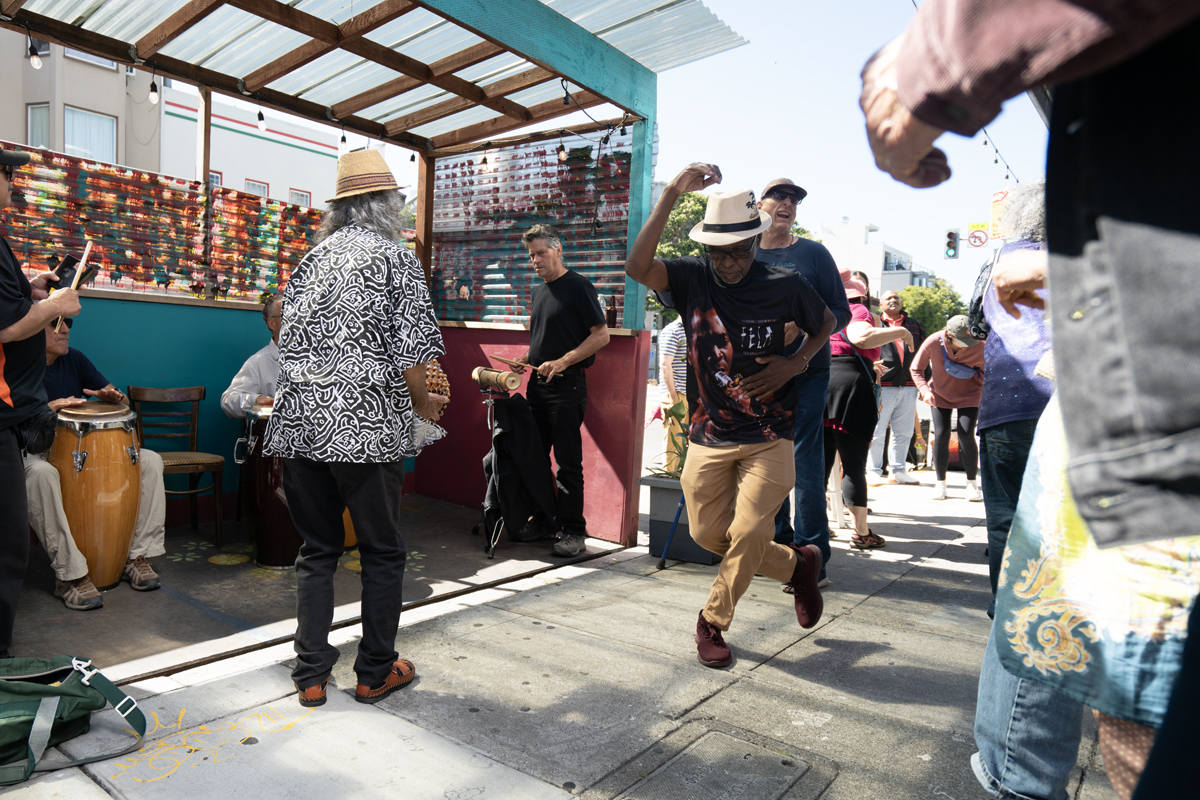 Live music from Radio Habana Social Club filled the air at Sunday Streets on Valencia Street in San Francisco, Calif on July 30, 2023. Photo by Gustavo Hernandez
Chen also noted the “stark contrast” between city funding for downtown events and neighborhood events.
“One downtown activation gets a DJ for $75,000 for one night. And we get $215,000 for the whole year,” she said.
Chen noted that during the pandemic, local businesses were the ones that kept the city’s economy stable.
“The ones who have been able to stick around, or even come back, need all the love and support that they can get,” she said. “And we’ve spoken with business owners who say they make triple their average profit in one day during Sunday Streets.”
Ball said the importance of the event cannot be underestimated.
“We all understand that in our city there are cuts that need to be made across the board,” said Ball. “What we’re advocating for is the opportunity to continue highlighting our neighborhoods.”
Join the 3,300 readers who keep Mission Local free for all!
Because of you, Mission Local reached and surpassed our $300,000 year-end fundraising goal. All we can say is thank you.
Thank you for choosing to invest in a local newsroom rooted in San Francisco’s communities — one that listens first and reports deeply.
If you haven’t yet had a chance to give, it’s not too late to be part of this community. Your contribution today helps sustain the reporting our city relies on all year long.
We’re grateful you’re here — and we’d be honored to have you join our donors.