
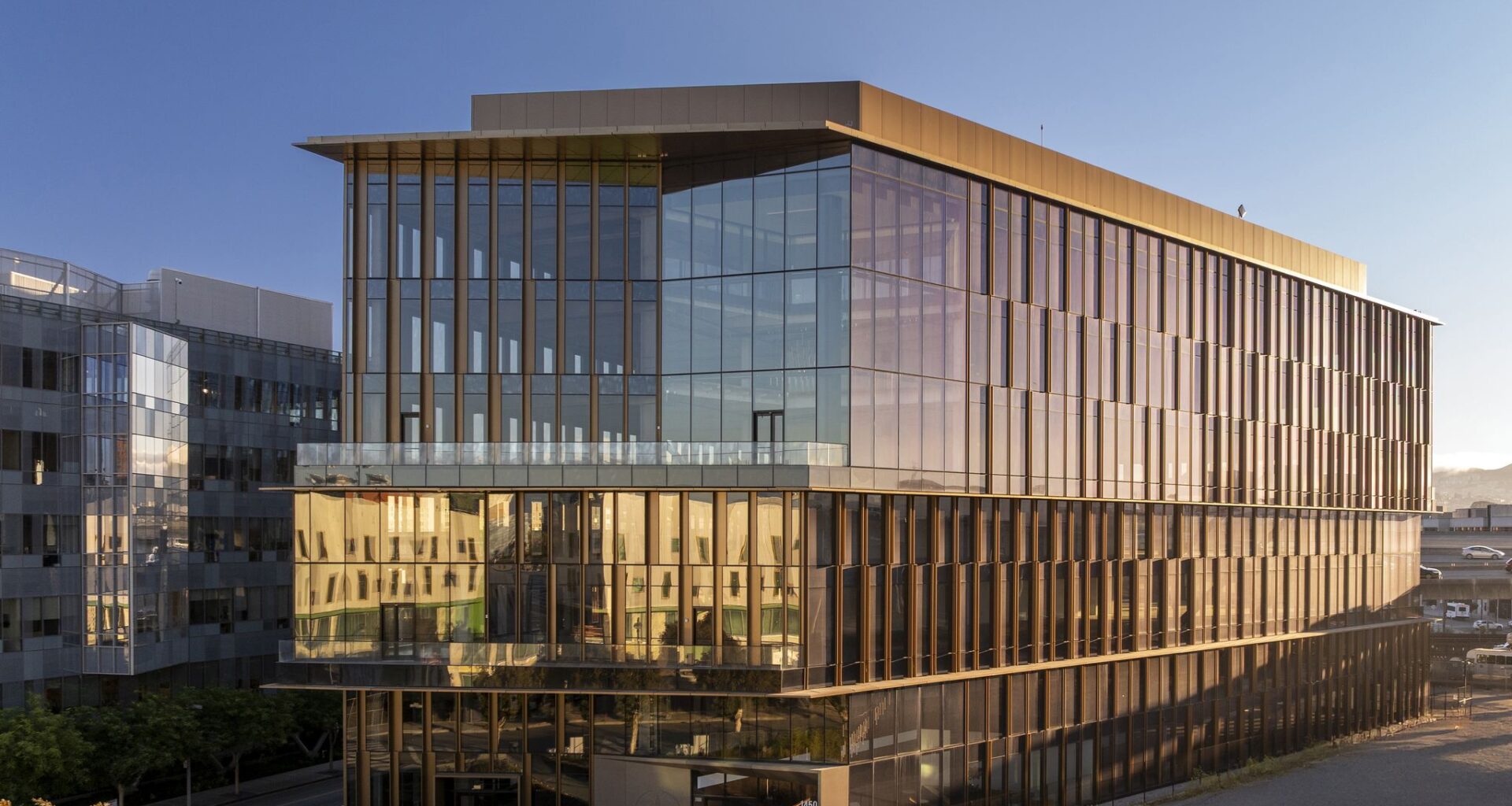
Gladstone Institutes has leased 105,000 square feet at 1450 Owens St. in San Francisco.
Alexandria Real Estate Equities
Biomedical research nonprofit Gladstone Institutes has leased 105,000 square feet in the last major new building of San Francisco’s Mission Bay, part of the company’s expansion plans that include hiring 300 new scientists.
The deal at 1450 Owens St. includes space for 30 new labs and is one of the city’s biggest leases of 2026, so far. It includes the option for Gladstone to purchase the building in the future and is a block from its headquarters at 1650 Owens St.
Gladstone’s work is increasingly focused on using artificial intelligence — a booming sector in Mission Bay — to speed up research around drug discovery. The new building will house the Gladstone Institute of Data Science and Biotechnology and the Gladstone-UCSF Institute of Genomic Immunology.
Article continues below this ad
“We embed the AI and technology with the biological questions,” said Dr. Deepak Srivastava, president of Gladstone. “We are both inventors and rapid adopters of technology.”
Deepak Srivastava, president of Gladstone Institutes, said Mission Bay used to be just “abandoned warehouses,” now his nonprofit joins a list of companies moving to the San Francisco neighborhood.
Michael Short
Gladstone’s hiring plans would increase its current staff of around 600 scientists by 50%. Research areas include heart disease, infectious diseases, cancer, neurological diseases including Alzheimer’s and Parkinson’s.
San Francisco Chronicle Logo
Make us a Preferred Source to get more of our news when you search.
Add Preferred Source
Gladstone is currently recruiting lab leaders from around the world. That’s despite two major challenges in the past year: the Trump administration’s hostility to foreign immigration and widespread federal research cuts.
Article continues below this ad
Around $80 million of Gladstone’s $125 million annual budget comes from grants from the National Institutes of Health, and funding dropped by 10% last year, Srivastava said.
“In the U.S. we’ve really benefited from the most brilliant minds coming here. That’s certainly under threat,” he said.
Despite the obstacles, Gladstone is continuing its expansion plans, in part by seeking more philanthropy support. Starting in 2024, Gladstone sought to raise $350 million by 2029. Around $200 million has been raised to date.
Major donors include real estate developer and former Giants owners Bob Lurie and his wife Connie; real estate developer John Sobrato and his wife Susan; former venture capitalist Bill Younger, who is chair of Gladstone’s board, and his wife Brenda; and hedge fund manager William Fisher, who is the son of Gap’s co-founders, and his wife Sakurako; and the Dolby family.
An architect’s rendering of Gladstone Institutes’ new facility at 1450 Owens St. in San Francisco.
DGA
“The work we’re doing is too important to slow at this moment when we have greater opportunity (through technology). I just wasn’t willing to slow down,” Srivastava said. “Every day we go slower is more people dying.”
Article continues below this ad
Gladstone was established in 1979 and is named for Jack David Gladstone, a real estate developer who left most of his fortune to biomedical research. The nonprofit was one of the first tenants in Mission Bay in 2004, alongside UCSF.
“When I moved here, it was all abandoned warehouses. There was just two buildings. This growth is phenomenal,” Srivastava said.
Alexandria Real Estate Equities, a major biotech landlord, has also built numerous Mission Bay buildings including 1450 Owens St., which marks the last major parcel in the area.
Alexandria doesn’t typically start construction on new buildings until it secures an anchor tenant, but did so at 1450 Owens after requests from the city, said Joel Marcus, Alexandria’s executive chairman. Construction started in 2022 and was completed in 2024. (Gladstone will build its own tenant improvements and plans to move in by early 2027.)
Marcus called the building “a great place for innovative research,” with state-of-the-art lab space.
Article continues below this ad
Around half of the building remains vacant, and Marcus said both biotech and AI tenants have shown interest in the remaining space. He called Mission Bay a “thriving metropolis” that now has biotech, AI, housing and a major sports and entertainment complex in Chase Center.
Still, the biotech industry remains in a downturn, with widespread layoffs and funding cuts.
Though Gladstone is a nonprofit, it partners with for-profit companies to take drugs through clinical trials and eventual Food and Drug Administration approval.
Srivastava is “starting to see the green shoots of a resurgence,” with more drug approval activity and investments.
Article continues below this ad
“It’s been a rough period,” he said. “People are starting to see the convergence of AI and biotech is so powerful right now.”