
Val Caniparoli works with Isabella DeVivo in rehearsal of his “Tears” at the San Francisco Ballet in 2014. Caniparoli is leaving the Ballet after 53 years.
Carlos Avila Gonzalez/S.F. Chronicle
San Francisco Ballet choreographer Val Caniparoli, right, and Janet Sassoon at rehearsal in 2012 for “Lady of the Camellias.”
Boston Globe via Getty Images
Val Caniparoli at American Conservatory Theater’s studio in San Francisco in 2010. Though the dancer and choreographer is leaving the San Francisco Ballet after 53 years, he is working on productions with other companies.
Liz Hafalia/S.F. Chronicle
Val Caniparoli takes his last bow with San Francisco Ballet this week, but he wants to be clear about one thing: He isn’t “retiring.”
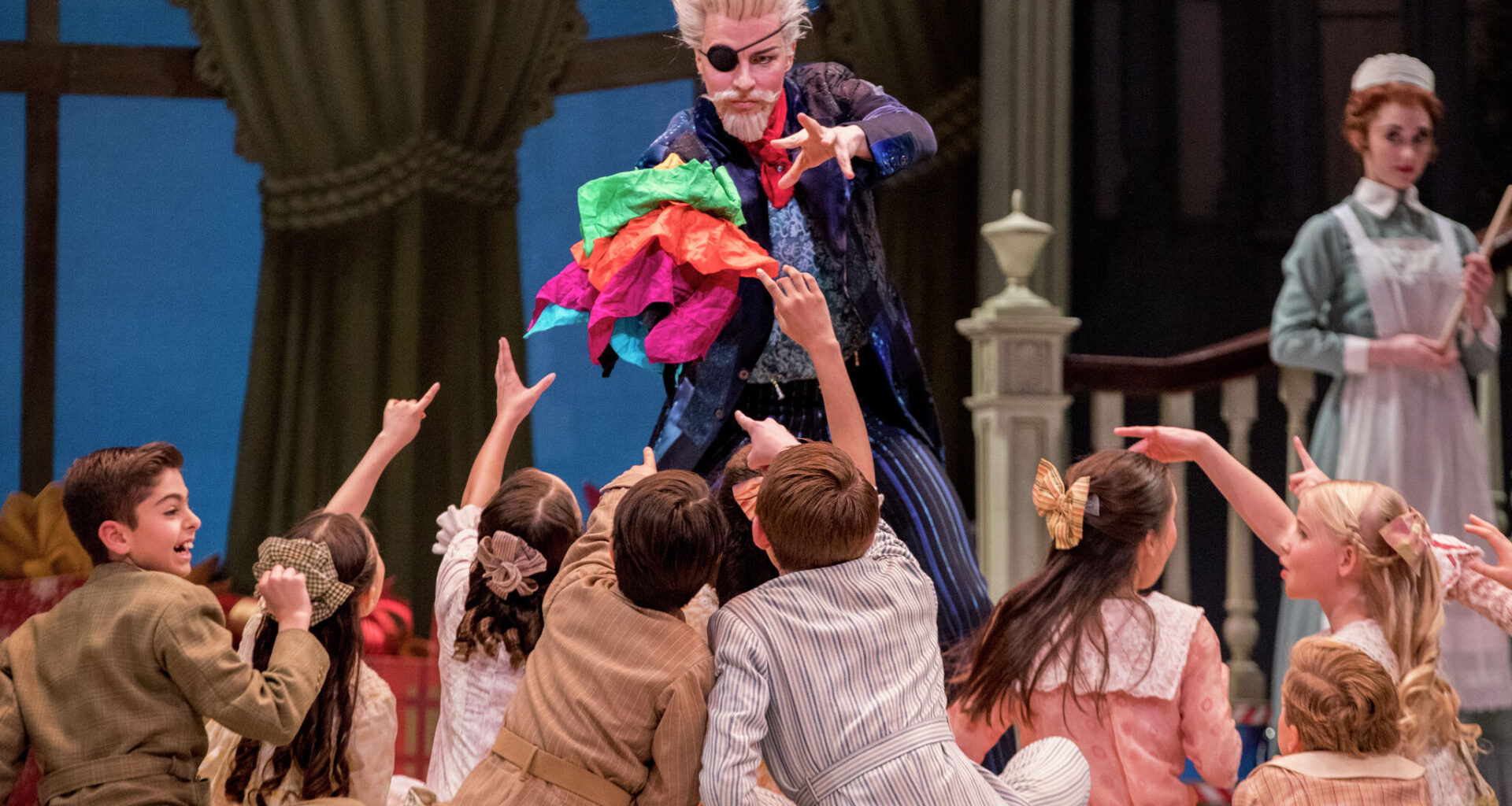
True, the 53-year veteran of America’s oldest professional ballet company is stepping away from roles like the mysterious Uncle Drosselmeyer in “Nutcracker,” and the loveable tavern-keeper Lorenzo in “Don Quixote,” parts that have endeared him to generations of audiences. But for decades now, his work has extended well beyond being in the spotlight. Since 1980, Caniparoli has dedicated most of his energies to a much-lauded choreography career, and rather than slowing down, he’s building momentum as he enters an exciting new phase.
“Don Quixote”: San Francisco Ballet. Through Sunday, March 29. $35-$575. War Memorial Opera House, 301 Van Ness Ave., S.F. 415-865-2000. www.sfballet.org
Caniparoli’s startling full-evening production of “Jekyll & Hyde,” commissioned by the Finnish National Ballet during the pandemic, won widespread applause for its engrossing theatricality and has gone on to be performed across the U.S. at companies like Kansas City Ballet and Ballet West. Looking forward — and northerly — Caniparoli has just been commissioned by the venerated National Ballet of Canada to create a new version of the classic ballet “Coppélia” set to premiere in March 2027 in Toronto.
Article continues below this ad
Meanwhile, his shorter ballets, along with three versions of “Nutcracker,” continue to be performed by companies across North America and abroad.
Preparing for his last show as the Ballet’s principal character dancer at the War Memorial Opera House, Caniparoli spoke with the Chronicle by video from his South of Market live-work loft about risk-taking and creative longevity.
Val Caniparoli, center, runs through a final dress rehearsal with young cast members for San Francisco Ballet’s “Nutcracker” at the War Memorial Opera House in 2018.
Jessica Christian/S.F. Chronicle
This conversation has been edited for length and clarity.
San Francisco Chronicle Logo
Make us a Preferred Source to get more of our news when you search.
Add Preferred Source
Q: Your final performance is this Saturday. How do you feel?
Article continues below this ad
A: It’s time. Against all odds, I’m still performing, still carrying around ballerinas. But for a long while, I thought I was getting choreography offers because I was connected to San Francisco Ballet, and I realized that was just in my head. It took other people pointing that out to me that I was getting commissioned on the strength of my work, not my position here.
And, I mean, at this point, I’ve survived five artistic directors, if you count Harold Christensen when he was artistic director emeritus. He came and restaged his “Nothing Doing Bar” when I was in the company and redid a section of “Nutcracker,” and I was cast in it.
Q: I still can’t believe the story of how you joined the company. You were a 20-year-old student in music and theater at Washington State University.
A: And some dancers toured to our university, and taught a movement master class for the theater department and the teacher came up to me at the barre …
Q: And you had never taken ballet?
Article continues below this ad
A: Nothing. And she said, “You’ve got talent. You should consider doing this.” And I said, “Aren’t I kind of old?”
Q: So you came down to San Francisco to audition for the school and told them you were 16.
A: Actually, I auditioned for a lot of schools. There were a lot of highly regarded programs in the Bay Area at that time. I got into every school, and every school gave me a scholarship. But San Francisco Ballet was the most highly regarded. And I wasn’t that turned out, or flexible.
Q: OK, did they take you because you were handsome?
A: I think being naive was helpful. I had no idea what things were supposed to be, and I had confidence. Maybe that was part of it. I have no clue.
Article continues below this ad
Herr Drosselmeyer played by Val Caniparoli in the San Francisco Ballet’s “Nutcracker” in 1980.
Michael Maloney/S.F. Chronicle
Q: And they moved you from the school into the company in one year. Dancing all kinds of roles, not just Drosselmeyer.
A: That was because they were already using me in performances and I was getting union salary, and they realized it would be cheaper to hire me.
Q: Amazing. And then you made your first ballet in 1980, at a time when Lew Christensen and Michael Smuin were in charge, and a lot of works were made by company members. How many works have you made now for San Francisco Ballet?
A: Well, the company and I kind of disagree about that, because I count things I made for one performance, like the time I choreographed for the 50th anniversary of the Super Bowl with (former artistic director) Helgi Tómasson. Including those works, about 25.
Article continues below this ad
Q: Are there advantages to being a choreographer who has studied music and literature but began ballet late?
A: I think it was an advantage not knowing what you’re supposed to do. And the biggest advantage is that I read music. If you’re choreographing and you don’t read music, I’m not sure you really hear all the layers.
Anita Paciotti, from left, Dores André and Val Caniparoli during a San Francisco Ballet dress rehearsal of Arthur Pita’s “Salome” in 2017.
Liz Hafalia/S.F. Chronicle
Q: In 1995 you made a ballet, “Lambarena,” set to a mix of Bach and West African singing and drumming. It’s gone on to have a long life and was even featured on “Sesame Street” — you know you’re a permanent part of American culture when your ballet is on “Sesame Street”! But it was also a risky ballet to make, because of questions of cultural appropriation.
A: It was risky, and I don’t know if I would have done it now. But I brought in African dance consultants, Zak (Zakariya Diouf) and Naomi (Washington Diouf) of the (dance troupe) Diamano Coura.
The authenticity of the work comes from collaborating with them, and whoever dances (“Lambarena”) now has to bring them in — actually, because Zak has died, it’s now being staged by his son, Ibu (Ibrahima Diouf). And a company has to have dancers of color, or else they can’t do it. That encourages them to make new hires, and come back and say, “We’ve got a dancer of color. Now, will you let us have it?”
My position is dance is for everyone. Everyone should learn African dance, you know. And everyone, if they want to, should learn ballet and ballroom. But I remember when I made it, Helgi Tómasson was artistic director and he had no idea what I was doing, because he would peek in, and African cultures are so family oriented. Zak and Naomi would bring in their kids, and there was Ibu, correcting (star principal ballerina) Evelyn Cisneros.
Val Caniparoli, center, is reflected in the mirror during a rehearsal at the San Francisco Ballet in 2014.
Carlos Avila Gonzalez/S.F. Chronicle
Q: Let’s talk about your much more recent “Jekyll & Hyde.” It was a risky ballet too because of its portrayals of mental illness and drug addiction. But the critics have noted how well it works as theater.
A: Well, I’ve been able to edit it each time a new company has done it — I’ve cut about 15 minutes.
I had (former American Conservatory Theater artistic director) Carey Perloff working with me as dramaturg. We had battles. (“Jekyll & Hyde” author) Robert Louis Stevenson is a character in the ballet, and Carey kept saying, “He’s not in it enough.” (But) the battles were worth it.
Even in the second year of performances, I called some of the dancers who had been brilliant in it (and) asked what they thought. I have no qualms about taking feedback. It always makes the work stronger.
Q: That’s interesting because dance, unlike literature and theater, has so few mechanisms for feedback and workshopping.
A: When I began working in theater, I realized how unfair it is that theater shows have a week of previews, but ballet choreographers are expected to be geniuses the minute the curtain goes up.
Jeffery Golladay, from left, Julia Adam, Peter Brandenhoff, Damian Smith and Val Caniparoli in San Francisco Ballet’s “Con Amor” in 1999.
Michael Macor/S.F. Chronicle
Q: Now you’re making a new twist on “Coppélia” set to premiere in March 2027, with Dr. Coppelius, the doll maker, as the main character in the story. Can you share what you’re up to?
A: (National Ballet of Canada Artistic Director) Hope Muir came out of nowhere and said, “Are you interested in creating a ‘Coppélia’?” And I love it when artistic directors give me a challenge.
She wanted it to be only two acts. And I agree, I think young choreographers should learn to make ballets in two acts to suit attention spans these days. She said, “You can do whatever you want, but it has to work for children.”
I put together an all-female collaborative team, costume designer, set designer, director, lighting designer: five women. And I knew right away I would make Dr. Coppelius the main character. He’s a loner, and he’s made fun of because he’s different, but the moral of the story is it’s OK to be different. He’s not a villain.
I’m keeping the dancing classical, and the designs are just stunning.
Q: You also have a premiere coming up at Virginia’s Richmond Ballet, and your ballet “What’s Going On? ,” set to protest songs by artists like Bob Dylan, is getting notice. Your 2012 ballet “The Lottery” is being danced by new companies too. With all the work you’re doing at so many ballet companies, will we ever see you in San Francisco again?
A: Oh, yeah. I don’t take vacations, you know. I stay here. I love San Francisco.
Q: As someone who sees so much of the dance world, what makes you hopeful about the direction ballet is going?
A: People are doing more narrative works again — not necessarily linear, but using point of view, not just abstraction.
And I will say, there can be so much ageism in ballet, but it makes me hopeful that I’m still being asked to create. Young doesn’t mean you have a patent on relevancy. I’ve been accepting commissions through 2030.
Rachel Howard is a freelance writer.