
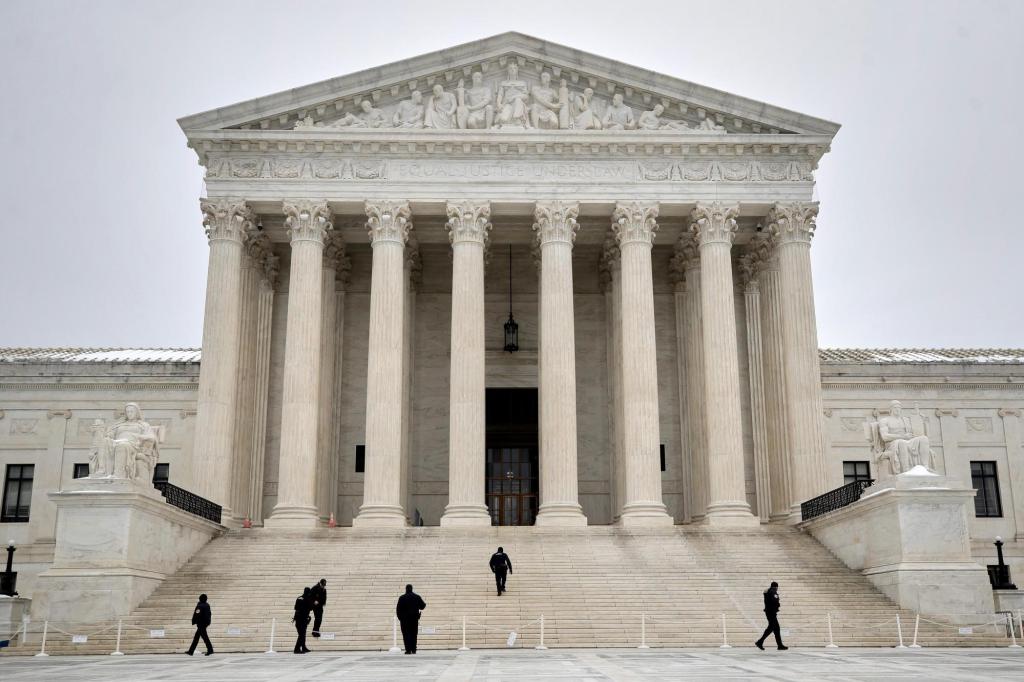
The U.S. Supreme Court heard oral arguments Tuesday morning in a San Diego case centered on “metering,” or turning away asylum seekers at the U.S.-Mexico border, with a government attorney telling the court that even though the policy was rescinded in 2021, the Trump administration and future presidents should have the option of reimplementing it.
“Administrations of both parties, since 2016, have consistently said this is an important tool in the government’s toolbox for dealing with border surges when they occur,” Assistant to the Solicitor General Vivek Suri told the court. “I can’t predict when the next border surge occurs, but I can say when it does occur, this is a tool that (the Department of Homeland Security) will want in its toolbox.”
The case is centered on a policy in which immigration officers systematically blocked and turned away asylum seekers beginning in 2016 at ports of entry in San Diego and elsewhere along the U.S.-Mexico border when they deemed a port to be at capacity. The government describes it as “metering,” but Al Otro Lado, the immigrant-assistance organization that filed the lawsuit challenging the practice, calls it an illegal turnback policy that violates both federal law and international treaty obligations.
A San Diego federal judge and a three-judge panel from the 9th U.S. Circuit Court of Appeals have agreed with Al Otro Lado, finding the policy unlawful. The Supreme Court last year accepted the Trump administration’s petition to hear the case, even as Al Otro Lado and others have alleged in new lawsuits that the administration has used other anti-immigration policies to make it nearly impossible for individuals to seek asylum.
Kelsi Corkran, the Supreme Court director of the Institute for Constitutional Advocacy and Protection at Georgetown Law, told the justices that systematically turning away asylum seekers should not be a tool available to the government because it is unlawful.
“For decades, port officers followed the statutory procedures designated by Congress for inspecting and processing arriving asylum seekers — it was not until 2016 that the government asserted for the first time that it can wholly avoid these mandatory duties simply by blocking asylum seekers just as they are about to step over the port threshold,” said Corkran, who was representing San Diego and Tijuana-based Al Otro Lado.
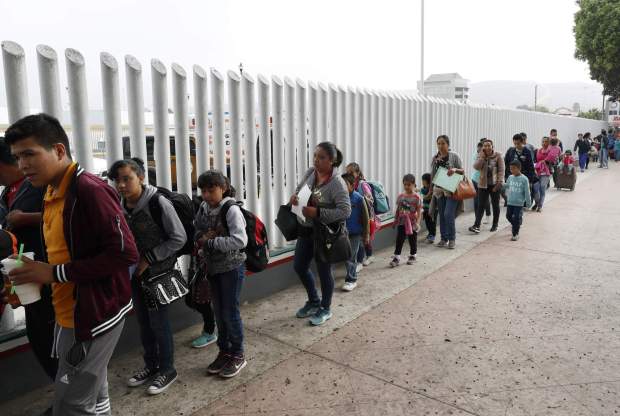 This July 26, 2018, file photo shows people lining up to cross into the United States to begin the process of applying for asylum near the San Ysidro Port of Entry in Tijuana. (AP Photo/Gregory Bull, File)
The metering or turnback policy began informally in 2016 under the Obama administration in response to an influx of Haitian immigrants at the San Ysidro Port of Entry. The practice later spread to other U.S.-Mexico ports and was made official policy by the first Trump administration. The Biden administration rescinded the policy in 2021.
Al Otro Lado and its legal team argued in their brief ahead of the hearing that there have been dire consequences for would-be asylum seekers who were turned away, including people who were killed while waiting in Mexico and others who were killed when they returned to the countries from which they’d fled.
Suri, the government attorney, conceded that returning someone to a country from which they fled persecution would violate the U.S.’ international obligations. But he argued that’s not what the metering policy entailed.
“Metering doesn’t return anyone to Haiti or Guatemala or wherever the person might be coming from,” he said in response to a question from Justice Clarence Thomas. “It just says you can’t set foot in the United States.”
The most fundamental question of the case is what Congress meant when it wrote that any immigrant “who is physically present in the United States or who arrives in the United States … at a designated port of arrival … may apply for asylum.”
The Trump administration argues that “arrives in” should be understood literally to mean an individual must step foot on U.S. soil to be eligible to seek asylum. Al Otro Lado argues that an immigrant who arrives at a port of entry has met the legal standard to seek asylum, even if he or she hasn’t technically stepped across the international boundary.
In a 2-1 opinion, the 9th Circuit ruled in favor of Al Otro Lado, finding that the relevant destination is the border where an asylum seeker can speak with a government official. The Trump administration is asking the Supreme Court to overturn that ruling.
“You can’t arrive in the United States while you’re still standing in Mexico,” Suri told the justices near the start of his argument Tuesday. “That should be the end of this case.”
On that key point, the court’s typically conservative justices appeared to ask more skeptical questions of Al Otro Lado’s theory of the case and how close someone must be to the border to meet the 9th Circuit’s definition of arriving in the U.S.
“What is the magic thing … we’re looking for where we say, ‘Ah, now that person we can say arrives in the United States?’” Justice Amy Coney Barrett asked.
In one instance, Chief Justice John Roberts and Justice Neil Gorsuch presented a hypothetical in which 50 people were in line to seek asylum at the border. Corkran said only the person at the head of the line would meet the definition of having arrived in the U.S. and presented his or herself to a border official. She also appeared to give somewhat inconsistent answers when questioned about what it means to arrive in the U.S. at points in between ports of entry.
Justice Ketanji Brown Jackson said the government’s interpretation of the law would incentivize unlawful border crossings. She asked Suri, the government attorney, why someone who is turned away while trying to lawfully seek asylum at a port would not then cross the border illegally in order to meet the requirement of being present in or arriving in the U.S.
“Your reading of the statute … suggests that a Congress that was authorizing asylum would be requiring people to break the law in order to obtain it,” Jackson said.
While much of the hearing focused on legal technicalities, the justices and attorneys also at times debated broader questions of the U.S.’ international obligations.
Corkran argued that “Congress carefully crafted our asylum system to ensure that the United States lives up to its ideals and its treaty obligations towards non-citizens fleeing persecution.” Suri concisely summarized the Trump administration’s view when he said, “The problem of the world’s refugees is not solely the United States’ burden to bear. It’s a shared responsibility of nations throughout the world.”
The court is expected to decide the case in the summer, likely in June or July.