
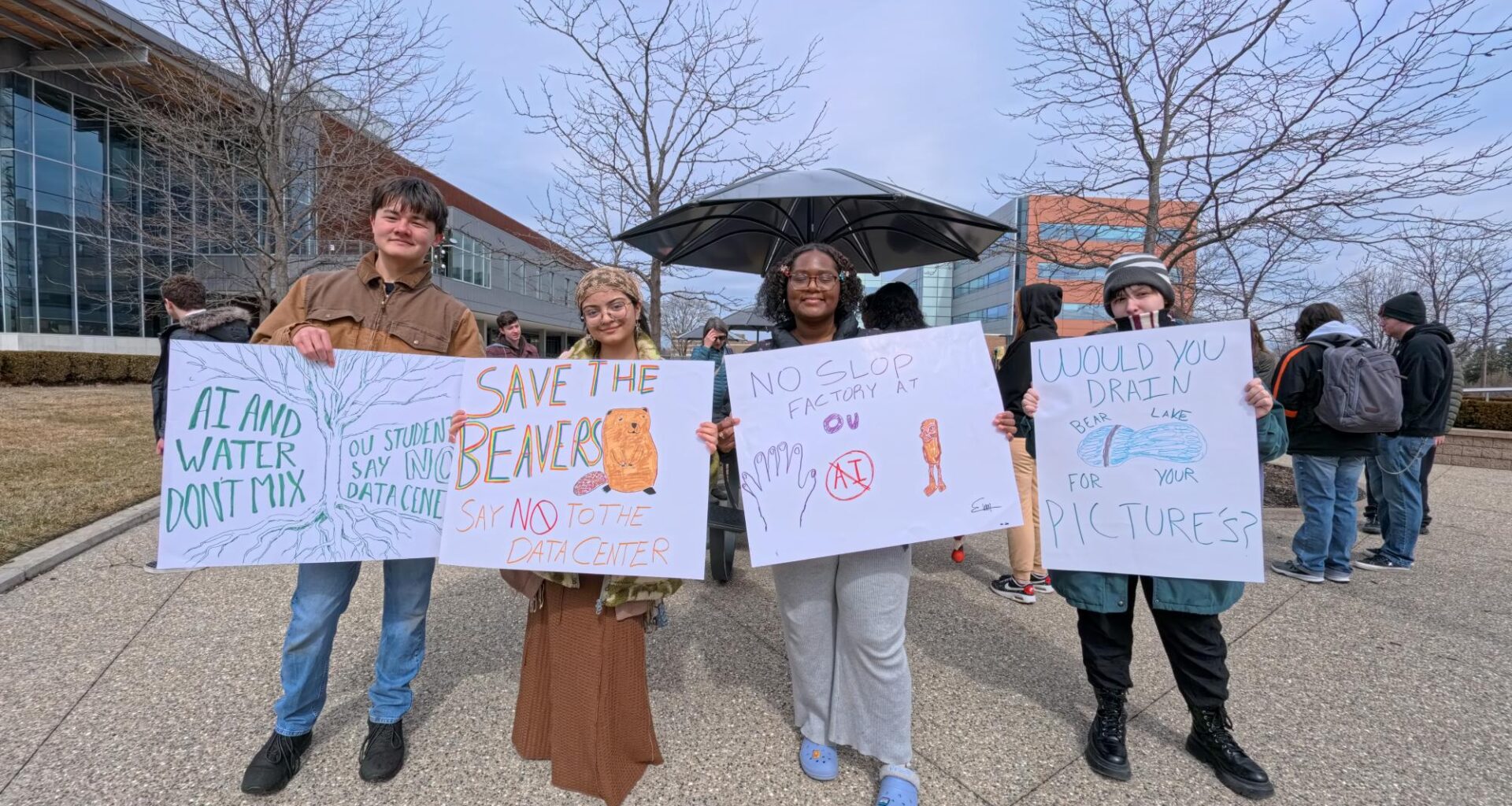
On March 19, from 1–2 p.m., students and community members gathered to protest the planned construction of a data center at Oakland University. Demonstrators raised concerns about transparency, environmental impact and whether student needs were being prioritized in decision-making.
The protest began at Elliott Tower, where attendees met before marching across campus. The group continued outside Wilson Hall, holding signs and speaking out against the project.
“This is our campus as students, and there should be more information about what is being built here,” Anikya Whitner, a student protester, said
According to protesters, the proposed data center would replace Parking Lot 35 and extend into areas near the university’s biological preserve, a Native American heritage site and Hillcrest Hall. Many participants expressed concern about how construction and the long-term operation of the facility could affect these sensitive areas.
Protesters raised multiple environmental concerns, including the potential for noise pollution, ecological disruption, and impacts on wildlife and campus green space. Data centers are known for high energy and water usage, which attendees warned could strain existing infrastructure and increase utility demands.
“Is this worth the impact that it’s going to cause to the community and environment?”Lilia Stenger, a protester, asked. “I have an extreme hatred for AI and the amount of energy and water that it uses.”
Financial priorities were also questioned. Some participants pointed to ongoing infrastructure challenges across campus, including issues with the heating system, and questioned whether additional large-scale projects were appropriate at this time.
“As an OU student, it is unclear how this will benefit students,” Jahzeel Hernandez, a protestor, said. “It feels more profit-driven than student-oriented. Whoever proposed this shows where their priorities align.”
Additional concerns focused on potential environmental and community consequences. Protesters warned that the data center could lead to higher utility costs and contribute to air pollution, affecting both wildlife and students.
“It is a bad idea, with AI becoming more advanced, there are concerns about its role in education. The project could also increase noise and raise utility costs for people living on campus and in the surrounding area, along with potential air pollution affecting wildlife and students,” Dwaine Watkins, a protester, said.
The project is part of a broader expansion of data infrastructure across Michigan and the United States, driven in part by increasing demand for technology and artificial intelligence systems. Some attendees expressed concern about the pace of development and its long-term sustainability, questioning whether the university is weighing short-term progress against long-term consequences.
Despite their concerns, the demonstration remained peaceful throughout the hour.
Participants engaged in discussion and shared information about the project. Small groups formed, allowing attendees to exchange perspectives and raise additional issues.
Stephen W. Mackey, senior vice president for finance and administration and treasurer to the Board of Trustees, said the university has entered a feasibility phase in partnership with Fairmont Properties. This phase includes evaluating power supply, internet capacity and potential site options.
Mackey emphasized that the project is not finalized and must pass multiple stages before moving forward, including environmental review and financial viability assessments. The feasibility phase is expected to continue through late May, with a potential presentation to the university’s board in June.
A campus town hall meeting is also scheduled to gather feedback from students and faculty.
Oakland University has not publicly responded to the protest. Meanwhile, the construction project continues to generate discussion across campus as students seek more information.
The Aftermath: A debate on mute
Protesters expressed frustration at the lack of open dialogue with the university administration. Many stressed that, during town halls and board meetings, their concerns are often dismissed in favor of profit-oriented considerations.
The march from Elliott Tower was sponsored by the Young Democratic Socialists of Oakland University, the College Republicans and the College Democrats, uniting students across political lines.
“We have had some people here from several local clubs,” Clover Devore, president of the College Democrats at Oakland, said. “I know we have had some people come out of Troy. We have some people out of Saline Township.”
Saline recently faced its own data center debate, with Oracle proposing a project near the University of Michigan. Protesters drew parallels between the two conflicts, emphasizing the importance of considering community and environmental impacts.
While many students advocated for dialogue, proponents of the data center, including administration, IT faculty and engineering students, were largely absent from the protest.
University Chief Financial Officer Stephen Mackey was also questioned about scheduling press conferences, talks and meetings on Tuesdays and Thursdays, which are generally the busiest days for students. Protesters argued that this scheduling gives the appearance of faculty being uninterested in student input.
The timing of the due diligence phase, scheduled for the summer months, further aggravated students. They argued that key decisions are being made while many students are off campus, working jobs or completing internships.
Demonstrators framed this as a disservice to all parties, suggesting that the lack of student engagement undermines the fairness and transparency of the process.
Participants stressed the importance of open debate. They said that universities should provide safe spaces for constructive discussion, allowing students to engage with challenging topics rather than leaving decisions to closed-door meetings.
Sustainability versus progress represents one of the major debates in higher education today. Older faculty may reflect on civil rights and second-wave feminism, while younger faculty consider privacy, technology and environmental concerns.
Protesters emphasized that students will not graduate from Oakland without engaging in these debates, and the university should support those conversations while they are still on campus.
Students argue that the issue is not necessarily whether the data center is “right” or “wrong,” but that meaningful dialogue is absent. They say they feel condescended to and neglected, with little opportunity to speak directly with administrators.
After months of demonstrations, protesters reported having no more than ten meaningful minutes to discuss the project with decision-makers, often split into brief two-minute intervals at the end of long protest days.
The demonstrators stressed that conversations about artificial intelligence, technological infrastructure and campus development are essential. With the increasing reliance on data systems, universities face the risk of lagging behind without proper investment.
However, the students argued that this discussion should not take place behind closed doors and that transparency is critical to fostering trust.
Both supporters and critics agree that the ingredients for an open debate exist, but the challenge is making the conversation accessible to all stakeholders. Protesters at Oakland University said that until these discussions occur, the community will continue to feel frustrated and sidelined.