
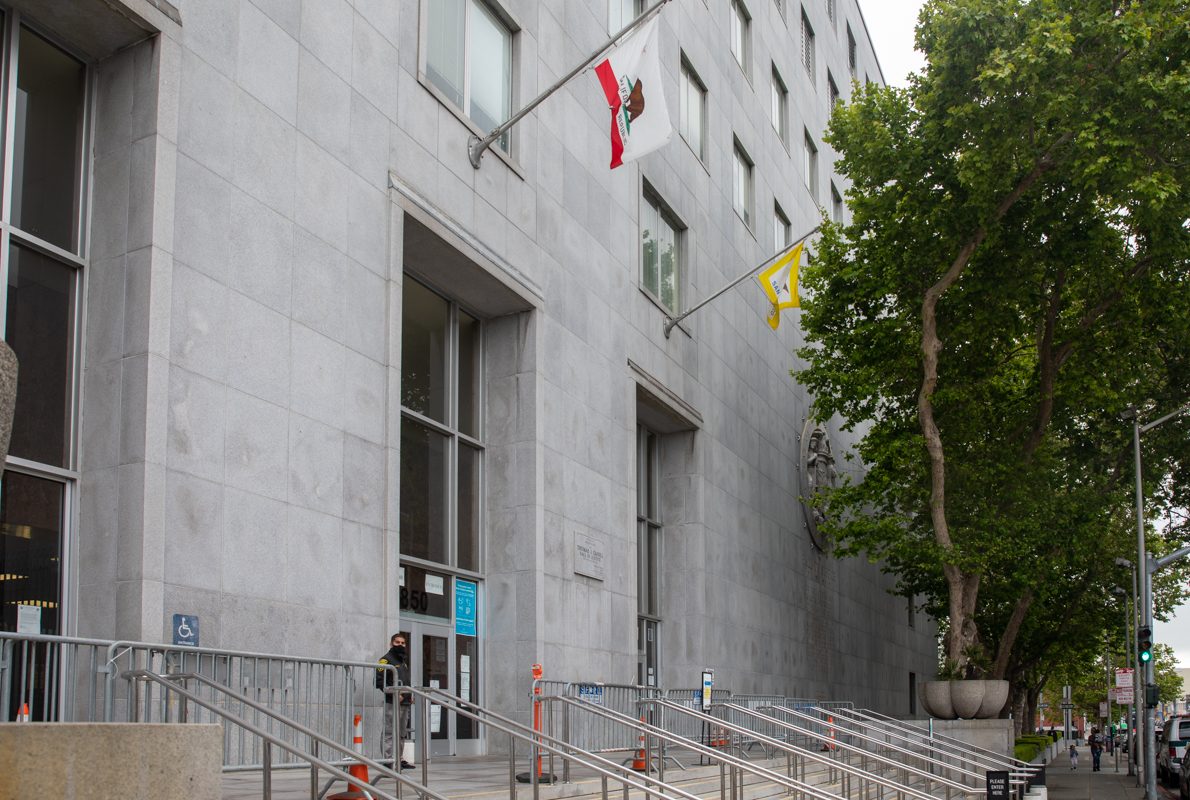
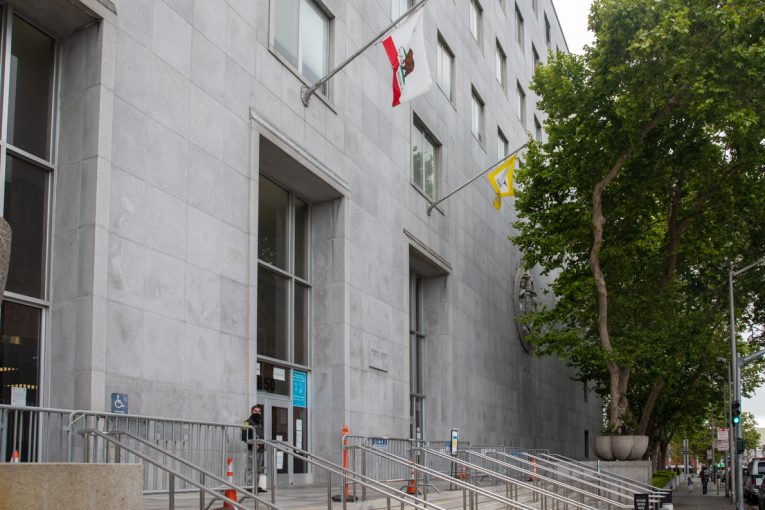
San Francisco Hall of Justice – Photo by David M. Greenwald
By: Nikou Kangarloo-Foroutan, Adrienne Bryant, Donovan Castillero
SAN FRANCISCO, CA — In the San Francisco Hall of Justice Tuesday afternoon, Judge Harry Dorfman denied a request for appellate review of his previous decision to hold San Francisco Public Defender Manohar Raju in contempt and ordered monetary sanctions of $26,000—despite compelling testimony from attorneys and staff members in his support.
The hearing followed Judge Dorfman’s earlier decision to hold Raju in contempt for refusing to have the Public Defender’s Office take on 28 cases from Jan. 12 to Feb. 10, citing that the office is already operating at 150% above its caseload capacity, according to the National Workload Study.
Prior to the hearing, a press conference was held in which Manohar Raju and other public defenders from different counties gave statements in support of San Francisco’s Public Defender, while also identifying the systemic issues that led to the situation.
Regarding his decision to decline additional cases, Raju told the press that taking on excessive caseloads compromises the quality of representation each client deserves. He argued that San Franciscans deserve a Public Defender’s Office that is properly funded and resourced to provide constitutional representation.
“When you represent a population like we do, that’s very vulnerable, it’s even more important that we represent them at a high level,” Raju said, adding, “This is a fight that needs to happen for equity.”
San Joaquin County Public Defender Judy Anne Vallado stood firmly with Raju’s concerns, arguing that her office faces similar issues of understaffing and underfunding.
“An attorney that doesn’t have enough time on a case is not an attorney,” ____ said. “That’s just a name next to a case.” She noted that her office handles 85% of the same cases as the District Attorney but has less than half the number of attorneys.
Public defenders from Alameda, Contra Costa, and Sonoma counties were also present in support of Raju, stating that the systemic issue is a lack of parity in funding between public defender and district attorney offices.
As the courtroom opened, it was filled with attorneys, community advocates, and interns supporting Raju, with many forced to wait outside once seating reached capacity.
Judge Dorfman began the hearing by outlining two key issues: whether his ruling would constitute one order of contempt or 26 separate orders for each case declined, and what sanctions would be appropriate. He revised his earlier count from 28 cases to 26, noting that three involved the same client.
The court then allowed the defense to present testimony.
Defense attorney Kory DeClark called several staff members from the Public Defender’s Office, beginning with Raju.
In his testimony, Raju cited the National Public Defense Workload Study to demonstrate that the office’s workload far exceeds recommended levels.
He argued that complying with Judge Dorfman’s order would be unethical and harmful to clients and staff. Following the order, he said, would mean “parents would not be able to return to their child as quickly,” “mothers waiting for their child to be placed in an appropriate stay will have to wait longer,” and “someone pleading guilty due to the lack of confidence of being served in a timely manner.”
Raju warned of potentially severe consequences, including wrongful deportations and unlawful incarceration, emphasizing that “this is a real human rights issue” and “this is contrary to the American Bar Association.”
Jesse Huber, a senior investigator with 8.5 years at the office, testified about increasing pressures on the Investigation Unit. He explained that advances in surveillance technology have made investigations more complex, while resources have not kept pace.
Similar concerns were raised by social worker Mileti Afuhaamango, who works in the reentry unit. She cited a 54% increase in assignment requests in 2025 compared to the previous year.
“The volume exceeds what the unit is staffed with,” Afuhaamango said, adding that her team “can only handle a small percentage of cases.” As a result, “the overall legal outcome seriously declines,” and “people remain in custody as social workers can’t do their work before the deadline.”
Because these services are critical, she said, excessive caseloads lead to longer incarceration, poorer outcomes, and diminished reentry support.
Deputy Public Defender Tal Klement testified that he is at his “limit” due to increased felony caseloads, which he attributed in part to overcharging by the District Attorney’s Office.
He described spending up to 75 hours preparing for a single trial, along with an additional 15 to 20 hours weekly on court appearances and other cases.
“I take issue with the fact that there are so-called ‘trial-track’ cases and ‘non trial track’ cases, because every case requires the same amount of work,” Klement said.
He added that the workload has strained his personal life and harmed his physical and mental health, noting “physical pain in my back from writing motions” and that he attends “physical therapy as a result.”
“The whole system is being crushed by the increased violence, but the blame and punishment seems to only be put on the Public Defender’s Office,” Klement said. “We deserve, and most importantly, our clients deserve zealous and competent representation, based on a manageable caseload.”
Deputy Public Defender Seth Meisels echoed those concerns, saying caseloads have “expanded exponentially” while each case now requires more extensive review due to prosecutorial practices.
“Most cases will not go to trial, but it has become increasingly difficult to determine which ones will,” Meisels said, noting that the DA is often “unwilling” to engage in meaningful pretrial negotiations. As a result, attorneys may spend over 100 hours on a case that is later dismissed.
“There is simply too much work,” Meisels said. “We are constantly forced to prioritize not what our clients need, but who needs it the most.”
Rachel Jones, lead justice director and a San Francisco native, testified about Raju’s character.
“Mano is always diligent, responsive, and coordinated. As I’ve watched him over the last two decades, not just work within the San Francisco Public Defenders Office but in our community. He is the public defender,” Jones said.
She added that Mano “doesn’t just walk with us… but he walks with us through our successes in life.”
Addressing the court directly, Jones urged the judge to rely on evidence, stating, “trust the data, trust disparities, trust the science.” She concluded by emphasizing the broader implications of the decision, saying that “if we assume that the public defender’s office is in contempt, and then we assume that the mayor’s office is the public defender.”
In closing, DeClark argued that sanctions were inappropriate because the issue is systemic, and therefore beyond the scope of contempt power.
“The Public Defender should not have to carry the weight of something that is not their fault,” DeClark said.
He added that Raju has nothing to gain personally and that complying with the court’s order would violate ethical obligations.
DeClark also argued that monetary sanctions would worsen the problem, given the office’s underfunding.
“Given the publicity of the case, court finding contempt is already in itself a sanction,” DeClark said. “Monetary orders would make the problem worse.”
Judge Dorfman acknowledged the testimony and the more than 45 letters he received from attorneys, organizations, and unions nationwide urging him to reverse course. Nonetheless, he reaffirmed his decision, clarifying that each of the 26 cases constituted a separate act of contempt.
Responding to DeClark’s characterization of his ruling as a “great and unjustifiable abuse of power,” Dorfman maintained that the court has authority in assigning cases.
“The court is not a bystander in this case,” Dorfman said, arguing that once attorneys were deemed available, he was required to appoint them.
“Mr. Raju, you have defied every order,” Dorfman said. “Just because I recognize Raju’s good faith does not mean I will refute court orders.”
Judge Dorfman imposed $1,000 per case, totaling $26,000 in sanctions, due by April 3. He denied the request for appellate review.
DeClark requested additional time, “at least 3 weeks,” citing the complexity of appealing multiple contempt findings. Dorfman granted an extension to April 10, noting the issue was “not a new issue.”
DeClark and Raju plan to appeal the order, with the next hearing scheduled for April 14.
Follow the Vanguard on Social Media – X, Instagram and Facebook. Subscribe the Vanguard News letters. To make a tax-deductible donation, please visit davisvanguard.org/donate or give directly through ActBlue. Your support will ensure that the vital work of the Vanguard continues.
Categories: Breaking News Court Watch Northern California Court Watch San Francisco Court Watch Vanguard Court Watch Tags: Caseload Crisis Indigent Defense Judge Harry Dorfman Manohar Raju monetary sanctions San Francisco Public Defender