
OPD has struggled for decades to retain police chiefs, with the most recent top cop, Floyd Mitchell, resigning after just a year and a half on the job to lead Fremont’s police department.
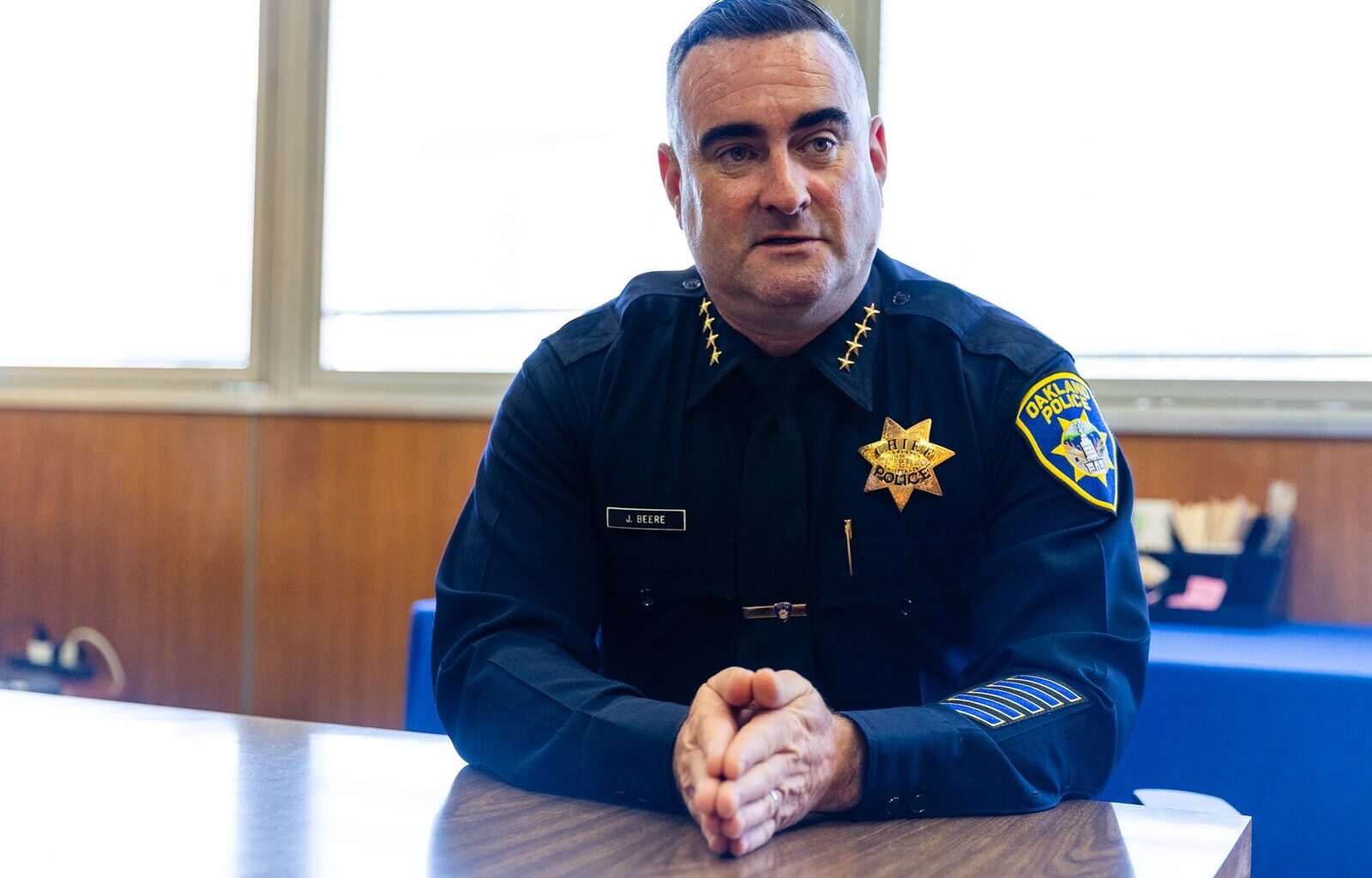
In November, Mayor Barbara Lee appointed Assistant Police Chief James Beere to helm the department while the city and the civilian-led Police Commission search for a permanent replacement.
Yesterday, Beere announced that he threw his hat into the ring for the job.
The Oaklandside sat down with Beere on Tuesday morning after the department decided to hold a press day, inviting local news outlets to each do their own 15-minute, one-on-one interviews with the interim chief. At 5 p.m. yesterday, the police department also released a six-minute video of Beere highlighting his experience and his first 100 days as interim chief.
There was a lot we wanted to ask Beere. Time didn’t afford this. Because we only had 15 minutes, we zeroed in on police staffing, since that’s one of the biggest challenges facing OPD.
Our conversation has been edited for clarity and length.
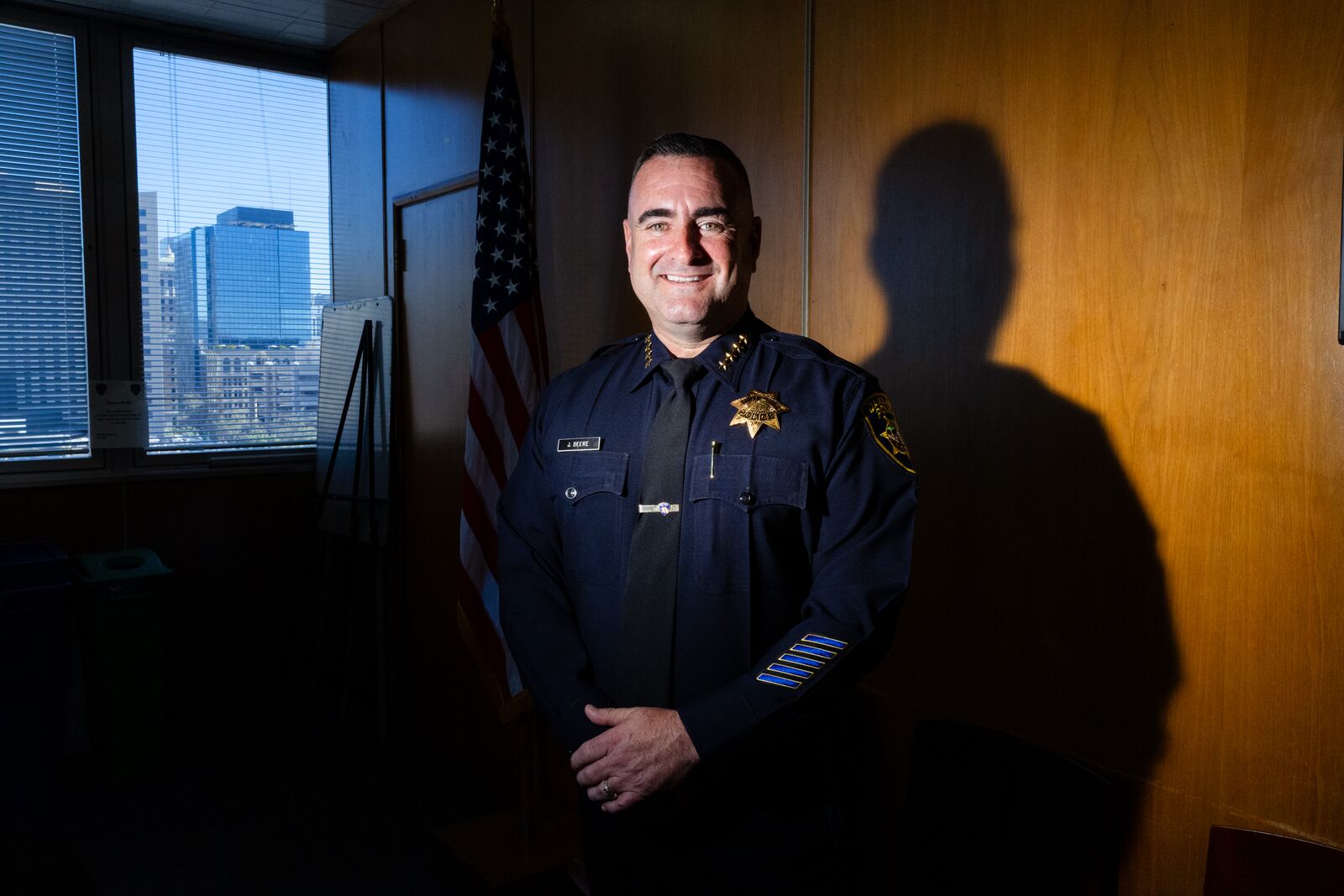 Beere has worked at OPD for nearly three decades. Credit: Estefany Gonzalez for The Oaklandside
Even though OPD is understaffed, Oakland has made some notable strides in public safety, such as the city’s lowest homicide rate in five decades and a sustained decrease in violent and nonviolent crimes. How do you square OPD’s low staffing levels with these low crime rates?
In 2023, we did have significant challenges. The city was plagued by violent crime and property crime. As a deputy chief, I took over the crime strategy. I continued that when I became the assistant chief. It was difficult, but we had to deploy our resources in the areas that we saw were most affected by violent crime. We had to reinvest in the Ceasefire strategy, and that was huge because the city had moved away from Ceasefire, and it was a proven system that had worked. In fact, Oakland has now become the national model for Ceasefire.
But they had dismantled Ceasefire, and that created significant issues. It became more reactive, not proactive. We wanted to work hand-in-hand with the Department of Violence Prevention to build it back to where it needed to be. I’m 100% committed to Ceasefire.
But it didn’t come without loss. Several police officers were hurt. One officer was murdered at the end of 2023.
But the operations were effective, and we continued that into 2024.
And then we saw a significant reduction. There was a 32% reduction in homicides, over a 30% reduction in shootings, and across the board, you saw reductions in property crimes, including robberies and rapes.
Then, in 2025, it continued. So on top of the reductions in 2024, we saw a 22% reduction in homicides and an over 20% reduction in shootings. That was the lowest number of homicides we’ve seen since 1985.
Of the 67 homicides, 11 were justifiable homicides. That brought it down to 56 murders. We hadn’t had that low murders since the late ’60s.
A lot of that has to do, obviously, with the women and men of the police department dedicating their time and efforts where they needed to be. But I think a huge part of it was rebuilding our relationship with the community.
The community stepped up. They were part of our enforcement efforts. They told us where we needed to be, whether it was for human trafficking, drug dealing, or just reporting the crimes. There was an effort from the police department to encourage people to come forward. We wanted everyone to feel safe.
We started to leverage technology. In 2024, we were able to re-sign a contract with ShotSpotter. We recently had the private camera partnership, where we can access privately owned cameras. Then Flock came online, and it was a game-changer. We saw an over 40% reduction in robberies.
Sadly, if you’re a victim of crime, the data doesn’t reflect that. You’re not going to feel safer if you were just robbed or if your loved one was murdered. And we celebrate 56 murders, but we really can’t celebrate if there’s one murder at all. Those murders affect families and friends for generations, and it’s hard to overcome that.
Partnering with other outside law enforcement agencies — the sheriff’s department, San Francisco, San Jose, the California Highway Patrol — is also huge. CHP hones in on traffic safety in our high-injury network, where there’s been a lot of loss of life. They’ve also helped us with retail theft, which allows us to free up our officers so we can actually focus on the small number of people committing the majority of the violence. The U.S. Marshals took it upon themselves to go after fugitives, and we partnered with the Drug Enforcement Administration and the FBI to conduct long-term investigations, specifically for people who are committing violent crimes. So it really was a partnership.
I’d be amiss if I didn’t give credit to the changes in our community as well. The neighborhoods are coming forward. Our communities are cooperating with the police department. They’re reporting crimes.
And the DA is charging them and holding people accountable. We had a significant issue with people getting arrested for firearms possession or other violent crimes, and then they were being released and committing additional crimes. We have a new DA in San Francisco and a new DA in Alameda County. We know this is a regional effort. And working with the DA has been very beneficial for all of us.
The mayor has been a huge leader in changing how things work in the city as well. We’ve broken down silos. For the first time in my career, I’ve noticed that we’re all working together as one. We’re working with other city departments to improve environmental design to address crime. OakDOT has put up ballasts or delineators to prevent sideshows. The mayor and the city administrator have gotten us to the point where we’re communicating and working side by side.
So even though there is this chronic understaffing issue at OPD, the way you’ve been able to fill the gaps is through these partnerships with different agencies.
And leveraging technology.
One of the things we need to point out is that there’s more demand on the police department now than ever. The last time we saw a reduction in crime this significant was back in 2009 or 2010. But that was when the police department was staffed with 800 officers, and we had a population of 390,000 people.
Fast forward to 2016, our population was roughly 453,000. That’s an increase of over 53,000 people — almost the size of Alameda and four times the size of Emeryville. We inherited a whole new city with no police department to go along with it.
OPD had 800 officers at the time. Now, we’re operating with 600. So it’s imperative that we leverage technology.
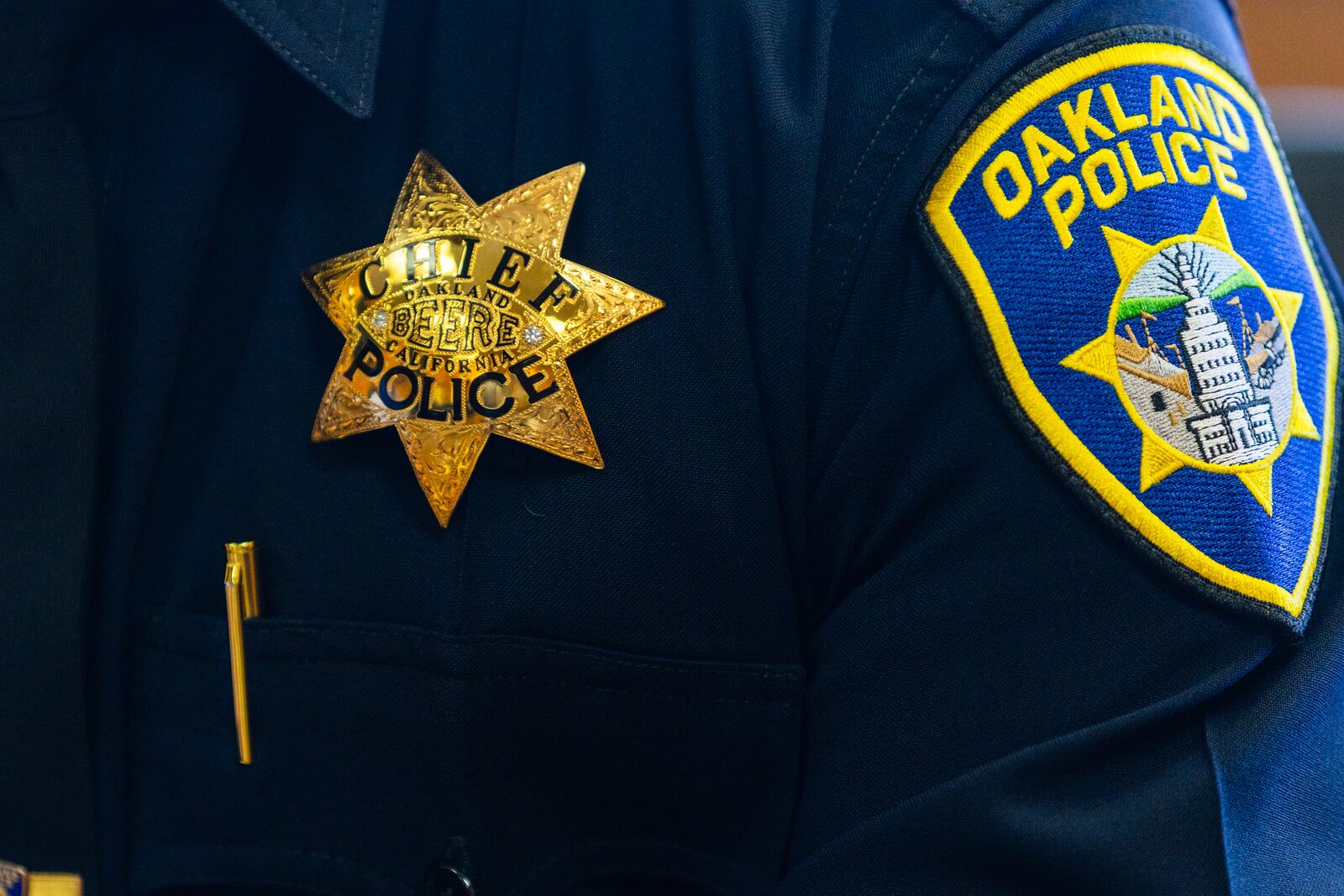 Beere wears a police chief badge during an interview at the Oakland Police Administration Building on Tuesday, March 24, 2026. Credit: Estefany Gonzalez for The Oaklandside
A lot of public officials and community members have repeatedly called for OPD to reach 700 officers. Right now, it’s authorized for 678, but the operational strength hovers around 500, right?
We have 500 today.
Attrition is also holding steady at six officers per month, and the department has struggled with hiring. Do you think 700 officers is still a realistic target? Do you think that goalpost should be moved?
That’s an excellent question, and my answer is gonna address multiple parts of that.
Our Office of Inspector General recently conducted an assessment. A third-party contractor came in and stated we should be at 877 officers just to maintain what we’re doing right now, not even to improve. That really shows you the effort that the women and men of this department and our professional staff are doing to maintain the police services that they’re at right now. That’s not even to provide the community with the best possible police service they deserve, because truthfully, they’re not getting it. What they need is closer to 1,200 officers.
That study wasn’t financed to look at that number. It was just to look at what we need with what we’re doing right now. So that’s a problem, and we’re not going to sugarcoat that.
Where did the 1,200 number come from?
If you look at a similar agency’s population and calls for service, and with the different challenges we have, 1,200 is about where you would need to be. But that’s to drive the crime down and maintain it for generations to come.
It’s not just our challenge. The challenge area-wide, statewide, and nationwide is recruiting people.
Since I took over, we graduated 14 trainees from the 195th police academy in December. They are now police officers in field training, and they’re doing well.
The 196th academy is currently underway. There are 18 police officer trainees in that class. They’re set to graduate here pretty soon.
Then, we’ll start the 197th academy in April. We’re looking at over 40 police officer trainees in that class.
That’s a significant jump. How did you get there?
It’s part of our larger plan, but it goes back to when I took over.
Operationally, I wanted people in positions that they know and will succeed at, so I made changes to my executive staff, including the assistant chief and deputy chief of operations in downtown. I wanted people who could carry the vision and the strategy I had in place when I was the assistant chief.
I wanted to bring in people who could help with the recruitment piece and our Internal Affairs Bureau. So starting internally, I sat down with every member of the executive staff, interviewed them, and laid out my expectations.
Going forward, the standard would be the same as it is for any other officer. I want the same standards from the officer all the way through the ranks and up to the chief. We need to hold ourselves accountable. No more virtual meetings unless there’s a justified reason for it. I want everyone at work normal business hours and to be expected to stay late and to work on the weekends.
The expectation is to be more involved in the community and internally. I want those kneecap-to-kneecap, eyeball-to-eyeball conversations — not just with other officers, but also out there. Since I took over as a police chief, I have attended more than 55 community meetings.
I think the first time I met you was at a Ceasefire Night Walk in 2024.
I was probably with my wife and kids, was I?
Yeah.
My wife and I have lived in Oakland for over 30 years. I’ve been with a police department for 29 years. We’ve raised three boys, all of whom went to Oakland public schools. We have been very involved in the community, and that’s the ethos and one of the standards I wanted to bring to my staff.
We brought back the cadet program, which taps into the community at the heart: the kids in the high schools. The mayor has relationships with the private sector, and they’ve helped us get funding for this cadet program. It was an established asset for the police department for 25 years. It helps free up police officers to do law enforcement stuff, but it also brings young kids into OPD so they can understand the culture, how the police department runs, and get paid, because most kids might not be able to afford to volunteer.
Then they are ambassadors back to their high schools, neighbors, and families. They tell people, “This is what the police department’s all about,” and they give us feedback. Not only are they force multipliers, but they’re also part of a long-term recruiting plan, because when they enter the police academy, their graduation rate is over 90%. And those who don’t join the police academy end up becoming dispatchers, police services technicians, and other staff within the OPD.
One last question — OPD is hiring a permanent chief. Are you applying?
Yes, I have applied. I’ve submitted my application. I’m going to be part of the process.
“*” indicates required fields