
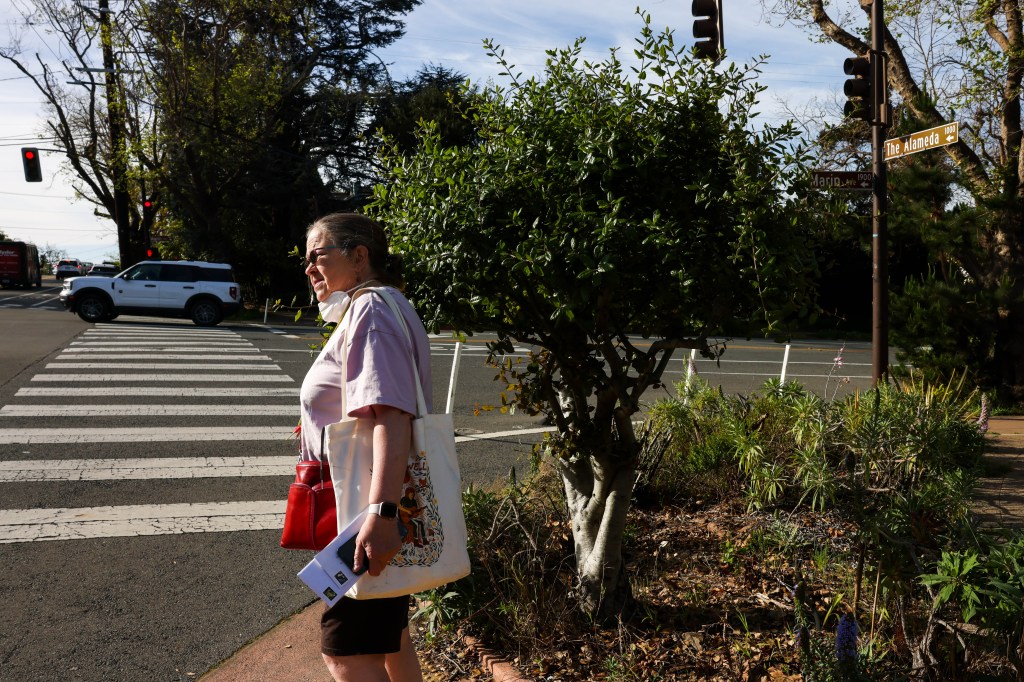
Melissa Quilter has quit crossing the intersection of The Alameda and Marin Avenue in Berkeley when she’s walking her dog.
“My dog is older. I’m older. We don’t take risks anymore,” said Quilter, 66, who has been living by the intersection for 27 years. Without a protected left-turn signal, drivers can turn through the crosswalk at the same time pedestrians are crossing.
Experts say most intersections are similarly not designed to support aging pedestrians, the Bay Area’s fastest-growing population. Issues like incomplete sidewalks, short crossing times, and turns conflicting with pedestrian crossings all make intersections more precarious. Seniors on foot may move more slowly, use walkers or have trouble seeing, and are more likely to be severely injured in even minor crashes.
Across the Bay Area, cities from Hayward to San Jose are beginning to confront those risks, rolling out safety initiatives aimed at redesigning streets and intersections with older pedestrians in mind.
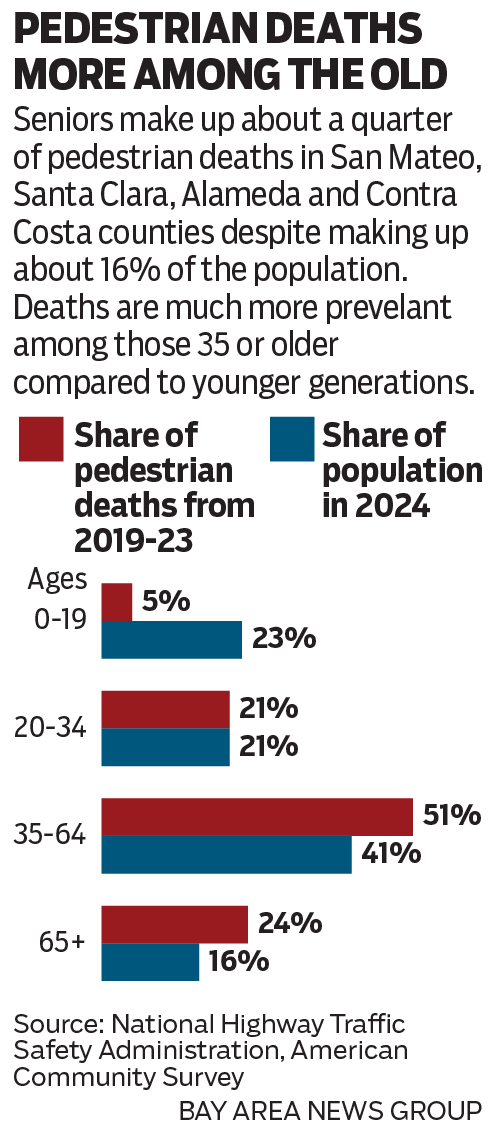 Older people on foot make up a disproportionate number of fatalities in car-related crashes. From 2019 to 2023, pedestrians over 60 accounted for 32% of deaths in San Mateo, Santa Clara, Alameda and Contra Costa counties combined, according to data from the National Highway Traffic Safety Administration. The group makes up 16% of the region’s population.
In an attempt to make streets safer, California’s new “daylighting” law prohibits parking within 20 feet of a crosswalk even if the curb is unpainted to improve visibility at intersections, according to the California Department of Motor Vehicles. It is intended to help drivers see pedestrians before turning and pedestrians spot oncoming traffic, addressing a common cause of crashes where sightlines are blocked.
Thoughtful design can help make streets safer for seniors, according to Rodney Harrell, vice president of family, home and community at AARP. This includes slower traffic speeds and narrower roads that reduce the risk of severe crashes, he said.
“As we get older, high-speed crashes are much more likely to be deadly,” Harrell said.
Harrell said he is encouraged by the growing number of cities adopting policies to slow traffic and improve pedestrian infrastructure, but progress remains uneven.
“Every time there’s a pedestrian fatality, it’s a reminder that we can make our communities safer for everyone,” Harrell said.
In Hayward, it’s a reminder officials hope not to need. They have started a program to make streets safer for older residents to navigate.
City transportation officials say older pedestrians are not involved in a disproportionate number of crashes, but when collisions do occur, they are often more severe. Between 2021 and 2024, about 7.5% of pedestrian injury crashes in Hayward were fatal, compared with 19.3% of crashes involving seniors, according to public works officials.
Proposed changes include new crosswalks, pedestrian-activated flashing amber lights to alert drivers when someone is crossing and redesigning intersections to shorten the distance needed to walk.
In the South Bay, officials are beginning to see progress in their efforts to reduce traffic deaths. The city launched its Vision Zero initiative a plan to eliminate traffic fatalities and severe injuries as pedestrian deaths were climbing, peaking at 65 in 2022, the highest number in the city’s modern history.
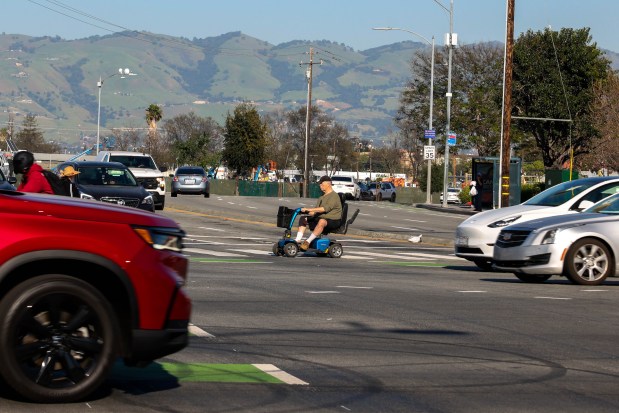 A senior using a power wheelchair crosses the wide intersection of Monterey Road and Curtner Avenue in San Jose, Calif., on Wednesday, March 18, 2026. (Ray Chavez/Bay Area News Group)
Fatalities have declined for three consecutive years, dropping to 50 in 2023 and 29 in 2024, according to the city. Officials attribute the shift in part to a mix of fast, low-cost safety upgrades completed within 18 months.
“The only acceptable number of fatalities is zero,” the city’s transportation public information officer, Colin Heyne, said.
Data from the city shows that speeding and red-light running remain the leading causes of severe and fatal crashes. In many cases, pedestrians are already well into the roadway when they are struck.
Officials say vulnerable populations, including older adults, remain a key focus. In 2019, the city accelerated safety upgrades near a senior living facility at Taylor and Sixth streets after multiple fatalities at the intersection. Traffic volumes did not meet the threshold to add a signal there, but the presence of older residents prompted the city to secure funding. The city activated the light in November 2022.
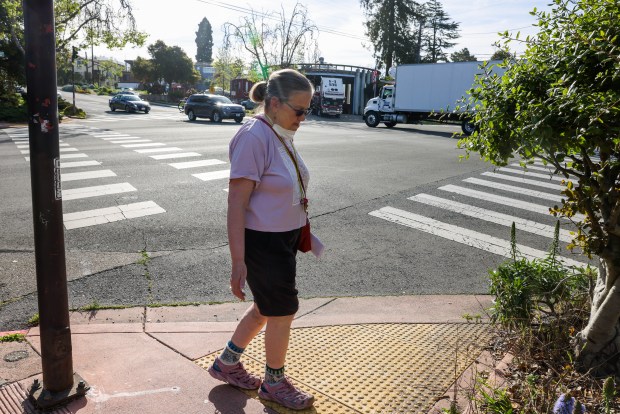 Melissa Quilter, 66, looks at the wide intersection of The Alameda and Marin Avenue in Berkeley, Calif., on Friday, March 13, 2026. “I don’t cross this intersection any longer because the cars don’t stop when the pedestrians have the right-of-way,” Quilter said. “I would love to see lights that control the left turns and speed limits to be enforced.” (Ray Chavez/Bay Area News Group)
Back at the Berkeley intersection of The Alameda and Marin Avenue, Helen Hallberg has seen near misses for years.
“I think people, if they’re not outside of a car, they don’t realize how it is out there,” she said.
The city is working to make streets safer for “all types of users,” said spokesperson Matthai Chakko, citing recent improvements in the neighborhood, including trimming back shrubs to improve sightlines.
AARP studies show that walkable communities allow residents to exercise, run errands and stay socially connected without needing to drive, said Harrell, of the AARP. Parks, grocery stores and libraries are the facilities older residents most want within walking distance.
“Everyone should be able to navigate where they need to go,” Harrell said.
Staff Photojournalist Ray Chavez contributed to this story.