
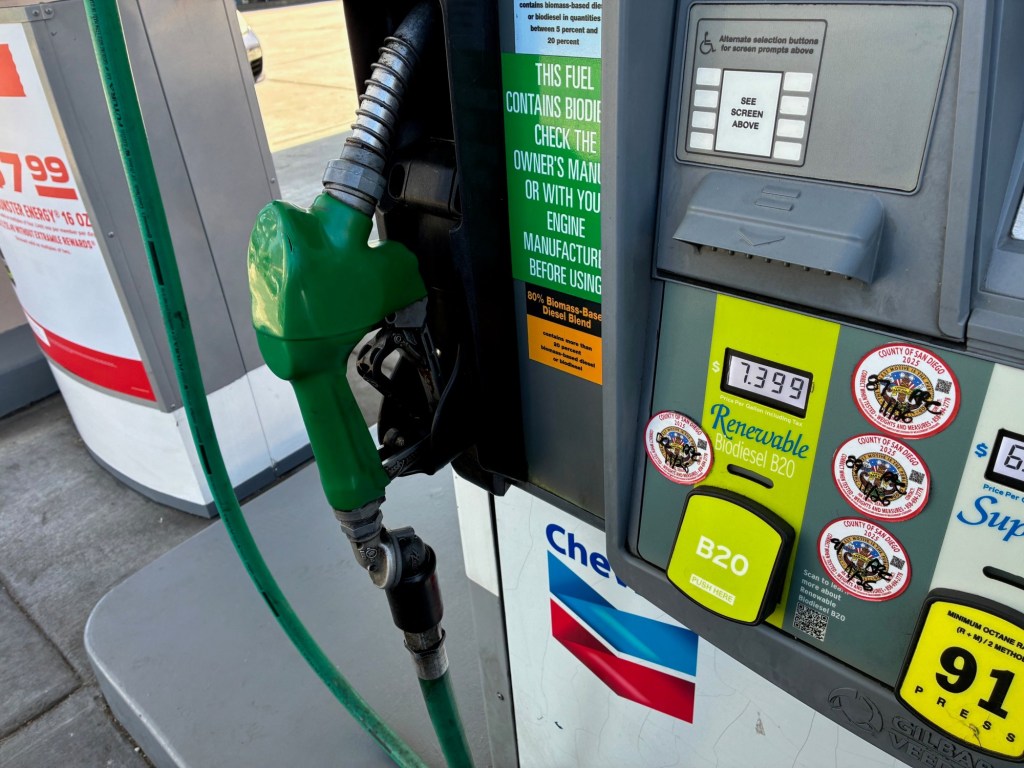
Average diesel prices surpassed $7 a gallon for the first time in San Diego on Wednesday, driven by the ongoing war in Iran that has spilled over to neighboring oil-producing countries in the Middle East.
The average price across the state flew to $7.072, also a record, according to AAA. In the San Diego area, the average diesel price was slightly lower, at $7.036 per gallon. The previous record for diesel in the San Diego area was $6.852 on June 18, 2022.
Before the start of the conflict in Iran, the average price for diesel in the Golden State hovered around $5 a gallon. That translates to a 40% increase in the past month.
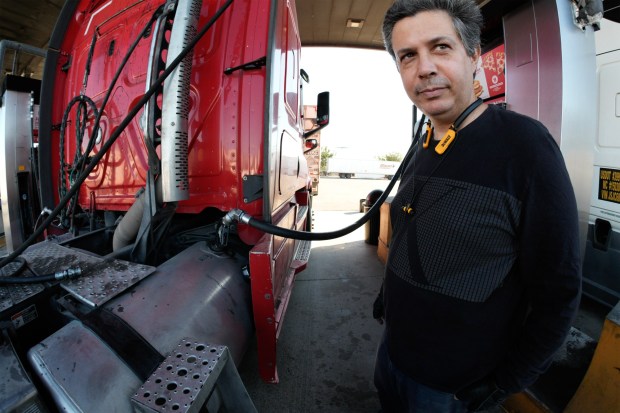 Mateo Bazzolo stopped at a local truck stop in Otay Mesa near the U.S.-Mexico border to fuel up with diesel, which was selling for $7.15 a gallon on Wednesday, March 25, 2026, in San Diego, CA. (Nelvin C. Cepeda / The San Diego Union-Tribune)
While drivers of passenger vehicles are well aware that gasoline prices skyrocketed, the soaring cost of diesel ripples through the national, state and local economies.
Patrick De Haan, head of petroleum analysis for GasBuddy.com, posted on X that the $7 mark is “not just a milestone — it’s a warning. Trucking and agriculture run on diesel. Higher costs are coming, and they won’t just stay in California.”
“The economy runs on diesel, everything you buy in the store got there by a diesel truck,” said Denton Cinquegrana, chief oil analyst at the Oil Price Information Service, which provides data and forecasting on global energy. “Since you don’t put diesel in your car, you say, ‘Oh, what do I care about diesel?’ Well, diesel really touches everyone’s life in one way or another.”
Arthur McCanless, owner of Elmer’s Moving van company in Mission Valley, is getting hammered every time he fuels up one of the three diesel-powered vehicles in his small company’s fleet.
“It definitely hurts, and it hurts the overall bottom line,” he said. “On a 60-gallon tank, a $2 difference is 120 bucks. You do that once or twice a week, that adds up, for sure.”
After holding off as long as he could, McCanless said he bumped up his company’s fuel fee by $15 per zone. For example, the surcharge for moving furniture from the South Bay to Solana Beach has increased from $25 to $40, even though McCanless said that does not fully cover his higher transportation costs.
“Other companies just charge a flat $100, $110 (fee), no matter where they’re going,” McCanless said. “But I try to base it off of where we’re traveling, so that way it’s fair for the consumer.”
In his moving company’s 12-year-history, McCanless has experienced diesel price spikes before, but he’s never had to ride out such a sharp increase in so short a timeframe.
“You don’t want to overcharge your customers because then you start losing business,” he said.
Diesel not only powers the commercial trucking industry, but it’s also a primary source of fuel for trains, boats, barges and farm equipment.
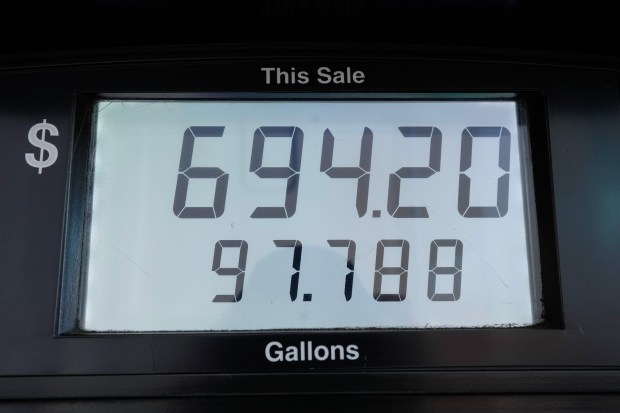 At a local truck stop in Otay Mesa near the U.S.-Mexico border, diesel was selling for $7.15 a gallon on Wednesday, March 25, 2026, in San Diego, CA. (Nelvin C. Cepeda / The San Diego Union-Tribune)
Higher transportation costs are not immediately felt by consumers, but with the conflict in the Middle East in its fourth week, they will start moving through the supply chain. That will likely result in consumers seeing higher prices at grocery stores and retail outlets as those costs get passed along.
“There are just lots of ways that oil and derivatives of oil get into the production and transportation of many, many things,” Federal Reserve Chair Jerome Powell said last week, adding that the effects on core inflation, which excludes food and energy, are “real, and they’re material.”
Since joint military airstrikes by U.S. and Israeli forces on Iran started on Feb. 28, the Iranian regime has restricted to a trickle the number of oil tankers and cargo ships going through the Strait of Hormuz. The waterway typically accounts for about 20% of the world’s petroleum products and its closure has sent oil prices soaring.
The price of futures contracts for Brent crude — the international benchmark oil price — rose to almost $120 a barrel since hostilities began, although they retreated below the $100 mark on Wednesday on speculation of negotiations between Iran and the Trump administration.
Diesel, gasoline and aviation fuel are refined products of crude oil.
“Until there’s a resolution and we have a clearer timeline or there’s an off-ramp for this conflict, it’s pretty safe to say that all bets are off when it comes to fuel prices,” Cinquegrana of OPIS said. “It seems like every day when the price goes down, it shoots back up the next day.”
Gasoline prices in the San Diego area stood at $5.903 per gallon on Monday, according to AAA. That’s an increase of $1.22 since the start of war. The all-time high for San Diego gasoline was $6.435, which was set on Oct. 5, 2022.
California has the nation’s highest average for gasoline, as well as diesel. That’s due to a number of factors, including environmental regulations that reduce the carbon intensity of fuel sold in the state and California’s lack of access (such as pipelines) from refining centers in other parts of the country.
Cinquegrana estimates that renewable diesel fuel from California refiners makes up about 25% to 30% of the state’s diesel supply.
“Granted, California companies are probably increasing their production of renewable diesel because the margins are there,” he said. “But you can’t replace all the California diesel with renewable. … Maybe that inches up a couple of percentage points, but it’s not going to solve the problems. Suffice it to say that diesel, gasoline and jet fuel — they’re all gonna be issues until this war clears up.”
The national average price for a gallon of diesel on Wednesday came to $5.366, or $1.71 lower than the Golden State’s.