
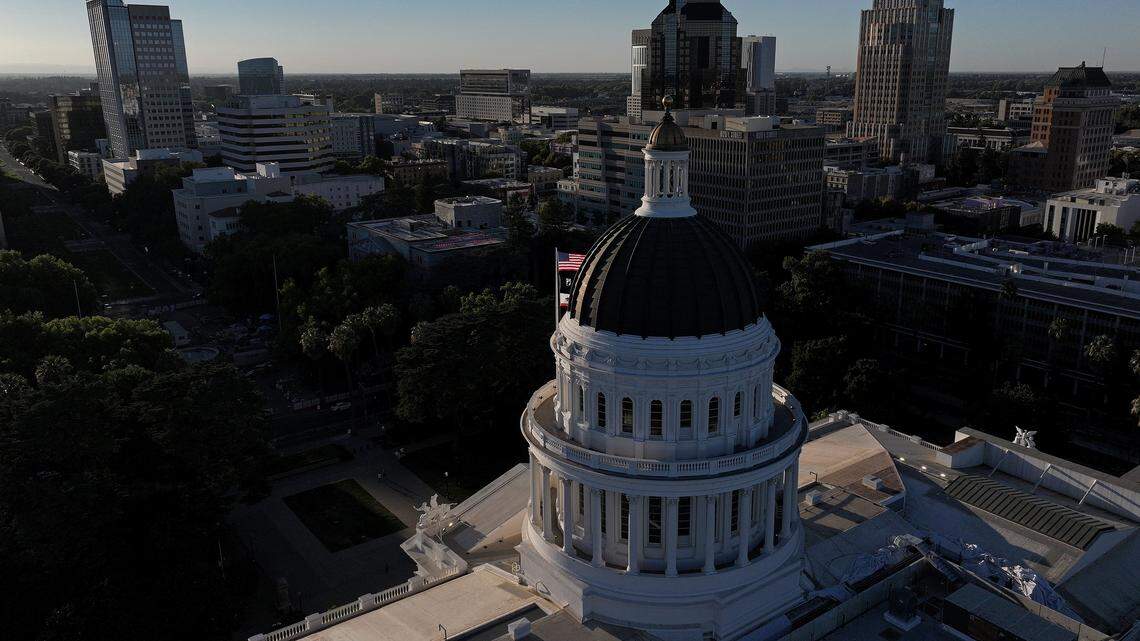
An aerial view of the California state Capitol on August 19, 2025 in Sacramento. (Photo by Justin Sullivan/Getty Images)
Justin Sullivan
Getty Images
A legislative committee on Tuesday directed the California State Auditor’s Office to investigate secretive, federally funded fusion centers, where state, local and federal law enforcement agencies share intelligence.
Though State Auditor Grant Parks said the effort may face legal hurdles, the inquiry advanced a long-standing goal of civil liberties and privacy advocates seeking more transparency into the centers, which critics said have operated for decades with limited oversight or accountability.
“Forty million Californians deserve to know whether these centers are serving their intended counter-terrorism purpose, or whether they have become unaccountable surveillance infrastructure operating in the shadows of our democracy,” state Sen. Sabrina Cervantes, D-Riverside, who brought the request, told the Joint Audit Committee at Tuesday’s hearing.
No federal or state officials appeared to testify on behalf of the fusion centers. In California, the primary center is operated by the California Highway Patrol, the California Department of Justice and the Governor’s Office of Emergency Services, Parks said.
“Should an audit move forward, the Governor’s Office and the agencies we oversee will coordinate and provide information as requested,” said Tara Gallegos, a spokesperson for Gov. Gavin Newsom’s office.
A network of fusion centers expanded nationwide after the Sept. 11, 2001, terrorist attacks. The U.S. Department of Homeland Security said the centers serve as clearinghouses for intelligence on terrorism and criminal threats.
California adopted a plan to open four centers in 2004, according to Cervantes’ letter. There are now at least five centers statewide, located in San Francisco, Sacramento, Los Angeles, San Diego and Orange County. Nationwide, there are at least 80 centers, according to a 2022 Brennan Center for Justice report.
The proposal submitted by Cervantes and approved by the committee calls for Parks’ office to look into the centers’ legal authority, their staffing, funding, training, data collection and privacy safeguards, as well as what oversight of them exists and what metrics the centers use to measure success.
Scrutiny of the centers grew among social justice advocates in 2020, after hackers released documents from the Northern California Regional Intelligence Center, the San Francisco office, showing officials had closely monitored protests over police brutality in the wake of Minneapolis police officers’ killing of George Floyd.
The bulletins “broadly labeled protesters as Antifa,” and went out to as many as 14,000 law-enforcement officers statewide during the protests, Cervantes said.
Leaked reports from centers around the country have captured the sharing of unverified, and at times easily discredited, rumors, as if they were verified law-enforcement intelligence. Those rumors are often tied to antifa, which is short for anti-fascist. While the second Trump administration has labeled Antifa as a domestic terrorist group, most independent experts say antifa is best viewed as ideologically connected groups of protesters against fascism and white supremacist organizations.
Fusion Centers have circulated false reports that antifa protesters were staging piles of bricks to sow destruction in Maine and targeting the annual massive motorcycle rally in Sturgis, South Dakota. MuckRock, a media outlet that pursues and publishes public records, obtained documents from the Northern California Regional Intelligence Center, the fusion center in San Francisco, where officials described members of Antifa entering the state to “engage in protest activities and violent criminal activity.”
In 2012, a U.S. Senate subcommittee evaluated fusion centers and issued a scathing report that found it “could identify no reporting which uncovered a terrorist threat, nor could it identify a contribution such fusion-center reporting made to disrupt an active terrorist plot.” The subcommittee was unable to pin down how much taxpayer money had gone to the facilities by then, but reported the U.S. Department of Homeland Security estimated expenditures of between $289 million and $1.4 billion over a decade.
More recently, however, some reports have credited fusion centers with providing prescient warnings about the Jan. 6, 2021 riot to protest Joe Biden’s electoral victory over Trump. Subsequent congressional investigations concluded both federal and local law enforcement did not sufficiently respond to intelligence reports warning of likely violence that day,.
Cervantes requested the audit at a time when the state Legislature has devoted much of its time toward reigning in federal officers in California, particularly in the realm of immigration enforcement. According to Cervantes’ letter, fusion centers provide a way for the federal government to circumvent California statutes prohibiting local law-enforcement agencies from working with U.S. Immigration and Customs Enforcement, and have in the past requested data from the California Department of Motor Vehicles that the Legislature has prohibited the state from sharing with ICE.
Only Republican committee member Assemblymember Carl Demaio, R-Valley Center, spoke against the audit proposal. He criticized Cervantes for bringing the measure amid the country’s war with Iran, which has spurred fears of increased national security threats or terrorist attacks.
“Did you at any moment pause and reconsider, whether now may not be a great time to go into these centers that are designed to detect terrorist activity and monitor terrorism activity in our homeland?” Demaio asked.
Cervantes said an audit would not interfere with the work fusion centers conduct.
“We can protect national security and public safety while preserving our essential civil liberties,” she said. “This audit is about transparency.”
The lack of an official to speak on behalf of the centers raised the eyebrows of the committee chairman, Assemblymember John Harabedian, D-Sierra Madre. “I would be a little bit more open to the constructive criticism if the agencies had actually bothered to show up,” he said following Demaio’s comments. A majority of both the Assembly and Senate sides of the committee had to vote in favor of the audit to approve it. Five of seven assembly members voted in favor of the measure, while four of seven senators did so.
Audit requests do not require a vote of the full legislative chambers to proceed, so Tuesday’s committee vote authorized the state auditor to proceed with the inquiry.
This story was originally published March 24, 2026 at 6:37 PM.
The Sacramento Bee
Andrew Graham reports for The Sacramento Bee’s Capitol Bureau, where he covers the Legislature and state politics. He previously reported in Wyoming, for the nonprofit WyoFile, and in Santa Rosa at The Press Democrat. He studied journalism at the University of Montana.