
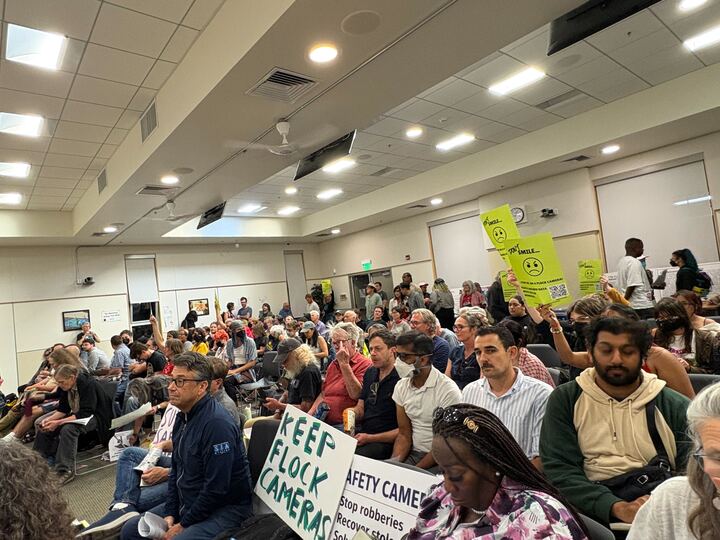
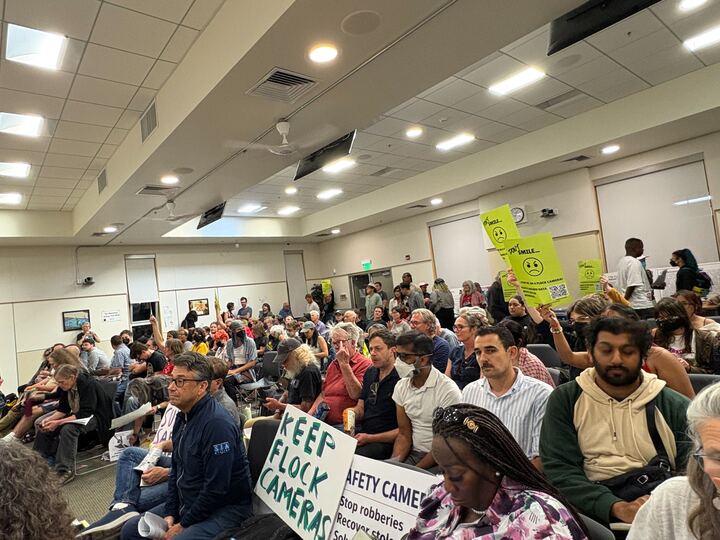
 The Berkeley City Council listened to dozens of residents and advocates speaking for and against (mostly against) a $2 million expansion of BPD’s surveillance network on March 24, 2026. The council is tentatively scheduled to vote on the expansion in June. Credit: Alex N. Gecan/Berkeleyside
Berkeley has once again delayed a vote on expanding its police department’s network of surveillance hardware from the Georgia technology company Flock Safety.
A standing-room-only crowd took part in a nearly five-hour-long debate at a City Council meeting Tuesday night, most to protest the Berkeley Police Department’s request for up to $2 million in new equipment and software. The audience in the council chambers occasionally devolved into shouting matches, once broke into song and frequently hissed and booed or hooted and clapped in response to arguments. As the hour grew late, those holding placards with competing slogans jockeyed for position in front of the council chamber’s cameras.
Berkeley police sought approval to renew its network of 52 automated license plate readers from Flock Safety, buy centralized software to sync Flock devices with other systems, acquire three drones running Flock software and launch a program that would let business owners feed live video streams into BPD headquarters.
But the City Council was forced to postpone a final vote thanks to a procedural issue. Council members must vote to allow meetings to last past 11 p.m.; after a first extension, to 1:30 a.m., a second extension did not get the two-thirds majority it needed. The vote was tentatively rescheduled for a special meeting June 2.
Police and proponents say the new hardware is crucial to catching criminals, while critics worry federal agents will hijack the data the network gathers to conduct mass deportations.
“This development represents the largest surveillance expansion in the city’s history, and it deserves careful and deliberate consideration,” Police Accountability Board Vice Chair Leah Wilson said early in the deliberations.
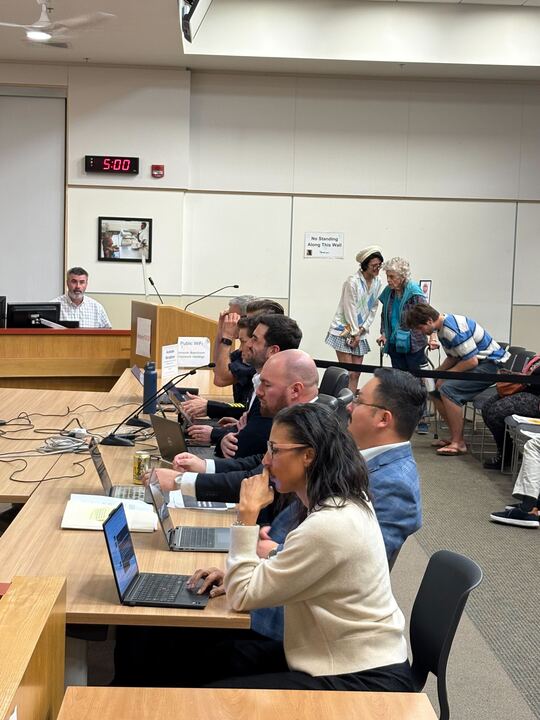 Berkeley Police Accountability Board Vice Chair Leah Wilson (foreground) called BPD’s proposed tech purchase “the largest surveillance expansion in the city’s history.” Credit: Alex N. Gecan/Berkeleyside
The PAB asked that the council hold off on any new tech purchases, or re-upping on the plate readers, saying BPD had not fully aired out the potential risks of such a widespread network — to Berkeleyans’ First Amendment rights, to Berkeley’s own decision-making if it relies more heavily on a single vendor, and from audits that take too long to find problems.
Advocates from the East Bay Sanctuary Covenant, East Bay Community Law Center, Oasis Legal Services and other organizations acting on behalf of undocumented, queer and other Berkeleyans spoke against the expansion Tuesday.
“This council unanimously voted to approve the sanctuary ordinance, codifying Berkeley’s commitment to protecting immigrants and declaring that cooperating with the federal deportation machine is against our moral obligation as the first sanctuary city,” Lisa Hoffman, an executive director for East Bay Sanctuary Covenant, said Tuesday. “Flock is a company whose investors are deeply tied to Trump’s deportation machine.”
Beth Roessner, CEO of the Berkeley Chamber of Commerce, said her organization acknowledged the privacy and data security concerns so many Berkeleyans had raised, but was satisfied with the safeguards BPD and some council members already proposed.
“For our business community, public safety and economic vitality go hand-in-hand,” Roessner said via Zoom Tuesday, shortly before midnight.
All nine council members, Mayor Adena Ishii included, had submitted last-minute tweaks to BPD’s proposal — some on their own, others in groups — all suggesting tighter restrictions if the city were to move ahead with the expansion. Ishii and council members Cecilia Lunaparra and Igor Tregub proposed dropping any proposed contract with Flock altogether.
But after the lengthy public comment period, and with several competing proposals for modifying the surveillance expansion on the table, the council’s discussion Tuesday night and early Wednesday morning was limited. There was no question-and-answer period between council members and BPD leadership, which is typical when agencies make substantial requests, nor debate among the council to indicate which plans its members favored.
Ishii, Lunaparra, Tregub and Councilmember Ben Bartlett all voted against extending the meeting a second time. The members did not say why they voted the way they did, so it is unclear to what extent the PAB’s recommendations, or residents’ testimony, had swayed them.
City Manager Paul Buddenhagen pumped the brakes on an earlier vote, in September, to buy 16 video cameras from Flock.
“*” indicates required fields