
Alejandro Lazo: [00:01:13] They’re always higher, right, but we just really notice in moments like this when they climb up significantly
Ericka Cruz Guevarra: [00:01:21] Californians pay more for gas than any other state. Today, we sit down with CalMatters climate reporter Alejandro Lazo to help us break down the numbers behind the pump.
Ericka Cruz Guevarra: [00:01:44] All right, Alejandro, well, I guess my first question for you, do you, how’d you get in this morning? Do you drive much?
Alejandro Lazo: [00:01:51] I don’t drive a whole lot, but yes, I drove here. I’ve got a 2000 Toyota Echo.
Ericka Cruz Guevarra: [00:01:58] Alejandro Lazo is a climate reporter for CalMatters.
Alejandro Lazo: [00:02:03] It is very, very efficient. So I hardly ever fill it up, but I did fill it last week and it certainly wins. I mean, in terms of anecdotes, I think the main one is just my wife who commutes in to her job in South San Francisco every single day. Yeah, it’s been not pleasant to kind of look at that rising price.
Ericka Cruz Guevarra: [00:02:30] I mean, yeah, I feel like when you’re just a person living in California, it’s kind of hard to avoid.
Alejandro Lazo: [00:02:36] Absolutely. I mean, especially if you’ve got to drive a long way and you’re physically required to be at your job, then I think you’re really in a conundrum, because there aren’t the greatest mass public transit options. We’ve got some good ones, but they’re also expensive and point to point, they probably don’t get you exactly where you need to go if you’re driving, because if they did, you’d probably be doing that already.
Ericka Cruz Guevarra: [00:03:03] I mean, how much is gas averaging in California right now?
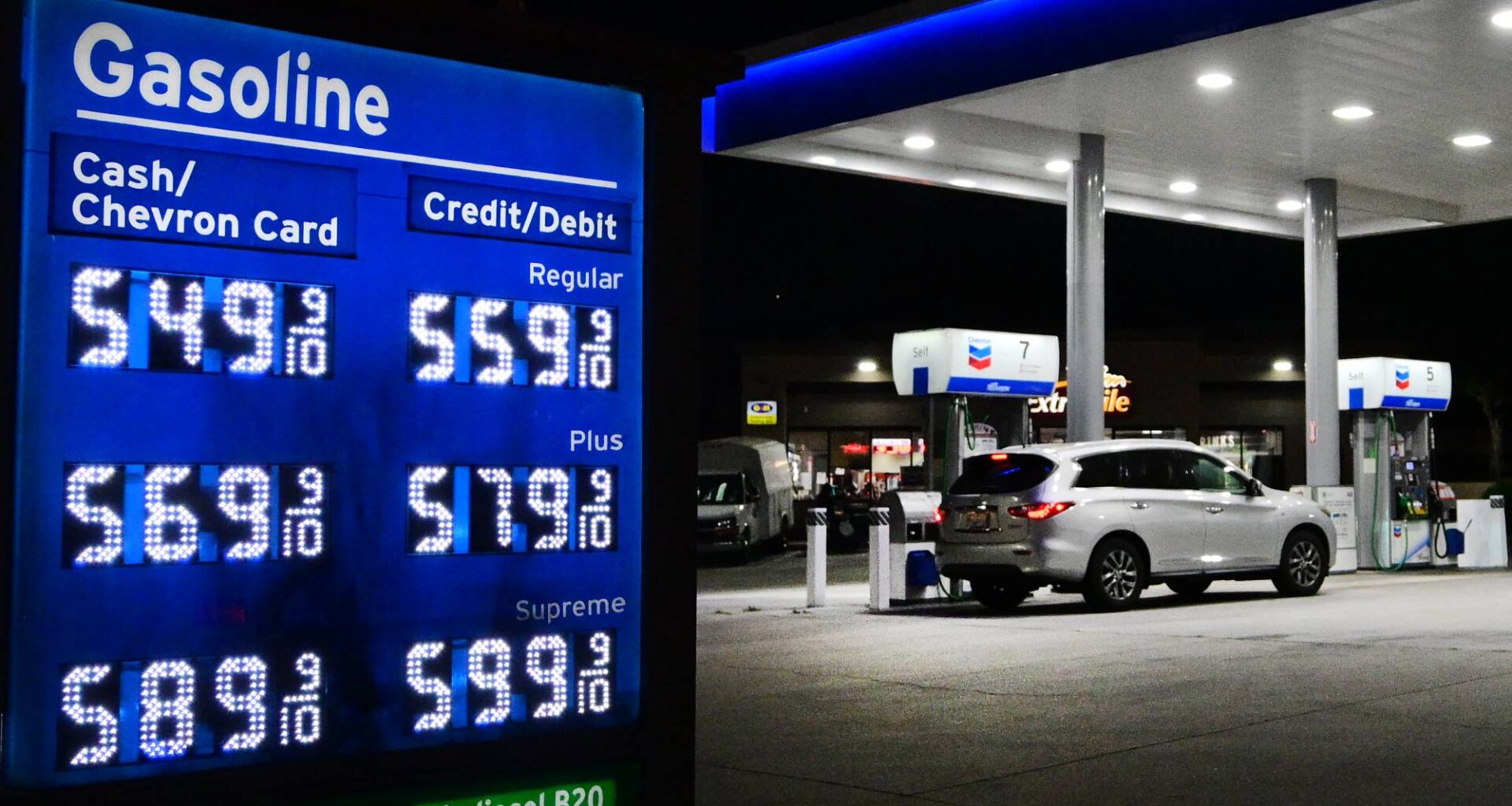
Alejandro Lazo: [00:03:07] Average gas prices state-wide are $5.82 a gallon. That compares to $3.98 for the U.S., so we’ve got nearly a $2 gap there. So it’s certainly climbing.
Ericka Cruz Guevarra: [00:03:20] And why is that Alejandro? Why is gas so much higher in California compared to the rest of the country?
Alejandro Lazo: [00:03:26] I think everybody understands like the basics of why gas prices are high across the United States. The United States and Israel is in conflict with Iran. We have a significant global choke point with the Strait of Ormuz closed. So we’re seeing about one-fifth of the world oil supplies cut off.
Alejandro Lazo: [00:03:52] There are just a few fundamental, structural reasons why gas prices are higher here in the state. First and foremost, we have taxes. We have higher taxes than pretty much anywhere. We have the gas tax. We certain environmental or climate policies. We have a cap and trade, the low carbon fuel standard. We have a special cleaner gasoline blend that we use. And then fundamentally, we’re an isolated market to some degrees. We don’t have any major pipelines that connect us to the rest of the country. So we rely on our own refineries and we also rely quite a bit on imports.
Ericka Cruz Guevarra: [00:04:36] On top of California’s programs and taxes that make gas more expensive, the state has identified a surcharge that oil companies have imposed on Californians. The companies say that charge is in place to pay for California’s extra taxes and compliance costs, but consumer watchdogs have accused the companies of price gouging.
[00:05:04] You mentioned a few taxes there that are very California specific. Why do these exist and where is the money from these taxes actually going?
Alejandro Lazo: [00:05:15] Right, well, so we do have a gas tax that adds about 61 cents to the gallon. That one largely goes to pay for road repairs. It’s become a political issue this year with some even Democratic gubernatorial candidates calling for the suspension of that tax. But experts say we would have to pay those road repairs and whatnot in another way. We have a cap-and-trade program, a low-carbon fuel standard program, and those climate programs, their intention is to fundamentally reduce emissions, CO2 emissions, and those add an extra cost. Those go on to pay for environmental programs, but those costs don’t add more than what refiners fundamentally add. Certainly, we have certain efforts, programs here to… That do increase the cost of gasoline, but they’re for certain purposes and they’ve been debated quite a bit.
Ericka Cruz Guevarra: [00:06:18] So, Alejandro, you’re mentioning these sort of structural things that make gas in California just inherently more expensive than the rest of the country. There’ve also been refinery closures in California, including an impending one here in the Bay Area in Benicia with the Valero refinery. Is that also a reason why gas is more expensive right now?
Alejandro Lazo: [00:06:41] Well, I think I just could go back to the point that I think the reason gas is so expensive at the moment is because of this global conflict that we have. And I think most experts would point to that as the reason we’re seeing this price increase. Now, the refineries are coming up as an issue because that is a long-term structural concern for the state of California. We’ve lost something between like 15% to 20% of our refining capacity. It is state policy to transition away from burning fossil fuels, fundamentally. That’s what we’re talking about here. We’re going to be losing more and more refineries. That’s sort of the whole purpose. That’s California’s policy, is just to get us off fossil fuels. But as we do that, and as we lose refinerys, if that’s not managed well, yeah, we could see price spikes as well there. And that’s become a major, major concern of California state government. So absolutely, yeah, the refinery issue is kind of the like the main native California issue that, you know, state policymakers are trying to address right now.
Ericka Cruz Guevarra: [00:07:57] Coming up, what tools California has to help consumers feeling it at the pump. We’ll be right back.
Ericka Cruz Guevarra: [00:08:11] Does California have any laws on the books to sort of help consumers in moments like this when there is a war, for example, or a sort of global oil situation that gets just sort of messy?
Alejandro Lazo: [00:08:26] Yeah, absolutely. I mean, it depends on who you ask about helping, right? But California certainly went through an era of trying to crack down more on the oil industry. And from that era, we passed a law in 2023 that has a couple of components. One that takes aim at refineries and oil companies in the state, capping profits and penalizing excessive profits. And then another one, a component that manages supply and does some monitoring. So we have that law on the books, and it’s partially being used. There’s a monitoring component there. People are watching where gas prices are going. But there is what consumer advocates call the hammer portion. Which is, you know, the penalizing excess of profits. That was put on hold for five years last year in the midst of this concern about refinery closures. So yeah, that key part of the law is not being used, and I’ve certainly heard environmentalists and consumer advocates complaining about that.
Ericka Cruz Guevarra: [00:09:45] Yeah, because it presumably would have been really, really helpful right now?
Alejandro Lazo: [00:09:49] Well, I think it’s interesting. It’s nuanced, right? I mean, these gas price increases are being driven by the global price of oil. But I have talked to environmentalists and consumer advocates who are supportive of kind of this harder line against the oil industry. And they have said that, yes, exactly. This is that moment when you should have that law armed and ready to go. Why? Because it is during these moments of high prices where you can start to see excessive profit taking. And so someone from the Newsom administration would tell you, no, what we did was the right thing. And this is not the moment to be using that law. But other people have other opinions about that.
Ericka Cruz Guevarra: [00:10:34] And I feel like that sort of gets at this tension that I feel keeps coming up in California, where you sort of want to protect consumers in moments like this, perhaps, but you also don’t want to necessarily drive out an industry that we can’t quite afford to lose yet. I’m wondering, Alejandro, what else could sort of help with that tension, because it seems like our reliance on oil is just causing… A lot of issues and sometimes it feels sort of inevitable in here in California.
Alejandro Lazo: [00:11:08] Right. Yeah. No, I think the tension that you’ve pointed to is one that has been popping up a lot over the last few years. And it’s one that I think is just kind of really getting a lot of tension now because we have seen gas prices go up so much. You know, I thing the tension is fundamentally that it’s good for the climate, for the state to move away from fossil fuels, right? Nevertheless, we’re still extraordinarily dependent on these fuels. In terms of a fix, certainly we’ve heard some ideas floated out there from a gas tax holiday to easing some of these climate regulations, obviously importing more fuel, finding ways to build storage, and then also enforcing these price gouging rules that consumer advocates have been calling for. Long term, the state has a solution which is to just reduce gas demand and move towards electrification. Electric cars are a huge part of California’s climate policy.
Ericka Cruz Guevarra: [00:12:12] Yeah, it does sort of seem like these tensions are also sort of coming up against, I mean, another huge problem in California, which is affordability. And that really being a big conversation in this year’s election even. And sometimes that just sort of butts up against our desire to fight climate change as well as moments like this.
Alejandro Lazo: [00:12:36] Oh god, yeah, I think the affordability, the quote-unquote affordability debate is like the central issue when it comes to climate change at the moment.
Alejandro Lazo: [00:12:47] It’s not just the price of gas, it’s also electric bills, expanding our grid, electric car adoption, whether it be trying to encourage electrification of buildings, so on and so forth. The good news story about that though is that renewable energy, in particular, solar and storage and wind, the cost of that is really coming down. But yeah, absolutely that tension is a core one for sure.
Ericka Cruz Guevarra: [00:13:19] Well Alejandro, thank you so much for joining me on the show and breaking this down. I appreciate it.
Alejandro Lazo: [00:13:25] It was a real pleasure to be here. Thanks so much.