
By Dan Walters, CalMatters

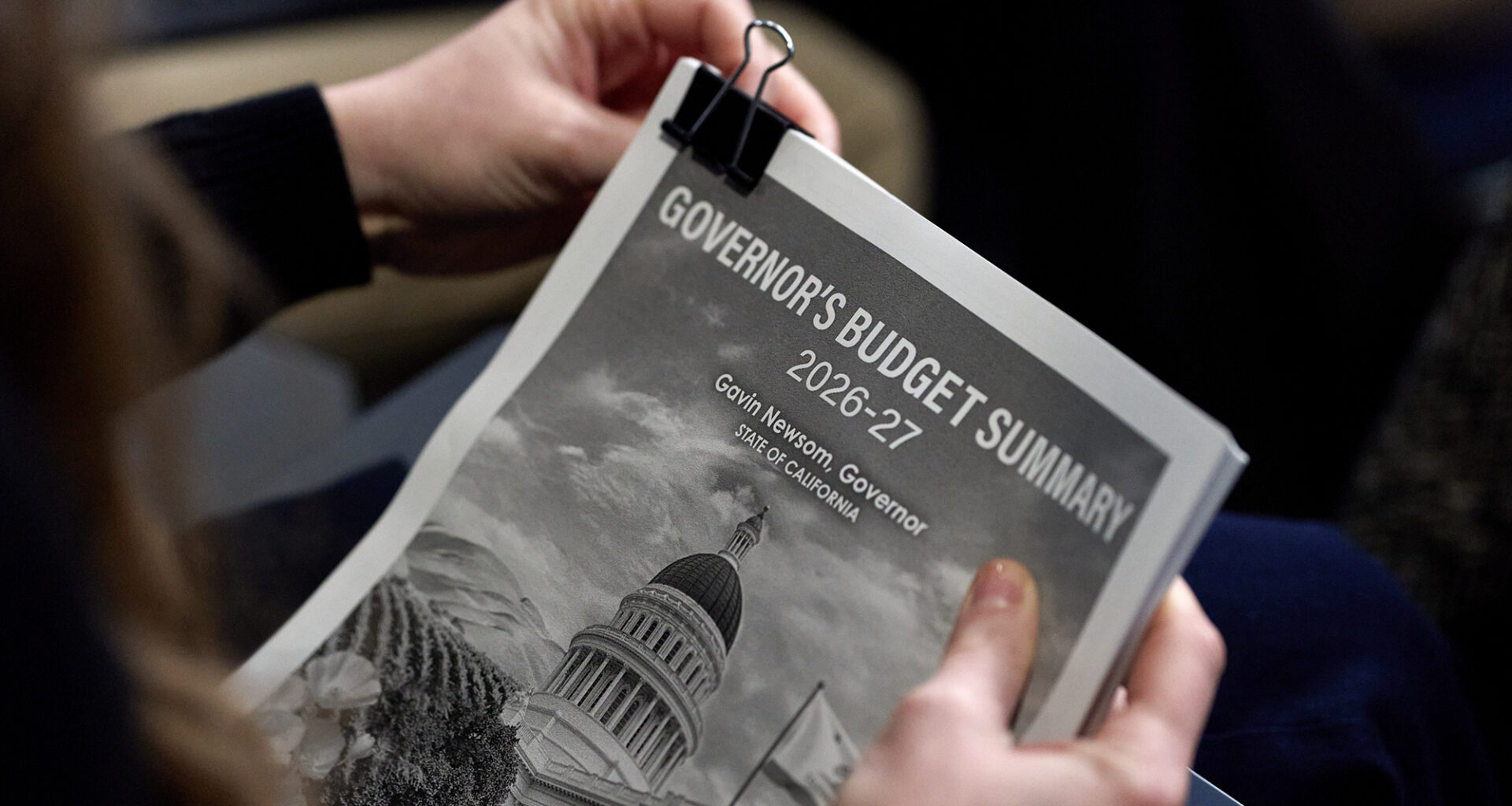
A reporter holds a copy of Gov. Gavin Newsom’s budget summary at the Capitol Annex Swing Space in Sacramento on Jan. 9, 2026. Photo by Fred Greaves for CalMatters
This commentary was originally published by CalMatters. Sign up for their newsletters.
Nine months into the 2025-26 fiscal year, state tax revenues are running several billion dollars ahead of projections in the budget that Gov. Gavin Newsom signed last June.
That’s a bit of good news, because the budget had a hefty gap between projected general fund income and outgo, a continuation of what budget officials call a “structural deficit” that has plagued recent budgets.
Spending has persistently outstripped revenues, with the difference bridged by a variety of on- and off-book loans, accounting gimmicks and raids on emergency reserves totaling $125 billion so far, according to Gabe Petek, the Legislature’s budget analyst.
Newsom’s proposed budget for the 2026-27 fiscal year contains a $21 billion general fund shortfall that he would shrink to $3 billion by employing an array of the same stopgap measures.
Newsom has promised that when the budget is revised in May, it will not only close its latest gap but end the deficit cycle that otherwise would continue indefinitely, according to Petek and Newsom’s budget writers.
The recent uptick in revenues, cited in a report from Petek’s office, slightly improves the income/outgo imbalance but falls way short of closing it, unless it becomes a major windfall, as Jason Sisney, a budget advisor to legislative leaders, believes it could.
“No one counsels humility about revenue projections more than me, but I think the odds are that general fund revenues for the budget window will be somewhere between $15 billion and $40 billion above the governor’s January 9 projections,” Sisney says in a recent email.
The sharp differences over revenues hinge on expectations of whether the stock market continues its mostly positive recent performance, buoyed by artificial intelligence companies, or if it falters. California’s budget is inordinately dependent on taxes on wealthy taxpayers’ investment profits and therefore is highly sensitive to stock market gyrations.
With the April 15 deadline for income tax returns nearing, everyone associated with the budget awaits new revenue data. Meanwhile, the administration and legislators are besieged with pleas from those with stakes in the budget, seeking more money than Newsom’s proposed budget offers.
On Wednesday, mayors of the state’s largest cities warned that Newsom’s budget — which would slash the traditional $1 billion allocation for programs to battle homelessness to $500 million — would “reverse the progress cities have made in reducing unsheltered homelessness.”
The mayors don’t just want a return to $1 billion; they seek a multi-year commitment with annual adjustments for inflation, the latest chapter in a long-running dispute. Newsom has chided cities for not spending money effectively to reduce the number of homeless people on the streets, while mayors complain that without multi-year aid, they cannot make long-term programmatic commitments.
Meanwhile county officials, citing $6 billion to $9.5 billion in reduced federal aid in President Donald Trump’s “one big beautiful bill,” this week asked Newsom and legislators for $6.4 billion over two years to offset the losses, “in order to prevent our safety net from crumbling.”
Filling the financial holes from Trump’s reductions in federal aid is also a high priority for groups representing California’s poor families, with the state’s Medi-Cal program a major concern. They have not only sought backfill from a state budget already leaking red ink but proposed tax increases for ongoing financing, including a tax on the wealth of California’s billionaires that may be on the November ballot.
What we have, therefore, is a budget with chronic, multibillion-dollar deficits that’s under additional pressure due to federal aid reductions, and it must be finalized in less than three months by a governor now in the last year of his reign who is contemplating a campaign for the White House.
It should be interesting.
This article was originally published on CalMatters and was republished under the Creative Commons Attribution-NonCommercial-NoDerivatives license.