
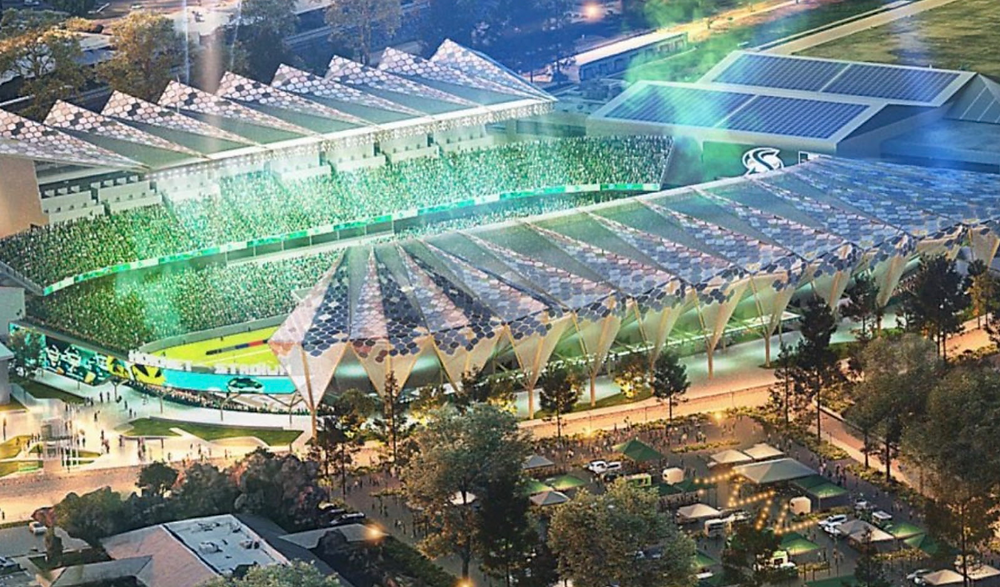

Courtesy of SAC State Athletics
In August, Sacramento State University unveiled a potential partnership aimed at converting the former horse racing grandstand at Cal Expo into a football stadium. This move has sparked considerable discussion regarding the future of the university’s football program and its facilities.
A preliminary feasibility study has estimated that renovating the existing structure at Cal Expo would entail a cost of around $171 million, which is significantly less than the forecasted $250 million to $300 million needed for constructing an entirely new stadium on the Sacramento State campus.

Courtesy of SAC State Athletics
“Sac State is not only a neighboring state agency, located just over two miles away, but we are also thrilled to partner on a project that will serve the larger Sacramento community by introducing Hornet football to Cal Expo,” stated Tom Martinez, CEO of California Exposition & State Fair.
Courtesy of Cal Expo (Michelob Ultra Grandstand)
The initiative aims to convert around 9.25 acres of the grandstand and racetrack area into a contemporary football venue, initially accommodating 25,000 fans, with the potential to expand to 40,000 in the future.

Illustration by Steven Kee, Stadium Journey
Cost Considerations: Renovation vs. New Construction
Building a brand new stadium at Sacramento State presents substantial financial demands. Proponents of this option argue that while the initial costs are higher, the long-term benefits could justify the investment.
Studies indicate that an on-campus stadium could generate an estimated $458.1 million in economic impact. This figure starkly contrasts with the $261.4 million projected for the Cal Expo option, raising important questions about the overall viability of each proposal.
The stark differences between the two scenarios—both in financial considerations and expected economic returns—could play a pivotal role in shaping the university’s final decision.
Economic Impact: A Major Factor
The economic implications of each option extend beyond the immediate budgetary concerns. An on-campus stadium could potentially create more jobs, increase student enrollment, and enhance the university’s visibility and attractiveness to sponsors and advertisers. The projected $458.1 million economic impact of the new stadium includes revenues from game-day spending, increased attendance, and possibly hosting other events.
Meanwhile, the $261.4 million impact expected from the Cal Expo renovation is considerable but pales in comparison to the potential of the campus option. This disparity in economic impact not only influences the university’s financial decision-making but also affects community stakeholders, local businesses, and the overall growth prospects of Sacramento State.

Photo by Lloyd Brown, Stadium Journey
Current Status and Future Plans
As it stands, Sacramento State is gearing up to play the 2026 season at Hornet Stadium, which will serve as the temporary home field while discussions around the long-term future of the football program’s facilities continue. This interim period provides the university with an opportunity to evaluate its options fully, gather more data regarding community preferences, and assess the financial viability of each proposal.