
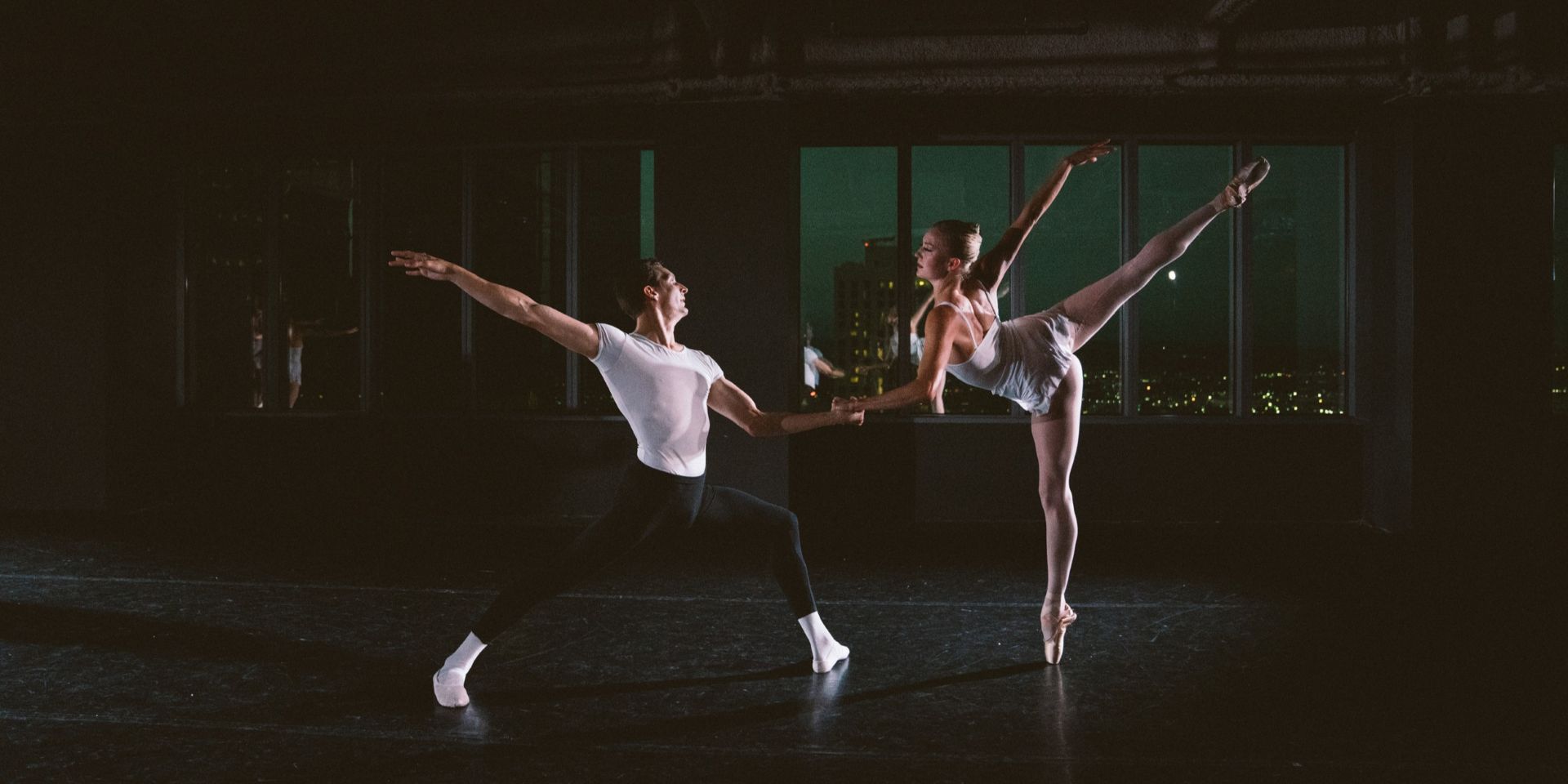
On the evening of Friday, March 20, 2026, I was able to attend a performance of American Contemporary Ballet’s “Balanchine: Twin Masterpieces.” The evening, taking place at ACB’s studios in the Bank of America building, featured George Balanchine’s “Concerto Barocco” and “La Source.” As the program noted, both of these works featured similar elements: eight corps dancers, one soloist, and a principal couple. They were both plotless, as Balanchine often chose to do, and sought instead to bring their musical scores to life through dancing. I loved the concept of pairing these works to show how even stripped of a plot, different choices in costuming, movements, dynamics, and arrangements of dancers gave these works completely different feelings. Both works were strongly performed by American Contemporary Ballet – formations were well-executed in the more intimate space, and lines were crisp and clean. Seeing ACB for a second time, I felt like these particular works were a great match for their technical precision.
Before the dance presentation in each act, chamber musicians Michael Freed on violin and Yu-Ting Hsu on viola performed a duet. The first one, “Passacaglia” composed by Johan Halvorsen, was a particularly great prelude for “Concerto Barocco,” as the leads of that dance are known as “First Violin” and “Second Violin” because they often follow the melody of those particular instruments. Freed and Hsu had moments of connection and playful interaction that foreshadowed the light competitiveness between the two main female dancers in “Concerto Barocco.”

ACB in George Balanchine’s “Concerto Barocco” – Photo by Anastasia Petukhova.
“Concerto Barocco,” to music by Johann Sebastian Bach, is performed elegantly in simple white leotards and skirts, like the uniform of a ballet student. It feels like Balanchine’s response to the accusation that tendus are boring. The movement vocabulary, particularly of the corps, consists of simpler steps and lower legs, arranged and layered with complexity that never leaves you bored. The simplicity of the steps puts a spotlight on the technique, and the dancers of ACB rose to that challenge well with sharp precise lines and footwork. If I were to give an area to work on, it would be checking some arm pathways for even more exactitude.
Barocco shows off Balanchine’s genius in arranging choreography – truly bringing the music to life with the layering. The corps might have two groups doing different timing while the two female leads, danced by Madeline Houk and Annette Cherkasov as the principal and soloist respectively, each had their own phrasing. At one point, the corps does a simple pattern of sharply opening and closing one arm and leg on certain beats, but in two distinct groups. At times, the two groups seem to evenly alternate, then they might sync up and move together for one gesture. At other moments, their timing is separated by just a hair of a beat, and the dancers have to be so specific with their timing and speed to stay distinct. Another recurring motif in this work are weaving walking patterns. In the middle adagio section, the corps link arms with each other and the principal couple, Houk and Maté Szentes, and walk around them in orbiting circles with their shoulders angled in a beautiful epaulement shape. On a specific beat in the music, they all change direction and speed up their pace for a weaving and unweaving effect. These moments of beautiful simplicity offer contrast to the busier moments.

ACB – “Balanchine Twin Masterpieces” – Photo by Norman Jean Roy.
Continuing from the playful banter between the two lead string players in their first duet, I would love to have seen Houk and Cherkasov find more moments of connection and intention to bring the music even more to life. Like the corps, they were technical and precise, but in these lead roles, I wanted them to find individuality or vivacity. The strong corps was made up of Hannah Barr, Tatiana Burns, Victoria Manning Long, Vanessa Meikle, Ellie Renner, Quincey Smith, Kristin Steckmann, and Sofie Treibitz.
After a brief intermission and another musical interlude, “La Source” contrasted to the crystalline precision of Barocco with more of a lilting softness, featuring more waltzes, flourishing spins, and gently tossed legs. “La Source” was danced to music by Léo Delibes. Being as close as we were to the dancers, you could hear them breathe together, emphasizing a more natural swing to the movements. In the unique venue with no wings, I also loved how the dancers would run on from beyond the stage or even through the center aisle for a magical effect.
The female dancers wore soft purple leotards with short romantic tutus that hit above the knees. The female leads were subtly marked with individual bow details and a headband for the principal woman. Balanchine’s choreography already puts the corps and soloists on a more even playing field compared to many classical ballets, and these subtle touches allowed the soloists to blend in and out of the corps at different times. Near the end of the piece, there was a moment when, in contrast to typical ballets, the corps’ movements were big and full, while the soloist, danced by Sarah Bukowski, executed smaller footwork on pointe in front.

ACB dancers – Photo courtesy of the company.
In this ballet, we were able to see more of Maté Szentes’ dancing, both as a partner to the female principal, danced by Cecelia Johnson, and in his solo variation, which was performed well. Their pas de deux featured unique assisted promenades, often where Johnson would rotate the opposite way that Szentes would walk. Johnson showed great strength and control, and I would love to see her find moments of release or risk – coloring outside the lines more at times, so to speak.
The corps of “La Source” was made up of Hannah Barr, Tatiana Burns, Ruthie Dalby, Victoria Manning Long, Vanessa Meikle, Quincey Smith, Kristin Steckmann, and Sofie Treibitz.
Overall, this evening of dance was a strong offering by American Contemporary Ballet. I enjoyed seeing these two pieces paired together – similar in number of dancers, but different in their overall feel; truly twin masterpieces from the same brilliant choreographic mind.
American Contemporary Ballet continues their performances of Balanchine: Twin Masterpieces through March 27, 2026. For more information and to purchase tickets, please visit their website.
Written by Rachel Turner for LA Dance Chronicle.
Featured image: ACB – Madeline Houk and Mat Szentes in George Balanchine’s “Concerto Barocco” – Photo by Anastasia Petukhova.
Please follow us on Facebook, Instagram, BlueSky, and LinkedIn.