
Despite growing calls for San Jose to divest public funds from certain companies, the City Council has decided to hold off — for now — on making any major changes to the city’s investment portfolio.
The decision Tuesday came as a setback to supporters of a proposal that would have seen the city gradually phase out its bond holdings in three tech giants — Microsoft, Amazon and Alphabet — that are said to conduct business, if only indirectly, with U.S. Immigration and Customs Enforcement (ICE). The measure, introduced by Councilmembers Peter Ortiz and Rosemary Kamei, would have prohibited new investments in these companies while allowing the city’s current bond holdings, valued at roughly $54 million, to mature.
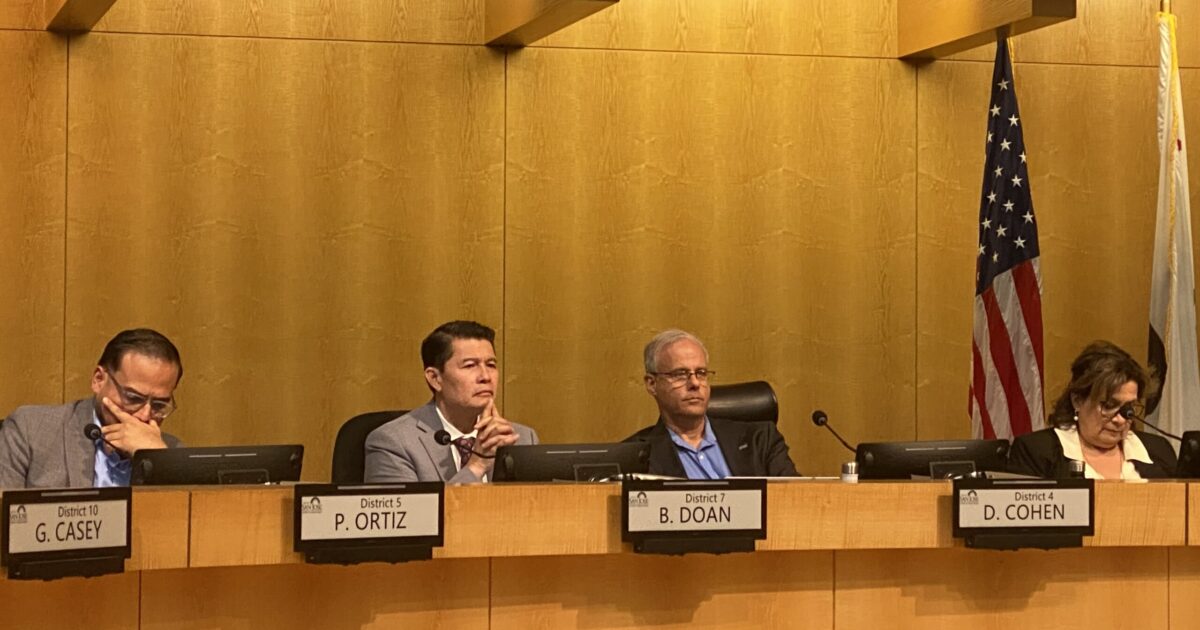
The proposal, which came as part of an annual review of the city’s investment policy, failed in a split 4-4 vote. Councilmembers Kamei, Ortiz, Domingo Candelas and Pamela Campos voted in support. Councilmembers David Cohen, Anthony Tordillos, Michael Mulcahy and George Casey voted against it. Councilmember Bien Doan and Vice Mayor Pam Foley recused themselves due to financial conflicts of interest. Mayor Matt Mahan was absent.
Instead, the council asked staff to study how other cities have modified their investment policies in response to ICE.
The decision came after two hours of at times heated deliberations that divided councilmembers, as well as residents who attended the meeting.
Backers of the plan point to the fear federal immigration enforcement has instilled in San Jose’s immigrant community and argue the city should avoid investing in any company that provides material support to ICE.
“Today’s vote is about holding companies accountable,” Ortiz said at the meeting. “While we understand that companies can choose who they do business with, when those choices involve profiting from terrorizing our residents, there should be consequences.”
Opponents contend such a measure would prove costly for San Jose, while doing little to influence either the targeted companies or federal immigration authorities.
Supporters of adopting an “ethical investment policy” note in recent years several Bay Area jurisdictions, including Santa Clara County, have taken steps to limit public investments in companies tied to environmental harms and human rights abuses. In 2021, San Jose eliminated fossil fuel companies from its investment portfolio.
San Jose’s $2.5 billion investments are spread throughout a variety of city accounts, such as the city’s retirement funds as well as a number of funds used for housing efforts, according to a recent financial report. Corporate investments make up 22% of the portfolio.
In the 2024-25 fiscal year, the city’s general fund received $15.5 million in interest earnings, according to finance officials.
In making the case to end investments in Microsoft, Amazon and Alphabet, Ortiz and Kamei cited a Forbes report documenting recent ICE purchases of the companies’ services. In some cases, the purchases were made indirectly through third-party sellers, the report stated.
Amazon and Alphabet representatives did not respond to a request for comment. A representative for Microsoft declined to comment.
San Jose Finance Director Maria Oberg told councilmembers it’s difficult to independently verify such business connections. She also warned laying too many restrictions on the city’s corporate bond program would ultimately make managing the fund untenable.
“Large companies tend to end up in trouble for one thing or another,” Oberg said. “If it’s not labor issues, it’s that they sell tools to an investor or someone who buys the tool and uses it for a purpose that was not intended by the company.”
A Finance Department review of various potential divestment policies concluded that cutting financial ties with even a handful of companies would “materially impact the city’s investment earnings” because doing so would lead to a less diversified, lower yield investment portfolio. Such losses could place the city, which is facing a $56 million deficit, under even greater financial strain.
Cohen, who represents North San Jose, questioned whether the proposed investment policy would actually provide an effective check on ICE enforcement. He noted San Jose conducts extensive dealings with all three companies outside of its direct financial investments. For example, over the past year San Jose spent $1.2 million on products from Amazon, finance officials said.
“I think we are in agreement that it’s reprehensible behavior, and that we should take every action as a city to protect from the abuses of ICE,” Cohen said. “It’s not clear to me that this is the vehicle to do that.”
Tuesday’s deliberations came partially in response to a two-year campaign waged by a coalition of residents. Their divestment demands are more expansive and include calls for the city to cut ties with companies that do business with Israel’s military as well as businesses involved in “mass incarceration and detention.”
“There are ethical alternatives. You just have to look beyond the surface,” District 6 resident Dina, who did not provide her last name, said during public comment. “We all must be aware of the detrimental long-term impact of our city’s investment in these types of profiteers. Do we really want our future generations to know that San Jose has profited from this terror on our local and international community?”
Contact Keith Menconi at [email protected] or @KeithMenconi on X.