
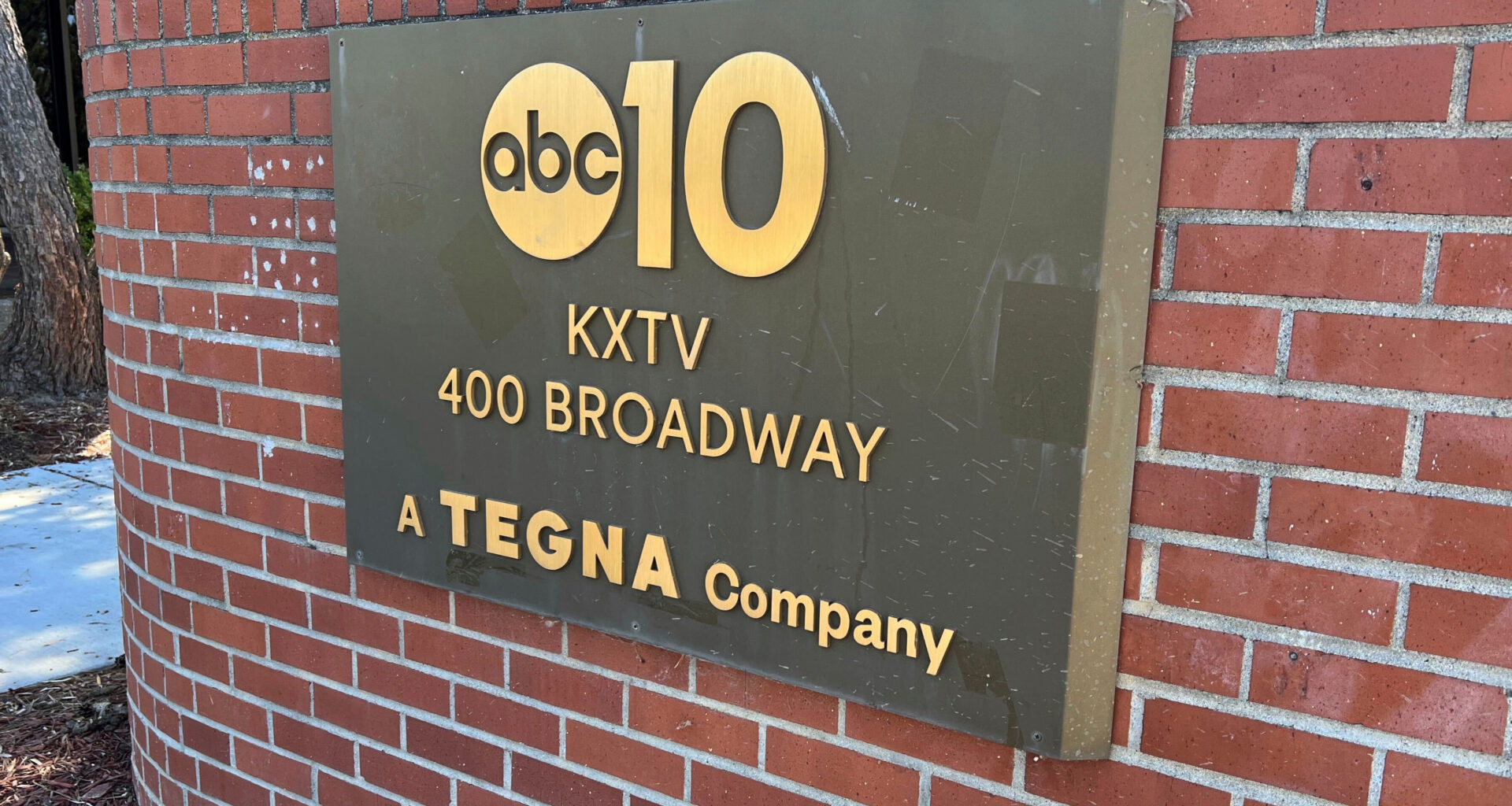
A major media shakeup is set to impact television news across the country.
Last week the media broadcasting company Nexstar announced it received approval from the Department of Justice and Federal Communications Commission to merge with its rival TEGNA.
The $6 billion deal that would give the new joint company control of more than 250 stations nationwide.
As part of its approval, the FCC agreed to waive rules preventing one company from reaching more than 39% of U.S. households. The new joint company is expected to reach up to 80% of homes, including many in the Sacramento media market where Nexstar owns FOX40 and TEGNA owns ABC10.
But the deal has proven controversial, and is facing pushback. Governor Gavin Newsom called the deal an outrage and a “consolidation of right-wing media.” He specifically singled out FCC Chairman Brendan Carr for supporting Nexstar’s decision to temporarily cancel comedian Jimmy Kimmel’s show last year.
Sacramento Congresswoman Doris Matsui criticized the federal approval, saying “it throws out limits designed to protect local journalism and viewpoint diversity.” Meanwhile, Attorney General Rob Bonta and multiple other states filed a joint lawsuit seeking to block the merger, one day before the acquisition was announced.
Bonta said the deal is expected to raise prices, harm local news and consumers, and reduce competition, and specifically mentioned the Sacramento-Stockton-Modesto metro area being impacted by the new combined company.
Frank Gevurtz is a Distinguished Professor of Law at University of the Pacific’s McGeorge School of Law. He spoke with CapRadio’s Chris Nichols on Insight about the merger.
This interview has been edited for length and clarity.
Interview highlights
The laws at the heart of some of these concerns are federal antitrust laws. What exactly do these do?
Federal antitrust law starts in 1890 with the Sherman Act, which was designed to break up the big monopolies, the trusts, and so on. And in 1914 Congress passed the Clayton Act, which specifically speaks to mergers. It allows the federal government to essentially block any merger which substantially reduces competition.
In this case the merger needed the approval of the FCC. How does that agency’s review compare to the regular antitrust process?
The FCC proceeds under a different statute and its authority is different than the Justice Department in dealing with antitrust law. The antitrust law looks at mergers which reduce competition; essentially the goal there is to keep prices low for consumers by stopping mergers, say between competitors, that would allow competitors to raise their prices. Notice that’s what the California Attorney General focuses on when he talked about the merger, because they’ll bring in action focused on the antitrust law.
By contrast the Federal Communications Commission review under the Federal Communications Act deals with the authority of a broadcaster to pass a federally granted license to some other broadcaster. That’s what’s going to happen in the merger. They have a very different standard of review in terms of approving that transfer. It’s what’s referred to as a “public interest standard.” It’s going to ask whether that transfer will serve or harm the public interest. Much broader than the federal antitrust law’s focus.
Attorney General Rob Bonta called this merger, “illegal, plain and simple, running contrary to federal antitrust laws that protect consumers.” What exactly would cause a merger to be illegal?
This is a merger between companies that compete. They operate stations like FOX40 and ABC10 in Sacramento which are local broadcasters that are competing. When there’s a merger between competitors, there’s less competition and thus prices can rise. But that’s not always or even often the case.
Let’s assume, for example, that two lawyers doing personal injury practice in Sacramento were to agree to form a partnership, essentially a merger. They would no longer be competing with each other, but there’s so many other attorneys doing personal injury practice in Sacramento, that they couldn’t really raise prices because suddenly two out of the hundreds, or maybe more, attorneys in this field are no longer competing.
On the other hand, if you had two companies [that] are the only producers of a certain board game merge and suddenly they’re the only producer, well obviously they could raise prices much higher than they were when the two were competing. So you’re trying to figure out whether this merger between these two companies that are operating local TV stations have the effect of enabling them to raise prices because they’re no longer competing, or whether it’s a situation in which there’s so many other choices that they can’t raise prices.
People might also be concerned about freedom of speech issues, and whether this new merged company might block access to different voices or news programming. Is that something that antitrust laws consider or look at?
You’ve asked a very controversial question. I think the underlying concern is a lot less about how many customers, and that’s probably advertisers, are going to have to pay to put a 30-second spot on a local TV show, as opposed to the concern that there’s going to be a cut off of various voices that can no longer reach the public. And in [the] worst case scenario you end up with something like Russia where very few independent voices can reach the public, because the media outlets are all owned essentially by friends of the government.
But the question is: is that something that the antitrust law can address? And the answer is, that’s disputed. The conventional view is that the sole goal of antitrust law is what’s [referred] to as consumer welfare; simply put, low prices. And if all we’re concerned with is mergers that reduce competition and thus raise prices to consumers, then free speech concerns are not on the table.
By contrast, that’s under a general public interest approach which is under the federal communications law, then that is on the table. That’s why you had the limit on the cap that was violated here on ownership of so many stations. There are folks out there who view antitrust goals more broadly to say that we should, under the antitrust law, look at other impacts as firms grow larger, more powerful — including their political impact. But right now that’s a view that is probably not predominant among judges within an antitrust.
Could courts order some changes to be made to protect competition in a place like Sacramento, while still letting Nexstar and TEGNA merge on the national level?
That’s a common response to mergers in which in local markets there’s going to be a reduction in competition that matters, and would make the merger illegal. In that situation it is extremely common to say, “we’ll let you conduct this merger if you sell off the operations you have to some independent owner in these few markets in which you are really dominant.”
Let’s assume that it was an unusual case in the merger in which the two companies who proposed to merge have operations in the same broadcast market [and that] Sacramento was one of those exceptions. There could be a proposal by the Justice Department or the parties involved to say, “why don’t you sell off to somebody else,” say FOX40… so we’ll still have the competition between independently-owned FOX40 and the now-owned-by-the-merging-parties ABC News in Sacramento. You eliminated the place where the problem exists.
But that of course would assume, which I don’t think is the case here, that this is an unusual situation where you’re going to have that kind of problem.
We talked about California and the states that have sued to try to block this merger. If they lose in court is that the end of the line? Or could the company be broken up again in the future if there are concerns raised that it’s monopolizing control?
It would depend in the first instance why the states would lose, if there’s a problem with their standing to bring the case at all. You have to have suffered antitrust injury. And in mergers that’s often a problem because the party who brings the suit might be another competitor. And if the merger was really going to raise prices, you would say, “this competitor would not be suing to stop the merger… so we don’t think they’re actually going to be hurt.” If that was the problem, then that would not foreclose somebody else who had an antitrust injury for bringing the suit.
On the other hand if we get to the merits, and a court were to find [and be upheld on appeal] that there really is no violation of the antitrust law from the merger, that would be it as far as unwinding the merger. That said there are examples, the Facebook/Instagram merger and so on, where the later conduct of merged companies might create its own violation of the antitrust law. That would lead a court to consider breaking up a prior merger.
Generally speaking, do courts like breaking up companies? Is it common?
No, they really do not like to break up companies. By and large, courts really don’t want to do that because you’re never quite sure [about] the consequences of breaking up companies.