
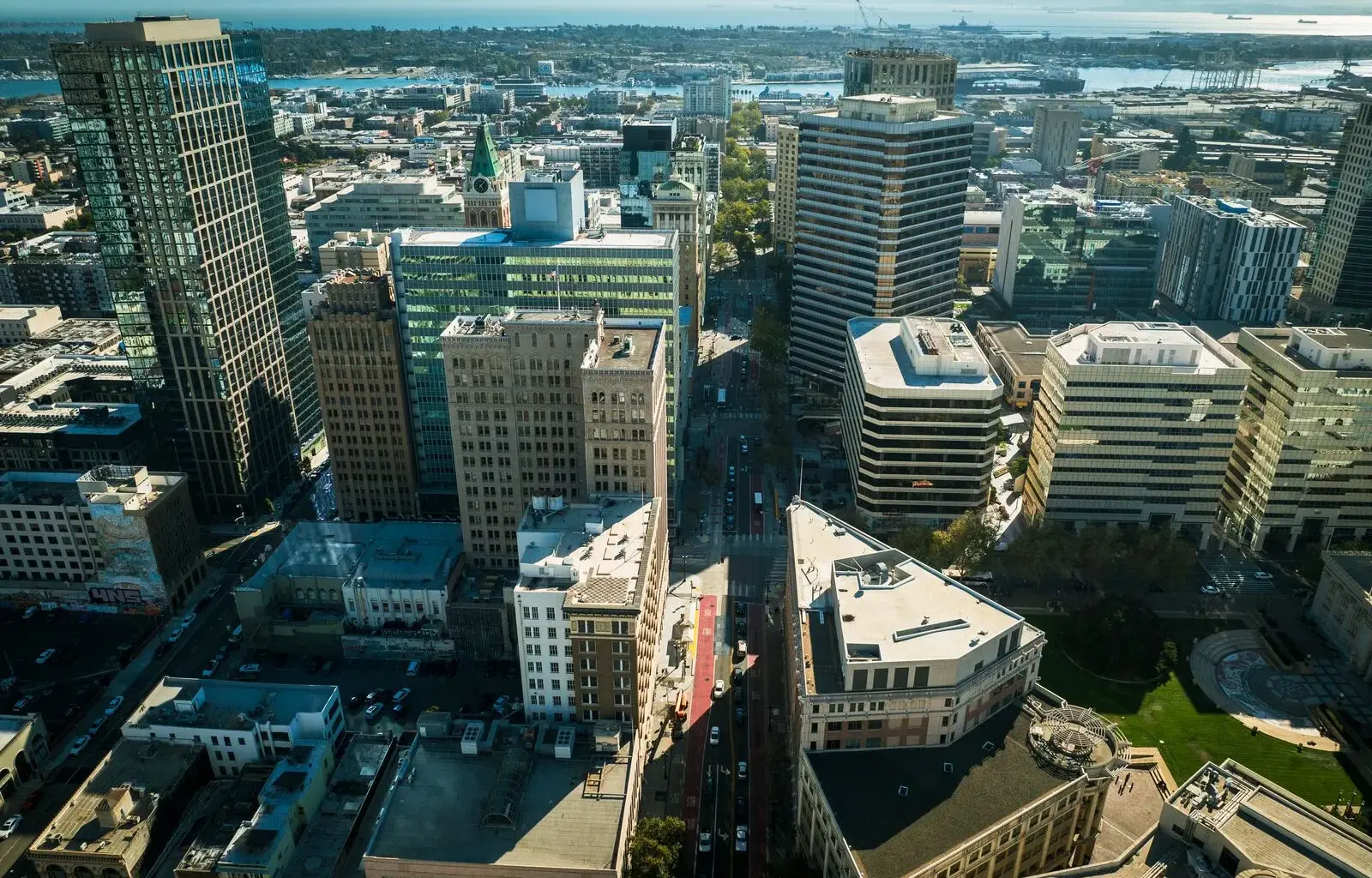
Oakland spent much of the last few years recovering from the devastating economic impacts of the COVID-19 pandemic. Now, the city’s economy is starting to adjust to the new reality created in the wake of the disease.
A new report issued by the Oakland Chamber of Commerce identifies lots of positive signs for the city’s economy in 2025, including robust investments in the healthcare sector and a growing reputation as a destination for food and culture.
“Oakland is securing its next chapter around essential and resilient sectors of our local economy, while also investing in industries poised for growth,” Barbara Leslie, the chamber’s president and CEO, said in a press release.
The chamber releases a report on Oakalnd’s economy every year.
Based on the report, Oakland’s next chapter looks like a mixed bag.
Employment has recovered from its recent nadir during the pandemic. But for the past two years, the number of Oakland jobs has plateaued, hovering around 227,000.
Much of the city’s employment growth is being driven by healthcare, which remains one of the biggest sectors in Oakland. The report cites some recent positive developments, including the opening of Samuel Merritt University’s new $240 million campus in downtown Oakland and a planned $400 million cancer center by Stanford Medicine and Sutter Health. The report also notes that the Young People’s Wellness Center in East Oakland is expected to open later this year, and planning has started around a proposed behavioral health recovery center in Temescal.
On the flip side, the report says that Oakland employment continued to decline in a bunch of other industries, including professional services, retail, education, construction, and finance.
Oakland’s real estate market is not doing hot
In the last quarter of 2025, the city’s vacancy rate for office space was 17.6%. By comparison, the vacancy rate was around 7-9% between 2015 and 2019. Most of Oakland’s offices are concentrated downtown, which the report notes has economic implications for that part of the city.
Home values declined by roughly 21% in Oakland between 2022 and 2026. Other cities, such as Berkeley, Alameda, and San Leandro, saw smaller declines. But demand for homes is still strong, and buyers are still paying above listed prices.
The pandemic pummeled Oakland’s hospitality industry, but the chamber reports that this sector is experiencing a “gradual recovery.” The occupancy rate last year was 62.3%. But that’s still roughly 13% below the occupancy rate before 2020.
The port’s container traffic hasn’t changed much
At the end of 2025, trade activity at the Port — considered one of the city’s biggest economic engines — was more or less the same as it was 10 years ago. Oakland’s port is doing better than other Pacific Northwest ports, but less so than rivals in Long Beach and Los Angeles. Still, Oakland’s port has advantages: it exports more goods than it imports, including many highly valued agricultural products.
The chamber also highlighted some concerns with Oakland’s airport. In 2025, OAK had 9.2 million commercial passengers, just 68% of the airport’s prepandemic level. The chamber cites a dip in demand for domestic leisure and business travel, partly driven by the continuation of remote work.
Major airlines have withdrawn or reduced service at OAK, too. But Oakland has also seen a “dramatic increase” in international services, adding several connections to Central American countries. And OAK remains the largest cargo airport in Northern California.
Economic changes aren’t happening evenly across Oakland. According to the report, District 7 in deep East Oakland saw the biggest increase in employment of any council district, with a 10.7% increase between 2022 and 2025. District 3, covering West Oakland, saw the worst, with a 1.5% decline over the same period.
In 2025, District 7 also saw the most new home permits issued, with 58 per 10,000 residents. District 5, which includes Fruitvale, had the lowest number of new permits, with just 5 per 10,000 residents.
The report also noted that Oakland shed lots of retail and food establishments during the pandemic. Since February 2020, Oakland has lost nearly 1,100 retail businesses.
The chamber acknowledged that Oakland’s downtown may not see a full recovery in terms of demand for office space. But improvements in public safety and a continued investment in cultural venues have made downtown a more attractive place for visitors.
BART ridership downtown, according to the chamber, increased over the course of 2025. The report also points to the reopening of the Henry J. Kaiser Center for the Arts and major festivals as indicators of what will define Oakland’s core going forward.
Noting that Oakland has always been a city that “adapts and leads,” Leslie said in a statement that Oakland’s investments in healthcare, education, and culture “are the building blocks of a stronger, more inclusive economy, and Oakland is well-positioned for what comes next.”
“*” indicates required fields