
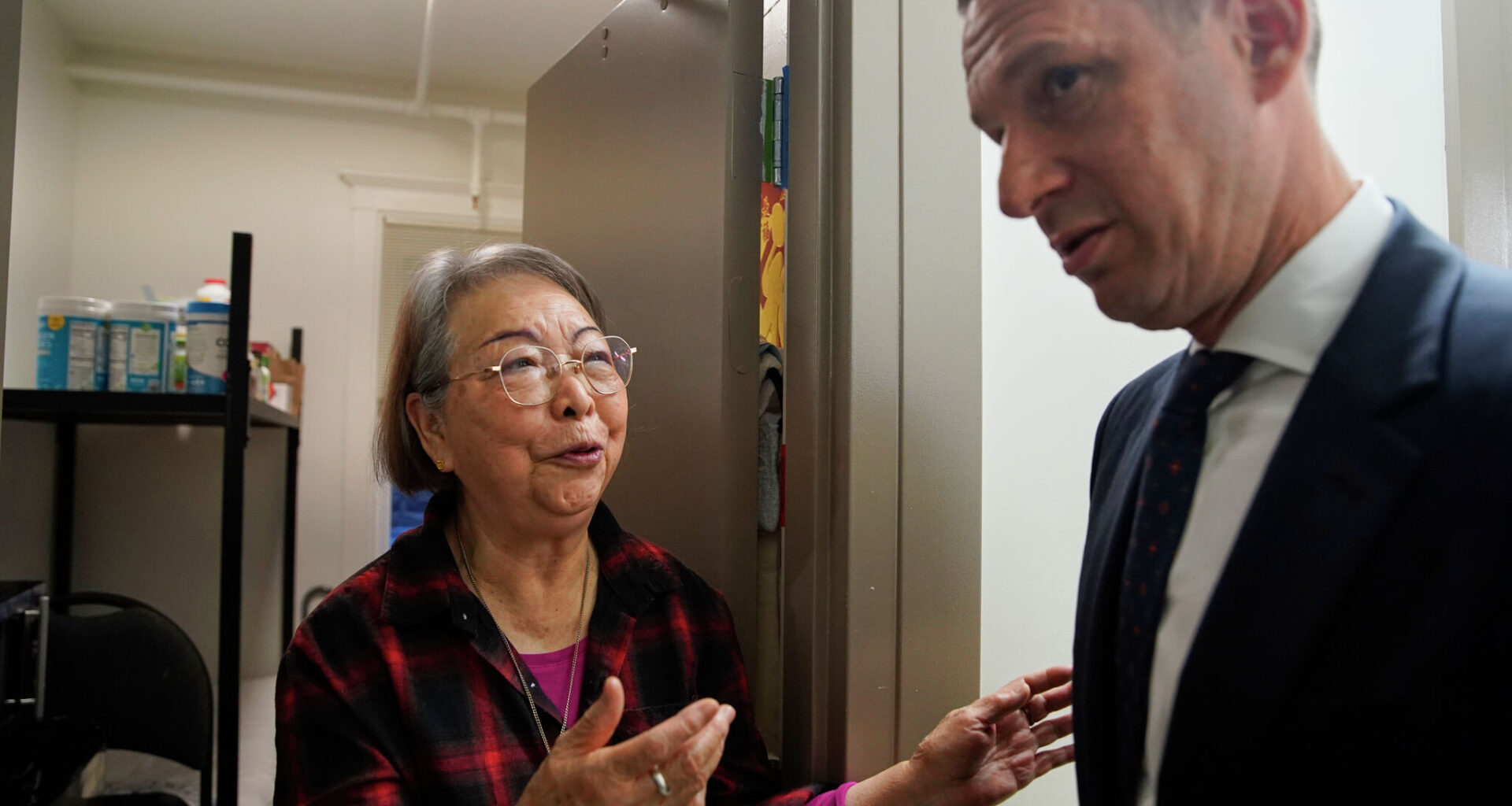
Yufeng Lin, tenant of the Clayton Hotel, speaks to Mayor Daniel Lurie in San Francisco. The refurbishment of the hotel is a reminder of the urgency of rehabbing existing affordable housing.
Giselle Garza Lerma/S.F. Chronicle
On a recent Friday afternoon in San Francisco’s Chinatown, the restored Clayton Hotel offered a rare welcome to city and state legislators touring the building: No ribbon cutting or drawn-out speeches, just residents lingering in narrow hallways buzzing with conversation and laughter.
On an all-women’s floor, an elderly tenant posed for a photo inside her freshly painted room with Mayor Daniel Lurie, proudly showing the city’s top official the unit she had only recently returned to following a 10-month relocation.
Two years ago, the decades-old, 82-unit single-room occupancy hotel at 657 Clay St. teetered on the edge of decline, another aging property at risk of slipping from the reach of low-income tenants. Today, its $9.3 million rehabilitation — financed through a state program notable for its scale — stands as both a quiet victory and a pointed lesson: preserving existing affordable homes may lack the flashiness of new construction, but it is no less urgent.
Article continues below this ad
While the city’s focus is often on the production of new housing, far less attention goes to maintaining what already exists, much of it home to working-class residents and low-income seniors, said Malcolm Yeung, executive director of the Chinatown Community Development Center, or CCDC. Over the past six years, he said, the organization has concentrated on reinvesting in its aging buildings — upgrades that can extend their lifespan by 15 to 20 years while improving efficiencies as costs rise. The priority, he said, is ensuring residents benefit directly with more stable, livable homes.
Mayor Daniel Lurie takes a photo with tenant, Guiying Li, at the Clayton Hotel in San Francisco on March 20.
Giselle Garza Lerma/S.F. Chronicle
The Clayton was the first building acquired by CCDC in the early 1980s. More than four decades later, tenants pay between $250 and $550 a month — rents that make it difficult to keep pace with rising maintenance and operating costs, a strain shared by thousands of similar properties statewide. Its renovation stems from a pandemic-era initiative by the California Department of Housing and Community Development, or HCD, to strengthen aging affordable housing. The agency launched its Portfolio Reinvestment Program in 2022 to provide flexible funding to preserve and stabilize existing buildings, and prevent them from being purchased by private developers and repackaged as market-rate housing.
San Francisco Chronicle Logo
Make us a Preferred Source to get more of our news when you search.
Add Preferred Source
The program has since allocated $427.5 million to roughly 1,880 units across 41 properties across the state, said Lindy Suggs, of HCD. The funding was distributed in two rounds — the second, she said, was “overprescribed within two minutes of the portal opening” as applications flooded in. Money targeted properties presenting the “greatest risk” within HCD’s portfolio, meaning buildings the department financed decades earlier or previously invested in. The program also supported smaller SRO hotels and buildings that had gone through foreclosure, which are less likely to attract private financing.
Article continues below this ad
Even so, the buildings that received the financial assistance represent only a “drop in the bucket,” said HCD Director Gustavo Velasquez. Between 2000 and 2024, California lost 18,000 income-restricted homes as affordability requirements expired, he said, often because nonprofits operating them lacked the resources to finance necessary upgrades once restrictions lapsed.
“It is estimated that in the next 10 years, we may be losing an additional 48,000 affordable homes that are at risk,” Velasquez said. “Every year when these restrictions expire, investors are out there who may offer the financial incentives for these owners to give these buildings away.”
Kung Bi Fung, tenant of the Clayton Hotel, stands with property assistant manager, Bing Shu Zhu, in San Francisco.
Giselle Garza Lerma/S.F. Chronicle
Velasquez said both California’s government and the private affordable housing sector have been “overly focused on new construction” financing — and for good reason. The state has imposed aggressive mandates to create more than 1 million homes for people in the moderate- to low-income range. San Francisco is expected to permit 82,000 new homes by 2031, roughly half of which must be income-restricted.
“We still cannot ignore the fact that we have so many older buildings, especially in urban cores … that are in severe need of repair,” he said.
Article continues below this ad
Even with the state funding, CCDC spent nearly $2 million of its own funds on hard costs and to relocate the Clayton’s tenants during renovation.
“We had to find 82 units in San Francisco that we could move people into for 10 months — you can imagine the cost of that,” said Whitney Jones, CCDC’s deputy chief of community real estate. The state’s funding covered the replacement of the roof and upgrades to community spaces, including kitchens, bathrooms and laundry facilities.
Inside, the rooms — ranging from 60 to 85 square feet — have been outfitted with new bedframes and refrigerators. Tenants of the Clayton have an average annual income of about $17,000, Jones said.
The exterior of the Clayton Hotel, an 82-unit single-room occupancy hotel in San Francisco’s Chinatown.
Giselle Garza Lerma/S.F. Chronicle
Velasquez, of HCD, said the state is taking steps to shift more resources toward housing preservation. Recent actions include the Tax Credit Allocation Committee pushing to expand the use of tax credits and tax-exempt bonds for rehabilitation and maintenance, not just new construction, allowing developers like CCDC to finance upgrades to existing units. At the same time, California faces declining revenues, making future funding uncertain — the state is exploring additional incentives to sustain preservation efforts, though the scale of support will remain tied to the budget cycle, according to Velasquez.
Article continues below this ad
After his tour of the Clayton wrapped up, Mayor Lurie acknowledged that the city’s budget crisis presents a challenge to fund preservation work, which he described as an “important part” of its housing ecosystem.
“We can’t do this alone — we absolutely need support from the state and the federal government,” Lurie said, adding that he supports any initiatives that can help “make this city more affordable and create more housing.”