
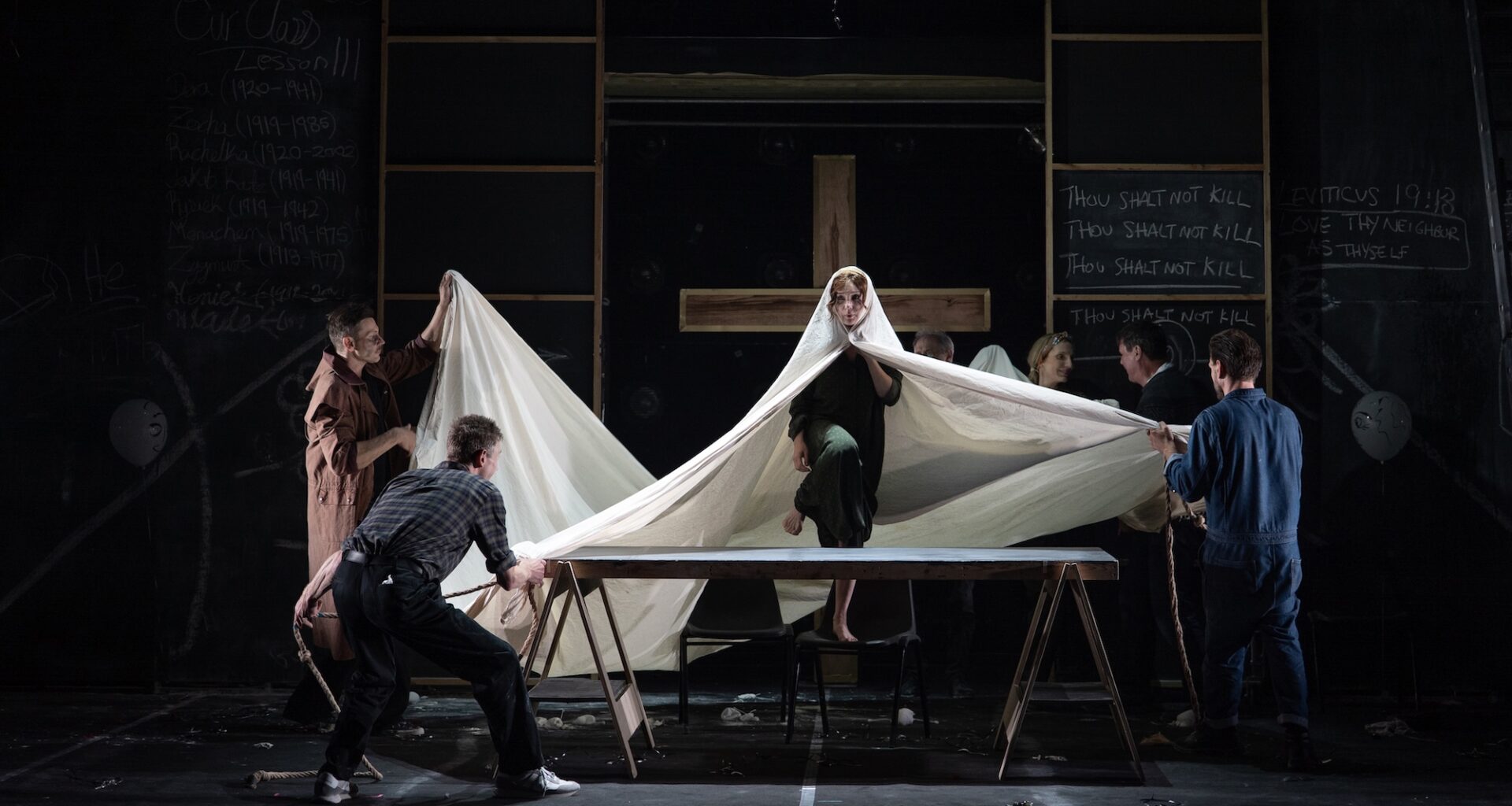
Now in San Francisco, Khamatova takes on her first English-language theatrical role in a timely production of Our Class, which has her thinking about the importance of art amid devastating global events.
This interview was translated from Russian and edited for length and clarity.
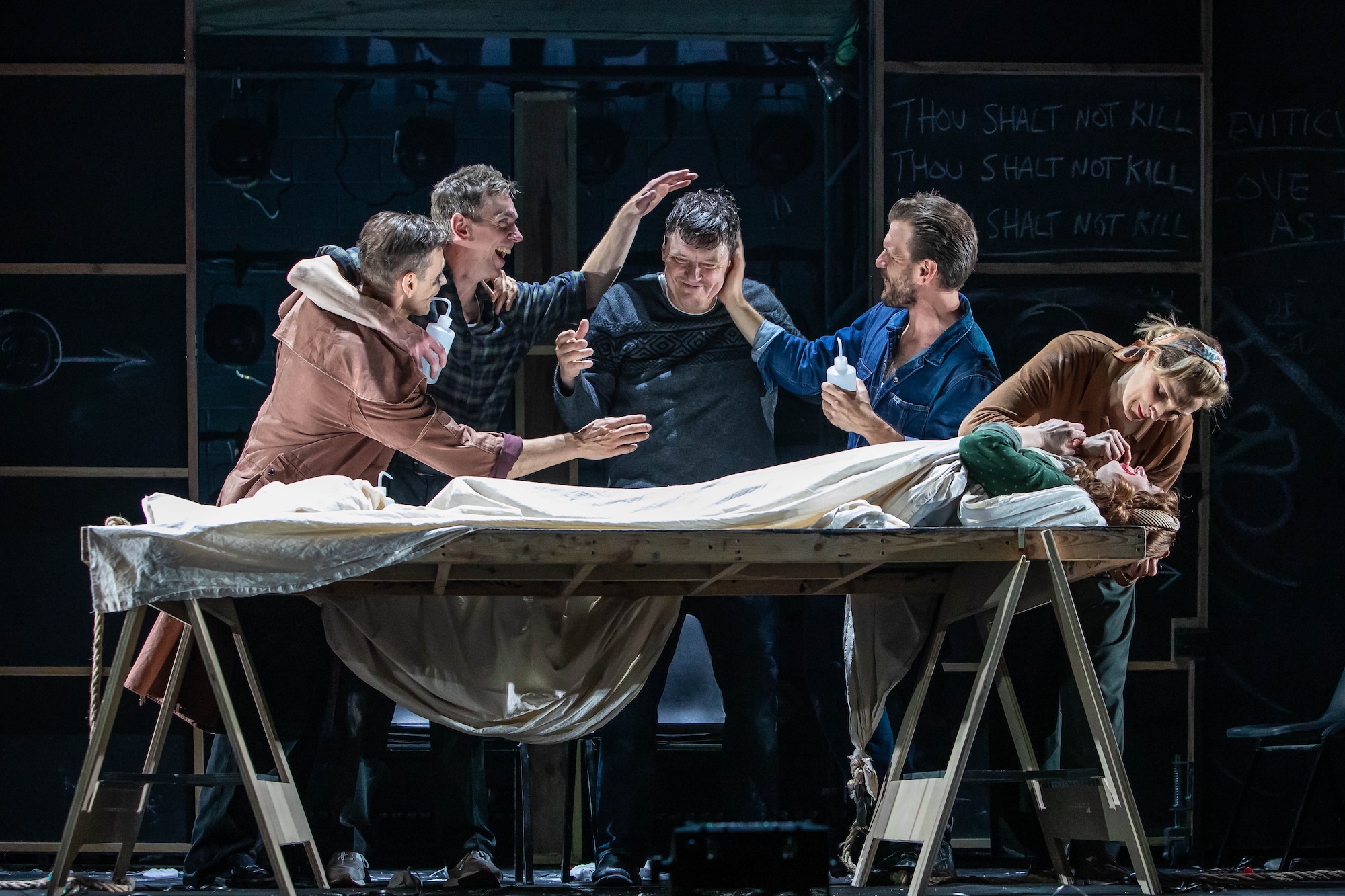 The cast of ’Our Class’ at a performance in Boston. (Olga Maturana)
Nastia Voynovskaya: What drew you to the story in Our Class?
Chulpan Khamatova: I saw the show in New York, and I really liked the theme of how quickly people who are in some kind of community, because of outside forces, lose their humanity. This is a true story that happened in this town, when you have your own neighbors [turn on you]. It seems like it was a long time ago, and it will never happen again. But, now, look. We’ve somehow ended up in this trap again.
Does it remind you of the political climate in Russia?
Not only in Russia. I think there is a danger to any society. How should we behave to prevent it? I have no answers. It seems to me that culture and education — nobody has tried it yet, not a single country has made its main focus on education and culture. So, it is impossible to prove my theory.
Our Class points to how even ordinary people are capable of violence. What does that tell you about human nature?
That we all have darkness and light, and it’s up to each one of us to balance them. It’s complicated, especially when you choose the light and you’re left completely alone for some time.
I really love my character in Our Class, Rachelka. I feel sorry for her. Not only because she is Jewish or lost her family, but also because she has lost her soul. I don’t judge her in any way. I can’t imagine myself going through such trials.
The situation broke her. She did not burn in the shed, but she died on the inside. She died as a person who had hope and faith that good and justice will somehow prevail. She swam with the current and betrayed the people she loved. I appreciate how the play shows that no one is absolutely bad or absolutely good.
It was interesting for me to act in an English-language play. I wanted to immerse myself in a new world, a new mentality, and it turned out to be very close to home, which made me very happy. I was a little afraid that with my Russian training, I may seem too arrogant, too persistent. It turned out not to be the case.
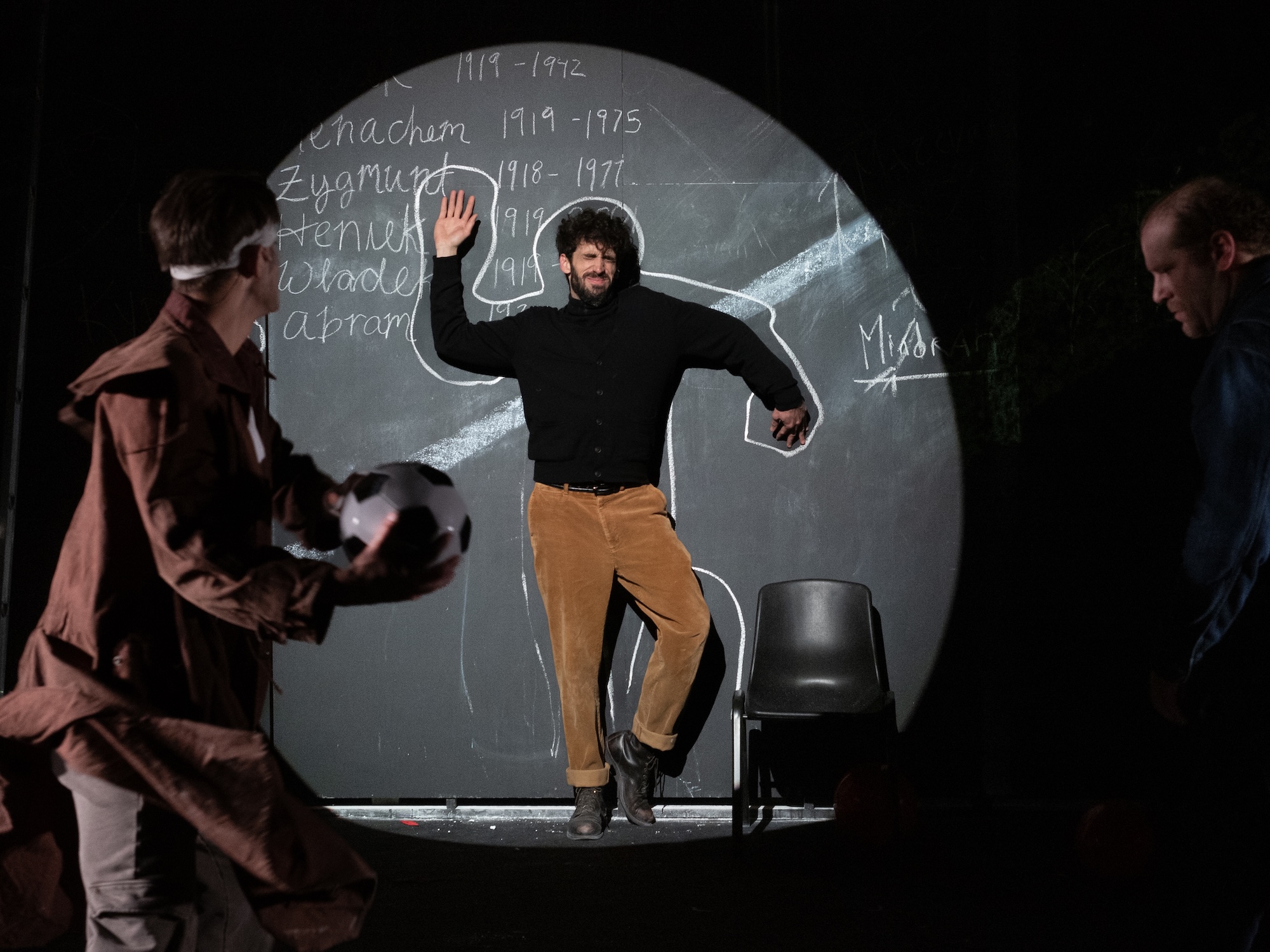 Stephen Ochsner in ‘Our Class.’ (Pavel Antonov)
The theater company presenting Our Class, Arlekin, is made up of people from the former Soviet Union. Director Igor Golyak has roots in Ukraine. What kinds of conversations are you having with the other ensemble members when you’re not on stage?
I share a dressing room with two wonderful American actresses, Deborah Martin and Gigi Watson. We discuss everything — the situation in America, the situation in Russia, the war there and the war here. Unfortunately there are many unhappy topics to discuss — the rising levels of antisemitism.
I do not believe in dividing people by nationalities at all. I look at the individual person. In all nationalities there are amazing people, and also everywhere there are scum. I think this construction was unnecessary when civilization was formed. Of course, I respect and believe in certain cultural traditions, but I don’t think it’s possible to divide people by nationalities. I’m absolutely against it. That’s how the Holocaust started.
You’re Tatar and you grew up in the city of Kazan. Is there anything you bring from your life experience that helps you understand the story of Our Class on a deeper level?
Yes, of course. The dominant ethnicity and language in the Soviet Union was Russian. Up until a certain age, I could not say my name — I was too shy. It was easier for me to introduce myself as Olya, Masha, Anya or some sort of typical Russian name. These experiences shape your personality, and they become like layers of bad skin that you have to shed as you get older.
I very much hope that the audience thinks about how the themes in the play relate to their own lives, not just the lives of some long-gone historical characters. There are just so many nuances and so many different interesting stories, both in our protagonists’ youth and old age.
I hope everyone in the audience imagines themselves facing these kinds of choices — a brave choice or a cowardly choice, to stay with yourself or to lose yourself. To go with the majority or to go against the current.
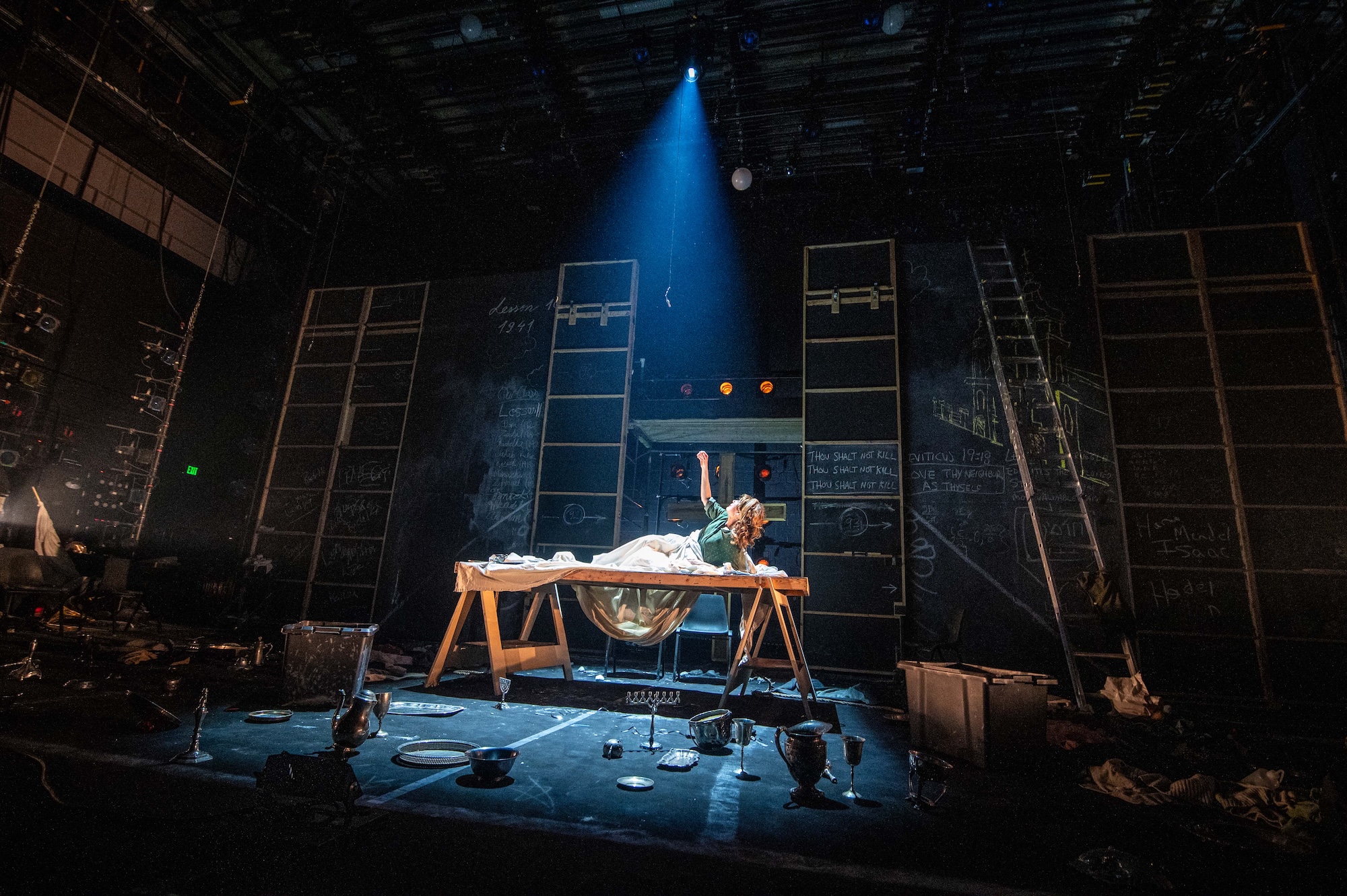 Chulpan Khamatova in ‘Our Class.’ (Irina Danilova)
Tell me about your life in Latvia. How has it been for you having to start your career practically from the beginning?
It was not easy, but we survived. I moved with three children. I had no idea what to do next, how to live and how to feed them. I can’t say that the European world supported me in this decision, because all the laws and all the rules were aimed at making life outside Russia as difficult as possible for people who were against the war and left. I still have no answer why it is so, why it was necessary to turn off our credit cards, why it was necessary to create a situation where I couldn’t access my savings [because of sanctions]. There were a lot of such restrictions.
In my life, I have wealth in the form of friends who helped me survive from the very beginning. I started to work, to learn Latvian, and to play in the theater in Riga. I also try to perform in Russian, because I see how much people need it who are scattered all over the world, who left like me.