
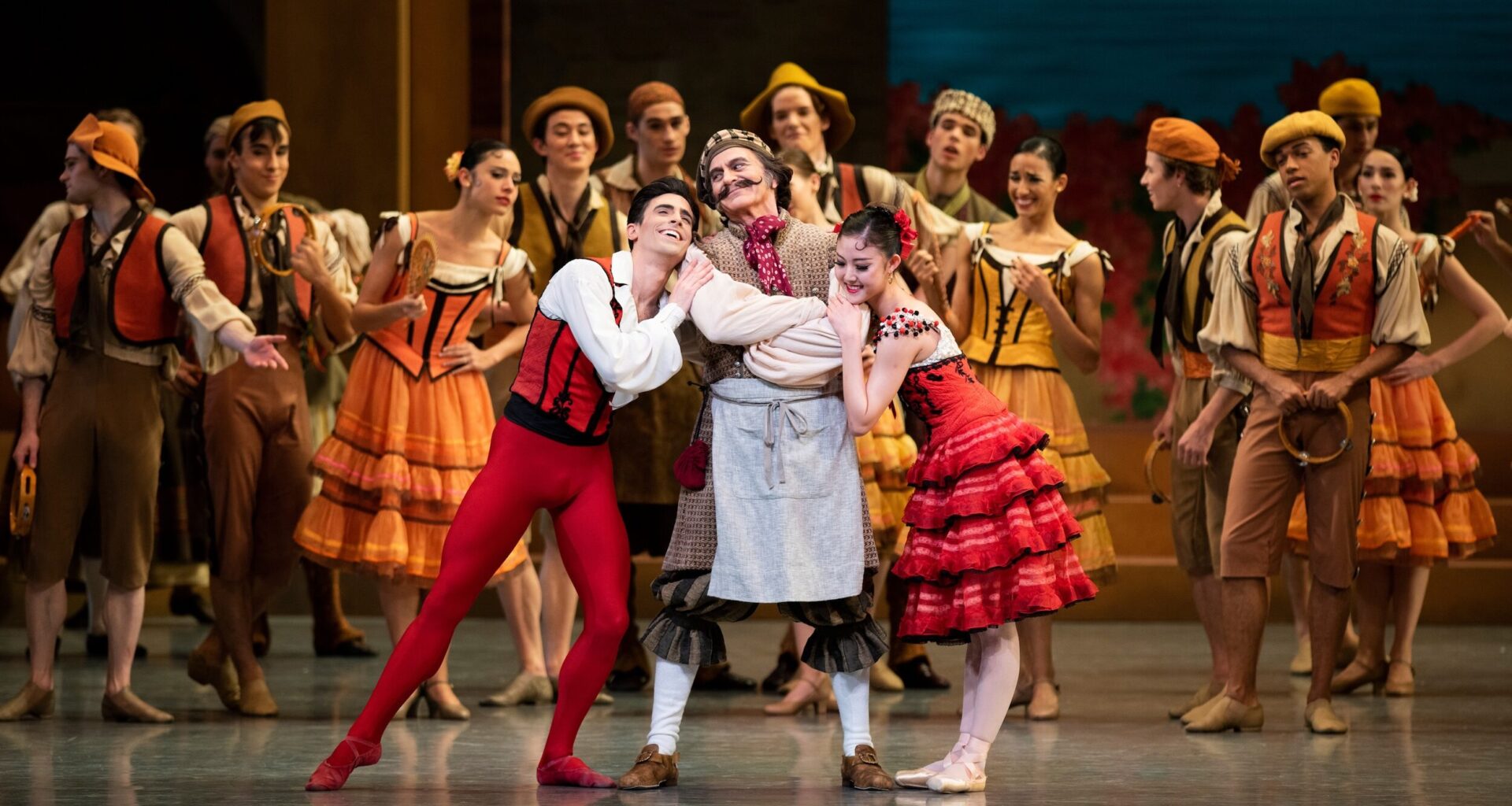
For 53 years, San Francisco Ballet audiences have watched Val Caniparoli disappear into a character, whether the eccentric Drosselmeyer in The Nutcracker, the titular errant knight in Don Quixote, or the menacing Herod in Arthur Pita’s Salome. A dancer with the company since 1973 and a principal character dancer since 1985, he’s also a prolific choreographer. Caniparoli has created more than 20 works for SFB—notably Lambarena in 1995 and Ibsen’s House in 2008—and has been resident choreographer not only there but also at Tulsa Ballet and Ballet West. His more than 150 works for companies around the world include five different productions of The Nutcracker.
Caniparoli will give his final performance with SFB in Don Quixote, on March 28. Even after five decades, he’s not retiring. Instead, he’ll shift his entire focus to choreography.
Why are you leaving SFB now?
I could go on forever, but I’ve got so many other things I need to do. I wasn’t forced out, I just decided it was the right time. I told [SFB artistic director] Tamara [Rojo] it’s not like I’m leaving the world. I’m still in San Francisco.
What was your first impression of SFB?
I didn’t have enough of an idea what ballet was to have a real impression. I started really late—I think I was 20. I was studying music and theater at Washington University, and a ballet company came through and gave us all a class. I had never taken ballet, but the teacher pushed me to think about it. I drove to San Francisco and auditioned for the school. I had no idea what I was doing. Maybe that was a blessing in disguise.
How long were you in the school, then, before joining the company?
Oh, a year, maybe less. It was really quick. Because I had a theater background, I got all the character roles right away. So I’m doing the same roles now that I did when I was in my 20s.
Looking back, are there moments as a dancer that stand out to you?
Absolutely. Being chosen for major dancing roles. A lot of choreographers or stagers pick from class, and I was not a classroom dancer. But Jerome Robbins gave me a leading role in Moves, and I was picked for a major role in Sunset, by Paul Taylor. Francia Russell cast me in Melancholic in Four Temperaments. And I danced with Paula Tracy in Michael Smuin’s ballets.
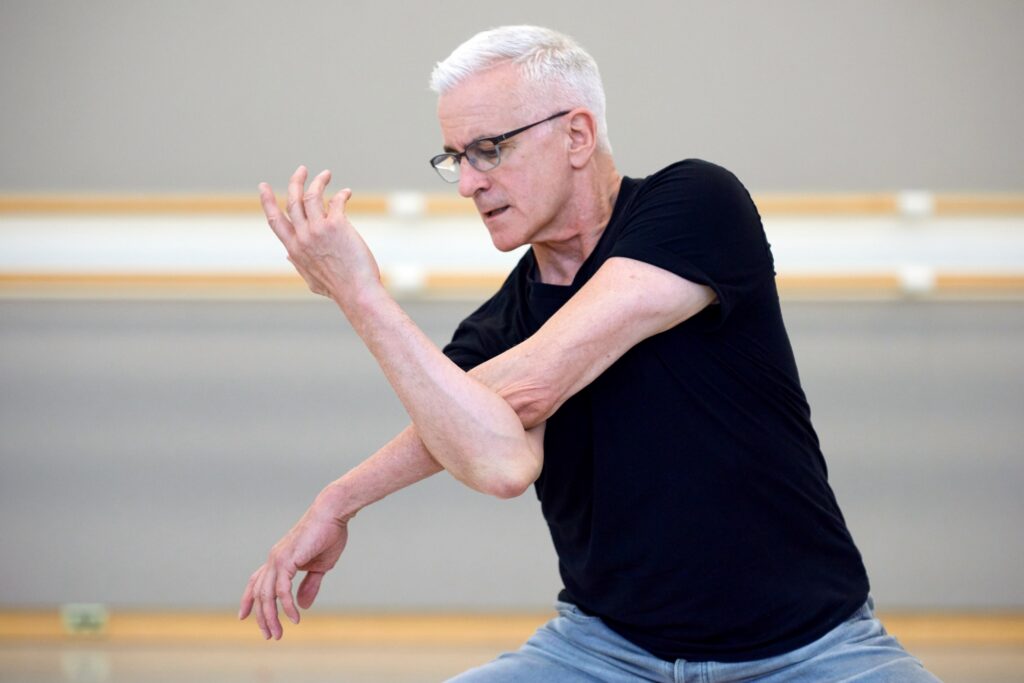 Val Caniparoli in the studio. Photo by Erik Tomasson, courtesy San Francisco Ballet.
Why did you start choreographing?
[Maurice] Béjart had come and done some works, and I was intrigued by the process. I realized I had been trained for this by studying theater, music, directing, and writing. So I experimented on schools in the area. My big break came from [former Pacific Northwest Ballet co-artistic director] Francia Russell. She said, “Pacific Northwest Ballet has this program—it’s low-tech and the choreographers are new. Are you interested?” That ballet was Street Songs, in 1980, and it’s still done to this day.
When did you start choreographing for SFB?
Helgi [Tómasson] and Michael [Smuin] asked me to choreograph for San Francisco Ballet’s Stravinsky Festival in 1982. Love-Lies-Bleeding was my first work for the company. It went well, but some of the reviews weren’t kind. I had breakfast downtown with my parents, who had come to town to see it, and we ran into Erik Bruhn. He said, “Don’t listen to them. You’ve got talent. Learn your craft and keep going.” That encouragement—I’ll never forget it.
Has your experience as a principal character dancer impacted how you create roles in your choreography?
I always say that I can only do what I know. Whatever I do has storytelling or character development in it. Because that’s what I know: action, reaction. Speaking in sentences, even though you’re not talking. I can’t duplicate what Balanchine did, or even Helgi, because I have a different background, so I use that in my favor.
How did your choreography career expand beyond SFB?
I mailed out videos—because we didn’t have computers—to companies. It didn’t have an effect right away, but I kept sending them out. Eventually, sometimes 10 years later, I’d get an offer. It just kept building, even until now, when I’m getting more offers than I’ve ever gotten.
What are your future plans?
The major one is a new full-length for National Ballet of Canada. It’s a retelling of Coppélia in my own way, with my own synopsis. Right after my last performance here, I’m going to work with Richmond Ballet on a brand-new work with the Goat Rodeo recordings of Yo-Yo Ma. And there are a lot of revivals: Jekyll & Hyde, Lady of the Camellias, Lambarena, The Lottery are all being asked about. Having more freedom to focus on that was important to me.
Do you think about your legacy?
I don’t. I just want to keep working. Like I always say, youth has no patent on relevancy. I’ve got a lot of things that I still need to say in choreography. That drives me.