

The Trump administration is investigating whether two prominent California medical schools, UC San Diego and Stanford, engaged in racial discrimination in admissions and has demanded they submit students’ personal and academic data in less than a month or potentially face damaging federal funding cuts.
In letters to the schools as well as to Ohio State University, Department of Justice Assistant Atty. Gen. Harmeet K. Dhillon said investigations “will focus on possible race discrimination in medical school admissions” and said officials have until April 24 to turn over seven years of admissions data.
Hundreds of millions of dollars in research grant funding from the National Institutes of Health is potentially at risk. In 2025, the NIH allocated about $36 billion to universities, much of it to medical school researchers. The institute distributed $575 million to Stanford, $427 million to UC San Diego and $210 million to Ohio State University.
The information requested Wednesday includes information about students’ race, Medical College Admission Test scores, undergraduate grade point averages, home address ZIP Codes, citizenship status, admission essays, and whether they are legacy admits or have family who donated to the schools.
The department asked for information about campus diversity, equity and inclusion policies or programs. It also wants messages exchanged between the schools and pharmaceutical companies, which regularly offer educational funding and research grants to medical schools that focus on admissions and diversity.

Assistant Atty. Gen. for Civil Rights Harmeet Dhillon arrives for a news conference at the Justice Department on Sept. 29, 2025, in Washington.
(Andrew Harnik / Getty Images)
The department said it wanted an “explanation for any deviation between racial and ethnic categories in test scores,” a request apparently aimed at determining whether students of color have lower scores. The letter also asked for copies of communications from ethnic or race-related medical student organizations to the schools.
A UC San Diego official, who was not authorized to speak to media about the investigation, shared the text of the letter with The Times.
Laura Margoni, a UC San Diego spokesperson, said the school is “committed to fair processes in all of our programs and activities, including admissions, consistent with federal and state anti-discrimination laws.”
Stanford spokesperson Cecilia Arradaza said the medical school “prohibits unlawful discrimination on the basis of race, color, national or ethnic origin, or any other characteristic protected by applicable law.”
Ben Johnson, an Ohio State University spokesperson, said that the university is “fully compliant” with state and federal laws on admissions.
The data requests are similar to those the Department of Justice referenced last month in a court filing against the UCLA David Geffen School of Medicine, which the government alleged uses a “systemically racist approach to admissions” that favors Black and Latino applicants over white and Asian American ones.
The organizations Do No Harm and Students for Fair Admissions, as well as a white applicant who claims she was rejected from the school because of her race, originally brought the suit forward in 2025 before the Trump administration joined the case.
In its filings, the Justice Department said it reviewed median Medical College Admission Test, or MCAT, scores obtained from UCLA for four consecutive years beginning with the incoming class of 2021. Those scores, the government said, show lower medians for Black and Latino matriculants (506 to 509) compared with those for white and Asian American ones (513 to 516).
UCLA’s medical school does not have a published minimum MCAT score requirement and uses a holistic evaluation process that considers areas outside test scores and grades, similar to practices at UC San Diego, Stanford and Ohio State University. A UCLA medical school spokesperson has said it is committed to “fair processes” in admissions and follows state and federal anti-discrimination laws.
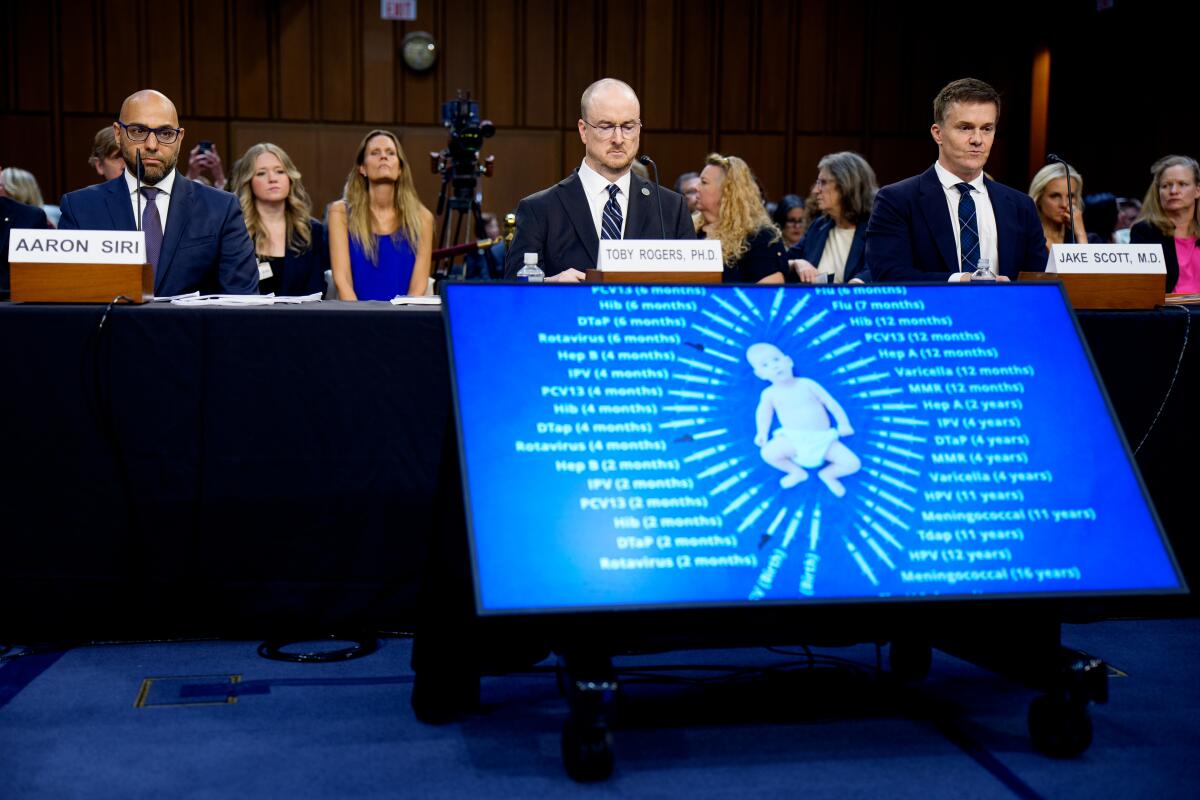
Attorney Aaron Siri, left to right, Brownstone Institute fellow Toby Rogers and Dr. Jake Scott, an infection disease specialist at Stanford University School of Medicine, appear at a Senate Homeland Security and Government Affairs Subcommittee hearing on Capitol Hill on Sept. 9, 2025, in Washington.
(Andrew Harnik / Getty Images)
In the current academic year, data from the Assn. of American Medical Colleges said that the 100,273 medical students in the U.S. are 42% white, 28% Asian or Asian American, 8% Black and 7% Latino.
Enrollment at the Ohio State University medical school mostly matches those figures but lags behind in Latino enrollment. UC San Diego and Stanford medical schools meet or exceed national averages for Latino enrollment and have a larger share of Asian American students than white ones. At Stanford, about 12% of medical students are Black compared with 6% at UC San Diego.
A leader of Do No Harm — a group founded in 2022 to oppose “disastrous consequences of identity politics” in medicine that has been critical of diversity programs — said she supported the Justice Department investigations.
“We applaud the Trump Administration for their work to end illegal and immoral discrimination in academic medicine and the broader healthcare sector,” said Do No Harm Executive Director Kristina Rasmussen.
But Cristhian Gutierrez Huerta, the president of the Latino Medical Student Assn., said he disagreed with the apparent suspicion the Justice Department expressed of medical school connections to ethnic and race-related medical student organizations.
“Our mission is not about creating barriers for anyone,” said Huerta, who attends the Medical College of Wisconsin. He said his group aims to “support students through that demanding path by providing mentorship, professional development, and community. … Our programs and opportunities are available for all students to benefit from.”
The latest investigations add to a growing list of Trump administration conflicts with California higher education institutions that have focused on allegations of admissions discrimination or antisemitism.

The University Student Union at California State University, Northridge on Aug. 22, 2025.
(Myung J. Chun / Los Angeles Times)
In one ongoing case, California and 16 Democratic state attorneys general are fighting a Department of Education mandate that UC, California State University and other campuses submit seven years of admissions data, including race, gender and GPA information. The Trump administration has said it could use the data to determine if there are legal violations, which would lead to schools facing fines.
Those data submissions were due Wednesday. But on Tuesday, a Boston-based federal district judge gave public colleges in the states an extension while he weighs arguments on whether to further prohibit the data collection while the case proceeds. U.S. District Judge F. Dennis Saylor IV said he will make a decision by April 3.
Universities said the requests are too cumbersome to produce quickly with accuracy and could violate student privacy, and said they have concerns that the Department of Education has followed a hasty process — months instead of the typical years — to expand data collection.
In another action last month, the federal government sued UC for alleged “severe and pervasive” employment discrimination against Jewish and Israeli workers at UCLA. A UCLA spokesperson said the university stands “firmly by the decisive actions we have taken to combat antisemitism.”
Since August, UCLA has grappled with a $1.2-billion settlement demand from the government to close out Justice Department investigations that alleged the university violated federal law by using race in admissions, recognizing transgender women by their gender identity and not responding adequately to complaints of alleged anti-Jewish incidents.
A federal court case has largely put the fine and demands for ideological campus change on hold, although UC said it is open to talks with the federal government and has not publicly foreclosed the possibility of a smaller settlement.