
While drug overdose deaths significantly dropped in Los Angeles County from 2023 to 2024, race and income disparities persist.
 The L.A. Standard Newspaper needs your support so that we can continue to create positive stories about Black communities. $20, $50, $100, $500, $1,000. Any amount would be greatly appreciated. -Jason Douglas Lewis, Owner/Publisher. Donations can be made through Cash App https://cash.app/$LAStandard, Venmo https://venmo.com @LA-Standard-Newspaper, PayPal https://www.paypal.com/paypalme/lastandardnewspaper, and GoFundMe https://www.gofundme.com/f/support-blackowned-los-angeles-standard-newspaper. Checks can be mailed to 2415 W. Martin Luther King Jr. Blvd., Los Angeles, CA 90008
 Shop Black Los Angeles! T-shirts and sweatshirts. https://lastandardnewspaper.com/index.php/shop-black-los-angeles.html
By Jason Lewis
With expanded investments in prevention, harm reduction, treatment and recovery, drug overdose deaths continue to drop dramatically in Los Angeles County as well as nationwide. In 2024 there was a 22 percent decline in overdose-related deaths in Los Angeles County when compared to 2023. There were 3,000 fewer deaths than in the prior year, with a 37 percent reduction in fentanyl-related deaths and a 20 percent reduction in methamphetamine-related deaths.
Fentanyl and methamphetamine are the top two drugs causing overdose in the county. But the decline in deaths related to overdose is not experienced by every community here in Los Angeles County equally.
“If we look at the racial demographics of overdoses, and this is the fentanyl-related overdoses, we see that Black Los Angeles County residents continue to have the highest rate of overdose,” said Dr. Brian Hurley, Medical Director, Substance Abuse Prevention and Control County of Los Angeles, Department of Public Health.
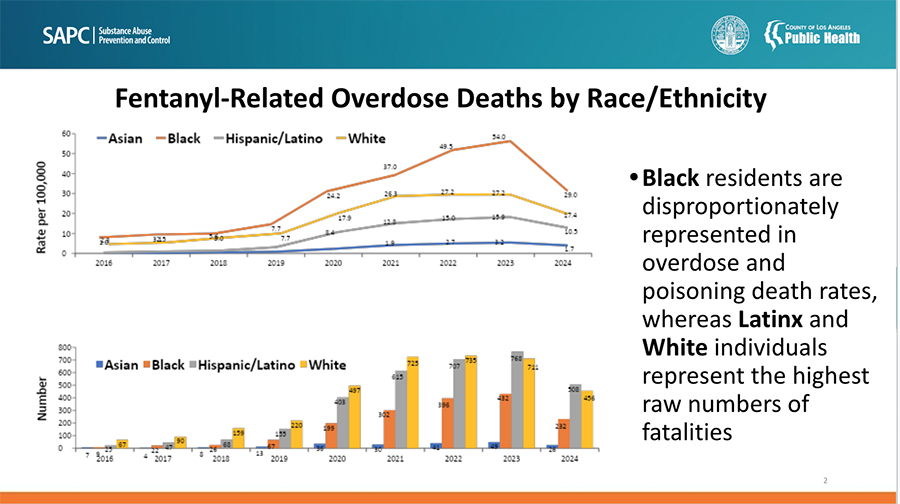
“The realities are clear and the numbers show them,” said Kelvin Driscoll, Director Homeless Outreach Program Integrated Care System at Homeless Outreach Program Integrated Care System (HOPICS). “Black communities disproportionately experience challenges with substance use. They also experience disproportionate challenges with experiencing homelessness.”
In 2024 in the county, 29.0 per 100,000 Black people died from fentanyl-related overdose deaths, compared to 17.4 for White people, 10.5 for Latinos, and 1.7 for Asians. In 2023, 54.0 Black people per 100,000 had overdose deaths compared to 27.2 for Whites, 13.9 for Latinos, and 3.2 for Asians.
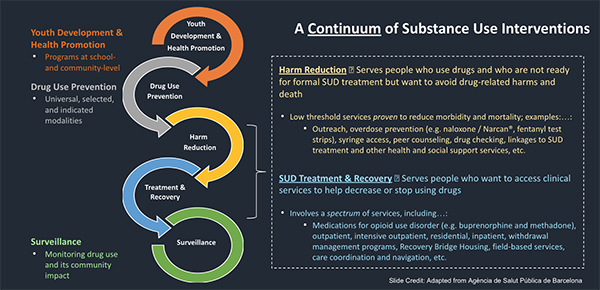
To combat this issue, Los Angeles County and community partners have expanded community-based services over the past few years. That includes education, treatment, harm reduction services and connections to other supportive services including housing, metal health support, and job training.
“The strategy to address overdose actually starts with youth development and health promotion,” Hurley said. “Our county is deeply invested in positive youth development and health promotion. We also as a health department invest in substance use prevention. But the bulk of our resources actually are in harm reduction and treatment and recovery. Harm reduction and treatment and recovery are categories of services that work with people who are directly impacted by substance use. Harm reduction services include things like naloxone distribution. It includes things like test strip distribution. It includes things like working with people who use substances without the expectation that they’re ready to entirely stop using, without the expectation that people who use drugs are ready to stop at the moment you talk to them. We also deeply invest in substance use treatment and recovery services, services that are focused around change oriented treatments to help people change their relationships with substance use. And there’s a popular misconception that the more harm reduction services you do somehow take away from treatment or the more treatment you do somehow takes away from harm reduction. That is just not true. Providing harm reduction services saves lives, reduces overdose rates, reduces the spread of infectious disease, and increases the chance that people go to treatment. Working with people who may not be committed to abstinence is deeply important on the treatment side. So both of these arms, we need to do more of both if we’re really going to engage our community and try to eliminate health disparities and reach all the people impacted by substance use that we need to reach in order to make an impact.”
“One of the strategies LA County is using is expanding indoor spaces or health hubs,” said Shoshana Scholar, Director, Harm Reduction Division, Los Angeles Department of Health Services. “They’re places where people who use drugs can go and connect with health care providers, a meal, a place where they can get a referral to drug treatment. In some places we have clinics. In others, we have like rest areas. There are job development pieces that are that are part of it. There are street outreach efforts through homeless services but also direct like overdose prevention services overdose prevention teams meaning like people that go out and distribute naloxone or or the overdose prevention medication.”
Agencies such as the HOPICS have street-based outreach and engagement programs which provides substance abuse care.
“Dedicated individuals from HOPICS are out on the streets of South Los Angeles doing this work and saving lives,” Driscoll said. “We do this work every day, day and night. We partner with people to provide healthy alternatives and we use our lived experience and our expertise as an organization to provide safe spaces. Our drop-in center is one of those spaces. It’s a community hub that is beautifully designed that people come in to visit every day and they receive a number of services.”
Roughly 8,000 people utilizes HOPICS’s drop in center per year.
For more information about Los Angeles County’s efforts to combat this issue, visit www.bylaforla.org. For more information about HOPICS, visit www.hopics.org