
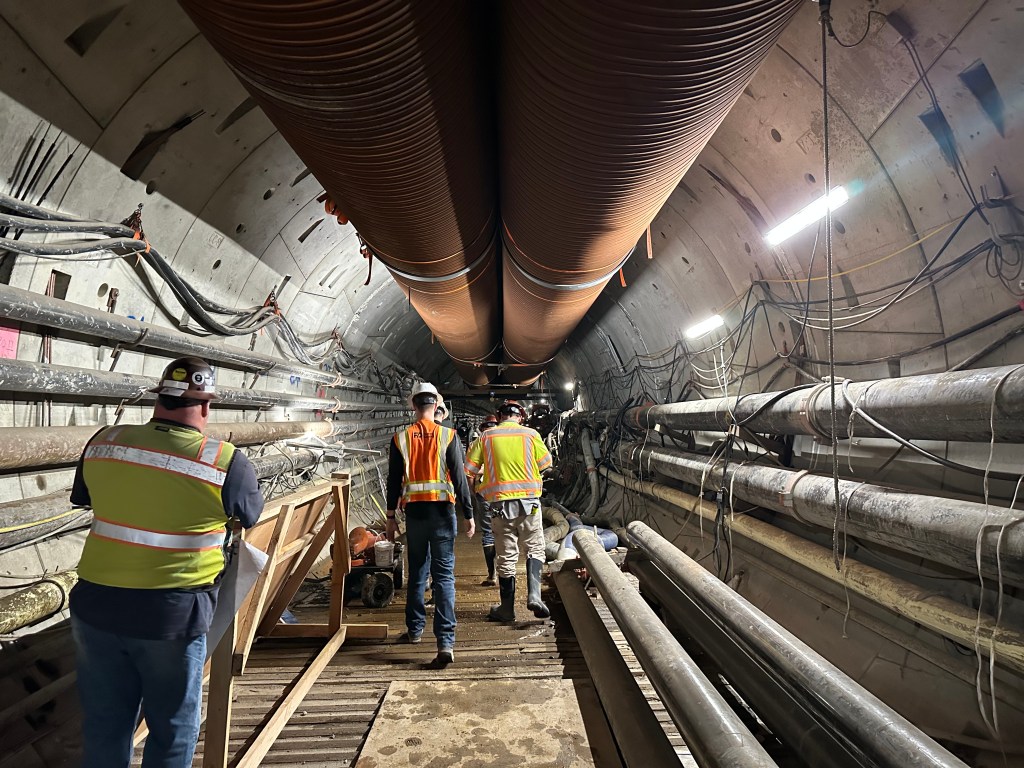
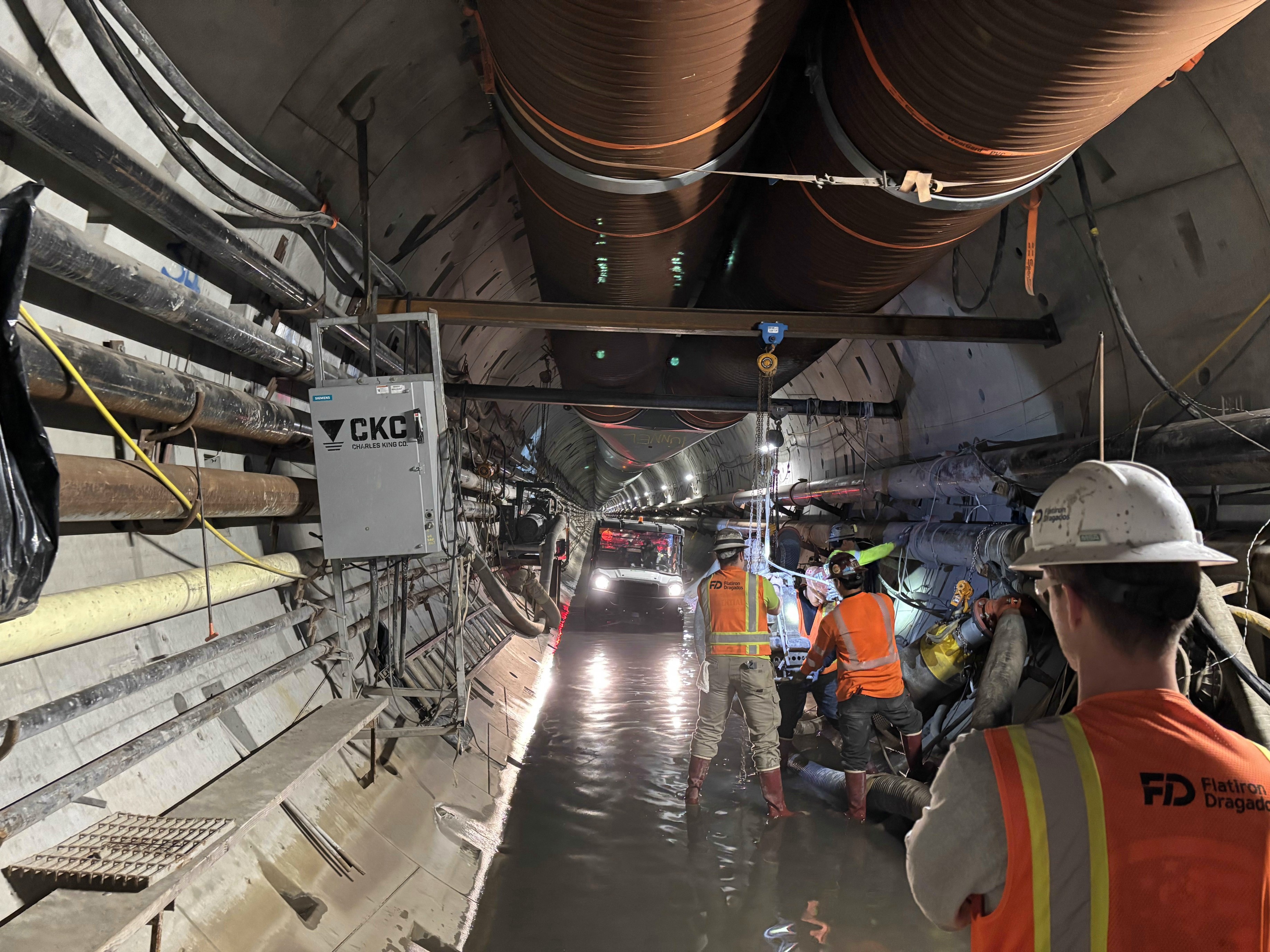
Inspection teams on Dec. 8, 2025, were allowed inside the Clearwater tunnel for the first time and will begin with the first 3 miles of the underground structure that experienced a breach at about the 5-mile point under Western Avenue in San Pedro. Dec. 8, 2025. (Photo Courtesy of the Los Angeles County Sanitations Department)
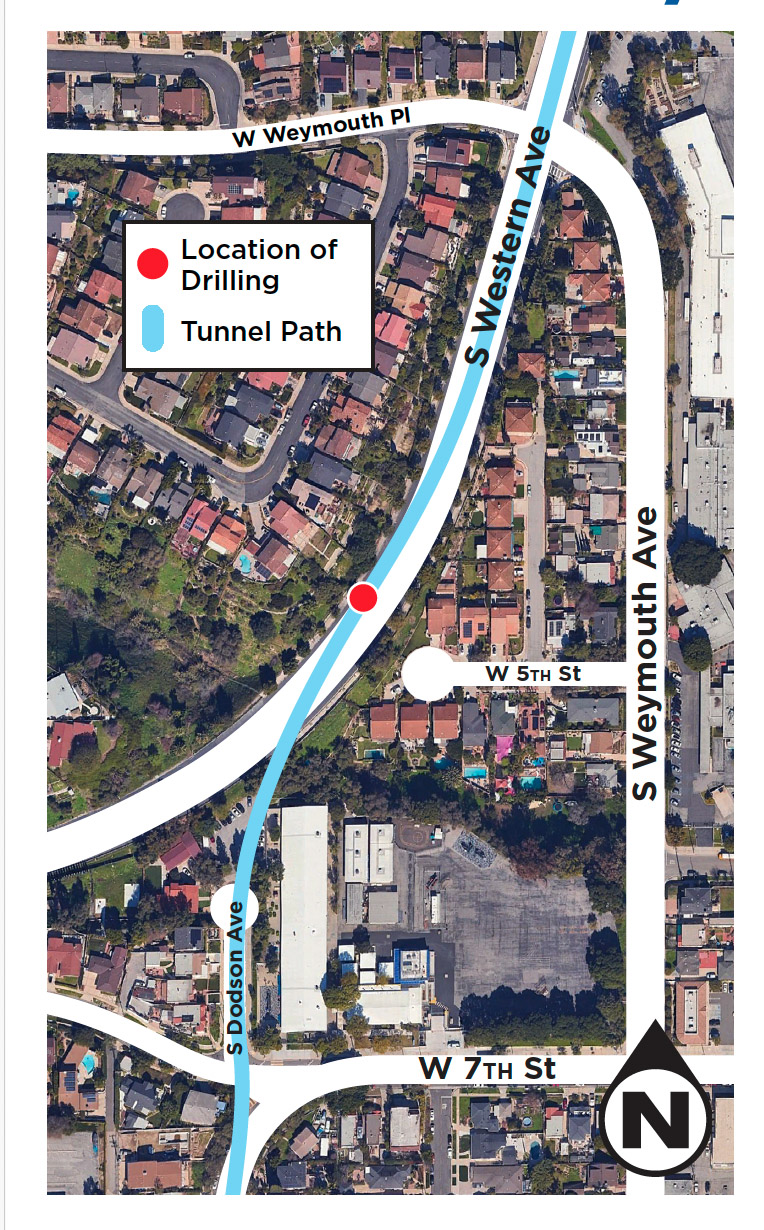
Map shows where bore holes are being drilled on Western Avenue in San Pedro. Workers send imaging equipment below ground to a depth of 370 feet to determine more about what caused the tunnel breach in a project to build new wastewater pipes from Carson to San Pedro. Work began in September 2025 on Western Avenue above where the underground breach occurred and was initially expected to take four to six weeks. The location is on Western Avenue across from the Fifth Street cul-de-sac. (Courtesy image)
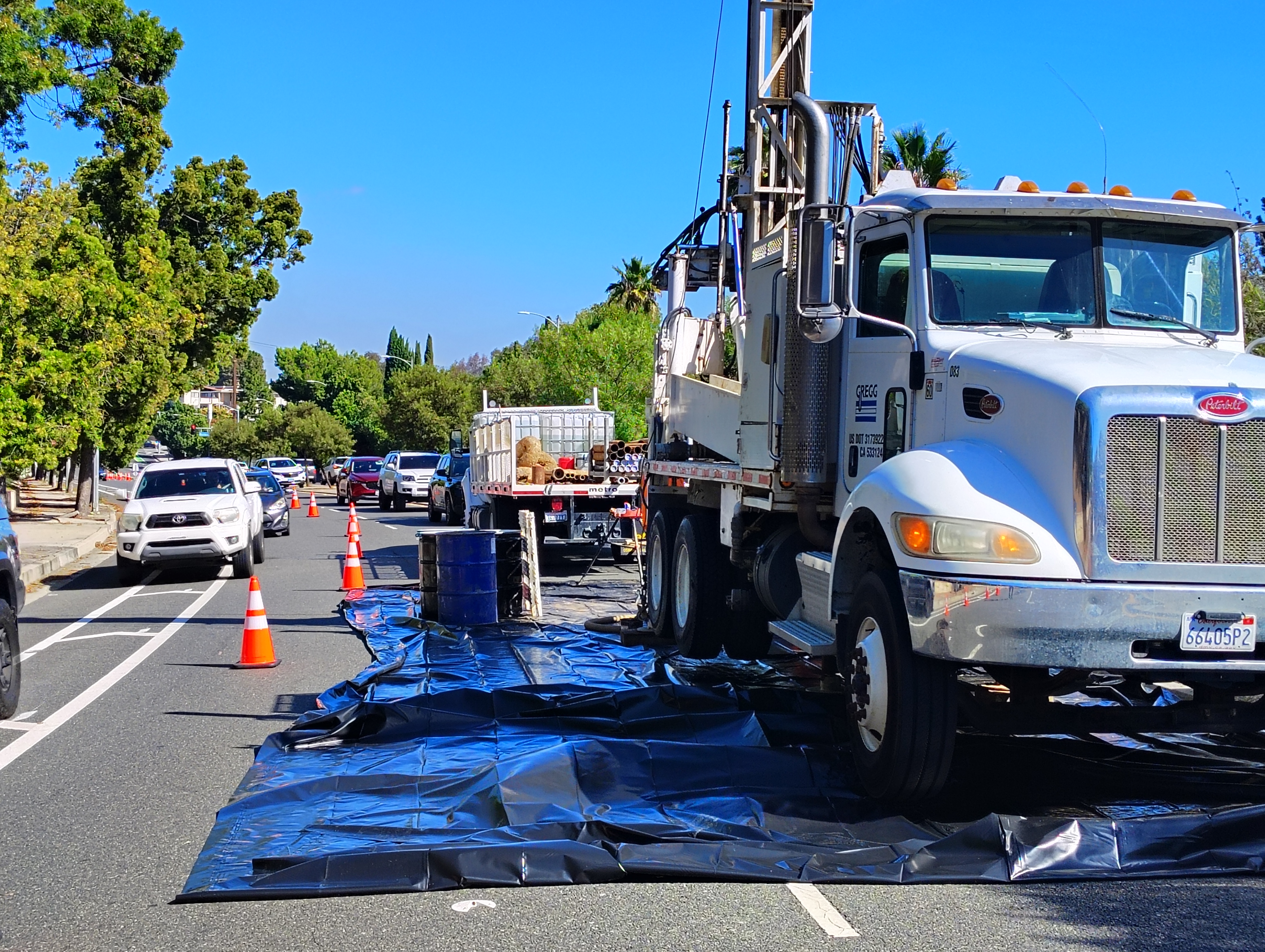
Rotary drilling rig on Western Avenue in San Pedro being used to explore underground breach in tunnel that will house new wastewater pipes. (Photo Courtesy of Los Angeles County Sanitation Districts)
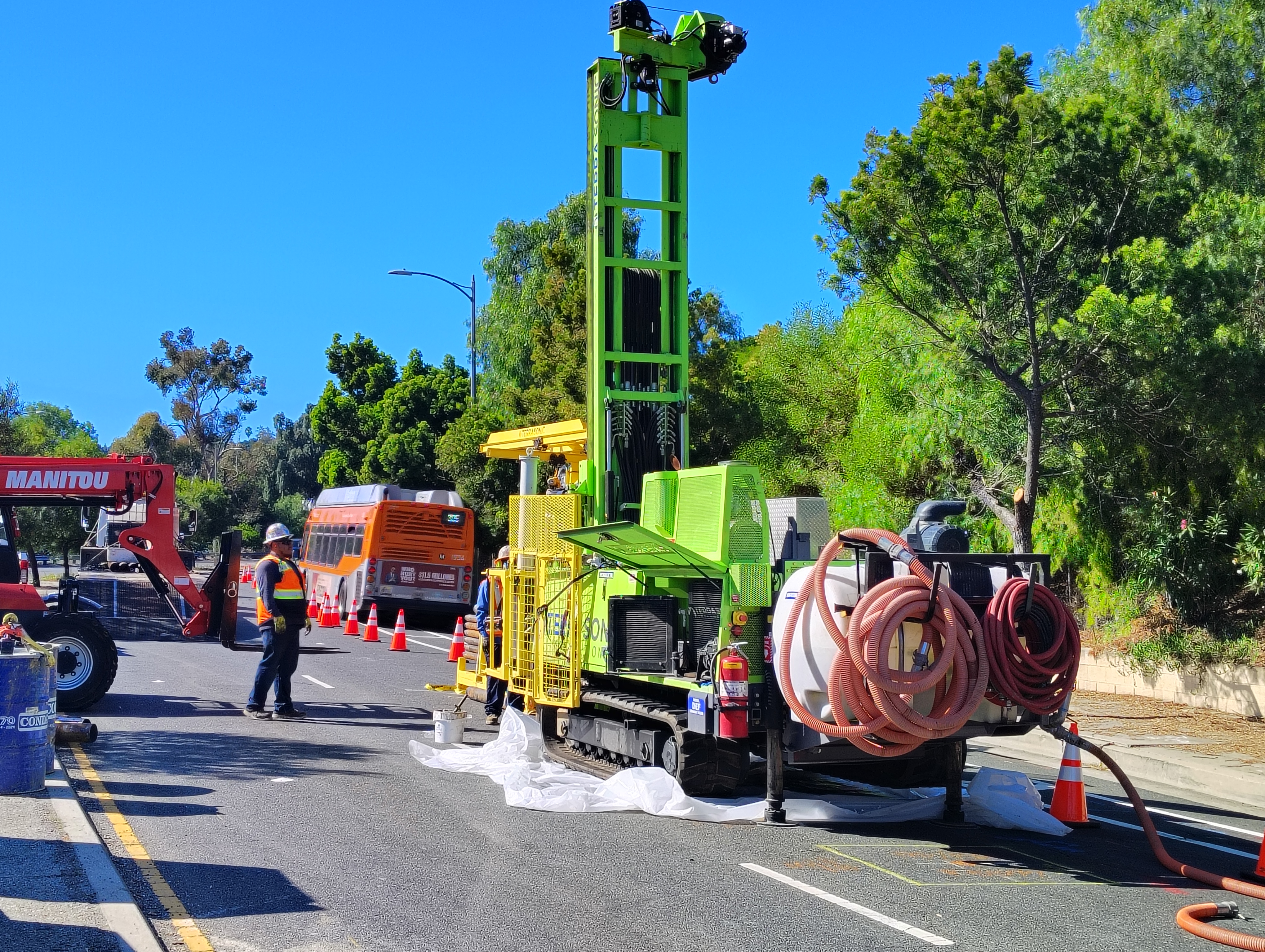
Sonic drilling rig used to explore underground tunnel breach on Western Avenue in San Pedro. The project will house new, larger underground wastewater pipes to serve the region. (Photo Courtesy of Los Angeles County Sanitation Districts)
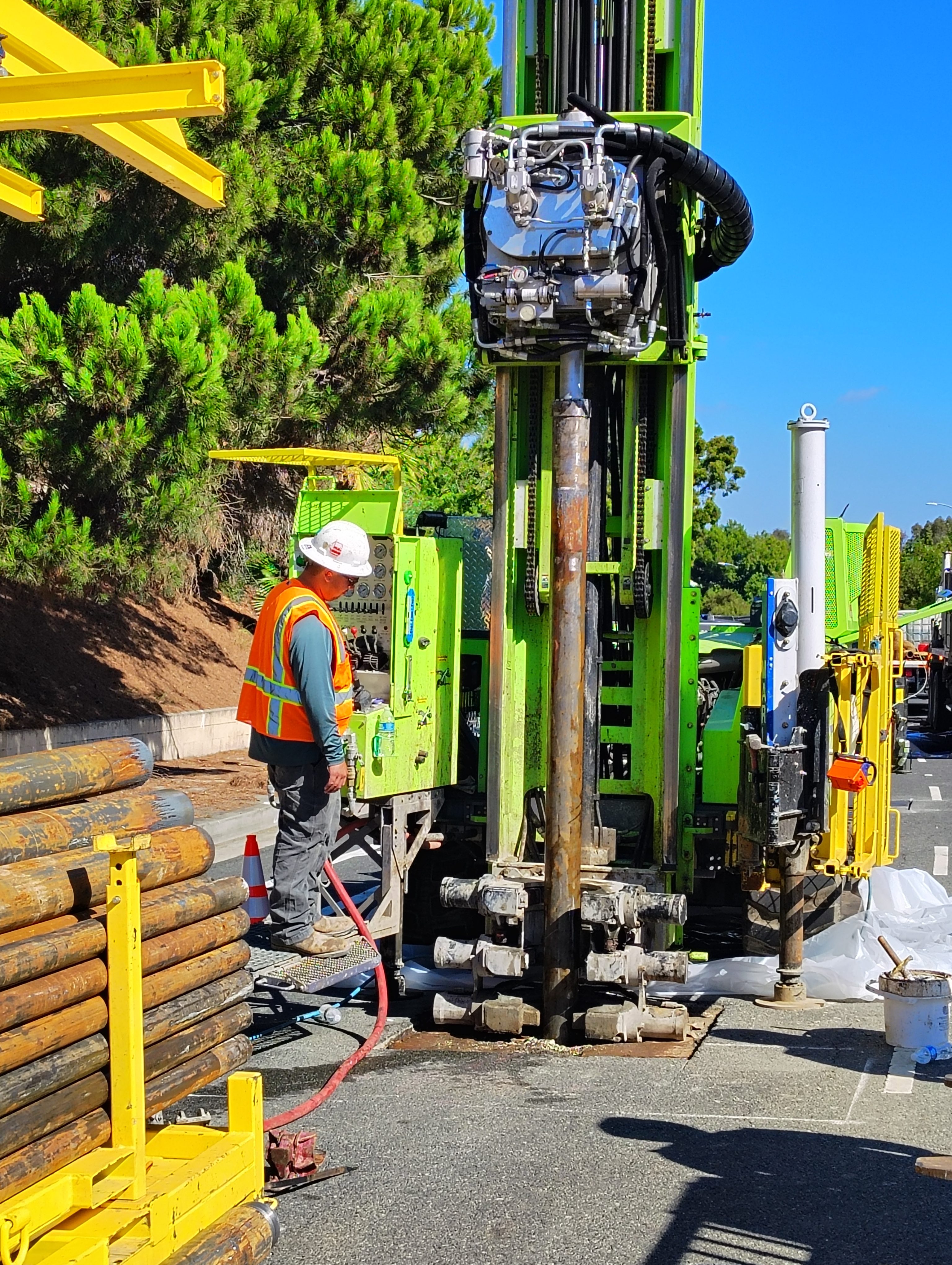
Sonic drill rig on Western Avenue in San Pedro. The equipment is being used to explore a tunneling breach some 360 feet below ground that is being created to house new, larger wastewater pipes. (Photo Courtesy of Los Angeles County Sanitation Districts)
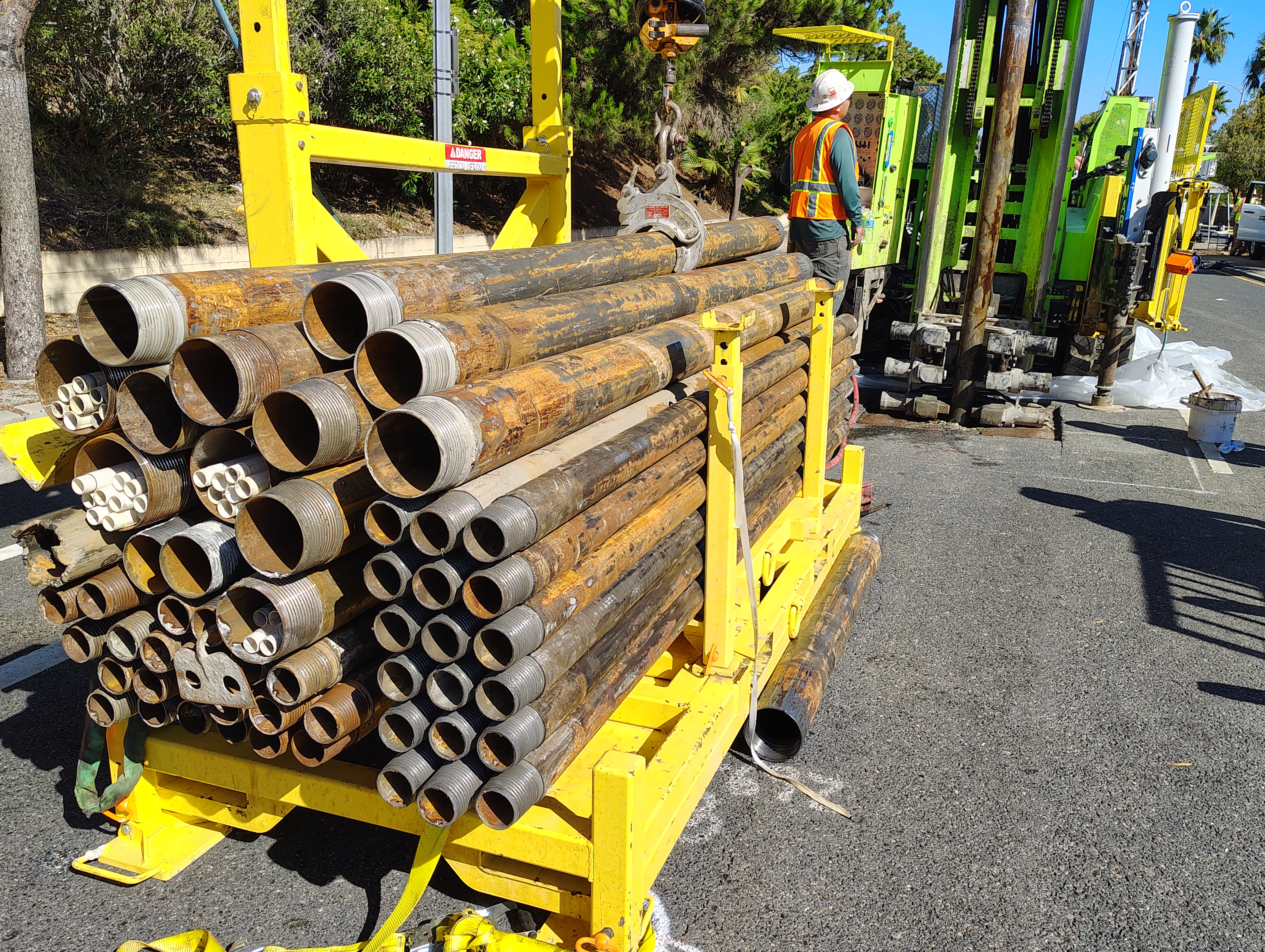
Six- and four-inch steel casings to encase underground cameras are shown on Western Avenue where Los Angeles County Sanitation Districts is conducting an investigation into what may have caused a 360-foot deep underground tunnel being created to house larger wastewater pipes to serve the region. (Photo Courtesy of Los Angeles County Sanitation Districts)
Show Caption
1 of 6
Inspection teams on Dec. 8, 2025, were allowed inside the Clearwater tunnel for the first time and will begin with the first 3 miles of the underground structure that experienced a breach at about the 5-mile point under Western Avenue in San Pedro. Dec. 8, 2025. (Photo Courtesy of the Los Angeles County Sanitations Department)
Work continues to progress to assess and repair underground damage cause by a July 2025 breach some 320 feet below Western Avenue in San Pedro as part of the ongoing Clearwater Tunnel Project, Los Angeles County Sanitations District officials reported in response to recent questions.
The project, which began in 2019, was nearing completion to lay larger wastewater pipes underground when the breach halted the progress.
Site preparation for the Clearwater Project’s termination site at Royal Palms Beach — which will be the southern end of the underground wastewater pipeline being built — also began in March, county officials said.
“We are resuming worksite preparation, including soil borings to help reinforce existing infrastructure,” a release said. “This work is necessary to prepare for the next major phase of construction to connect the new tunnel to our existing outfall pipe system (at Royal Palms). Working hours for this phase of construction are scheduled Monday through Friday from 7:00 a.m. to 3:30 p.m.”
There is currently no timeline to begin the next phase of major construction at Royal Palms Beach which will involve significantly more equipment and activity, the latest notice said. “Residents and businesses in the area will be notified well in advance of our full mobilization before that activity resumes.”
Activity at that site recently had been focused on the required historic work to search for, salvage and clear the site of artifacts, a process carried out by the Kizh Nation under the State Historic Preservation Office. No details on that process or what has been recovered were available.
Meanwhile, drilling on Western Avenue, just north of Ninth Street in San Pedro, is now complete, Los Angeles County Sanitation Districts reported also in March, with four bore holes now drilled to depth near the spot where a tunnel breach occurred in 2025.
Engineers, a spokesperson for the Sanitation Districts said in an email responding to questions for updates, are now placing more “advanced sound and radar equipment in these bore holes to obtain a better image profile of the voids (above and around the breach) and tunnel structure at depth.”
That part of the project, Sanitations District spokesperson Michael Chee explained in February, was needed to install a system of sonar devices lowered underground to produce a clear 3D image of the area at depth (approximately 320 feet below street level).
But initial drilling proved more complicated than expected to get detailed and stable images at such an extensive depth, officials said, requiring more sophisticated equipment and longer above-street working hours.
Overall, work on the $630 million, multiyear Clearwater Tunneling Project remains paused as further inspections are carried out surrounding the July 9, 2025, breach beneath Western Avenue that caused a cave-in, temporarily trapping several workers and halting the project to continue installing two new, larger regional wastewater pipes.
When it occurred, the breach temporarily trapped 31 workers and collapsed material largely closed off the tunnel. The workers, traveling through the tunnel on a tram, were able to climb over the top of the fallen sediment pile, where there was still space, and all were rescued, with only a few minor injuries reported.
The entire length of the tunnel — which runs from Carson to San Pedro, about seven miles — will be carefully inspected before work on the final leg of tunneling can resume, officials have said. In-person inspections were given the go-ahead in December and are continuing. The entry to the tunnel on the north is adjacent to the A.K. Warren Water Resource Facility on South Figueroa Street, north of Lomita Boulevard. Initial in-person work also was needed to restore ventilation and establish power, as well as to inspect the tunnel’s structural integrity.
For now, the department spokesperson said, the entire process that is anticipated to repair, stabilize and recover equipment, “could take well over a year” before full tunneling work is resumed to continue on to the end of the line outfall at Royal Palms.
Currently, the department said, drilling rigs and equipment on the surface of the Western Avenue site are being removed, with only crews and vehicles to be left to complete the imaging work.
“This data (now collected via the remote camera inspections) will provide more clarity about the ground conditions above and around the tunnel breach,” a department email response to questions stated.
An earlier investigation remotely identified an empty space about 10 feet by 20 feet in size, located about 310 feet below ground level at the breach site. The presence of underground water also was confirmed and work to remove the water remotely has been ongoing.
The first section of in-person inspections was concluded in February. It included only the initial portion of the underground tunnel to the north — the first 3 miles — and concluded that conditions in the 3-mile space ahead of the breach area appeared to be stable.
“The inspection along the completed tunnel indicates it is stable and intact,” the report issued in February said. “As a result, Cal/OSHA has authorized a second phase of re-entry to allow inspection of the tunnel to within 150 feet of the breach area so the investigation and engineering assessment for repair and recovery can take place.”
The tunnel boring machine being used in the project remains trapped underground just ahead of where the breach occurred.
In the “near future,” the latest March update responses said, crews will return to pump slurry, or concrete material, down the bore holes “in an attempt to fill and lock down the gaps and earth above and around the tunnel breach. It is intended that this slurry will also fill the tunnel through the breach and create a plug to stop the flow of water into the tunnel.”
As for the in-person inspections, “significant progress,” has been made, the department said this month, with first-hand assessments now at about the 150-foot mark of where the breach occurred.
“We have much better imaging of the damaged area and the debris pile,” the department’s written response to questions stated. “Groundwater is still entering the tunnel through the breach. The debris pile is holding back a significant amount of water all the way up to where the tunnel boring machine is still sitting a mile away. So there’s a water backup of approximately 1 mile. All work is being supervised and approved, step by step, by Cal/OSHA.”
Engineers also are attempting to “establish bulkheads inside the tunnel (in front of the debris pile) that will allow them to stabilize the debris pile with concrete and create a safety barrier,” the written responses said. “It’s a very complex operation that must be done slowly.”
The plan, the department said, is to “drill through the debris pile and place pipes that will allow us to begin draining the water that has accumulated behind the debris pile. The goal is to remove as much water as possible so we can begin to clear the debris and assess and begin repairs to the inside of the tunnel.
“Once the tunnel is safely repaired,” the response continued, “crews can turn their focus to moving through the last mile of the constructed tunnel to assess, repair and recover the (boring machine) itself.”
The two existing and smaller wastewater pipes underground, meanwhile, continue to be functional, officials have said.
Information about the Clearwater Project is available at clearwater.lacsd.org/.