
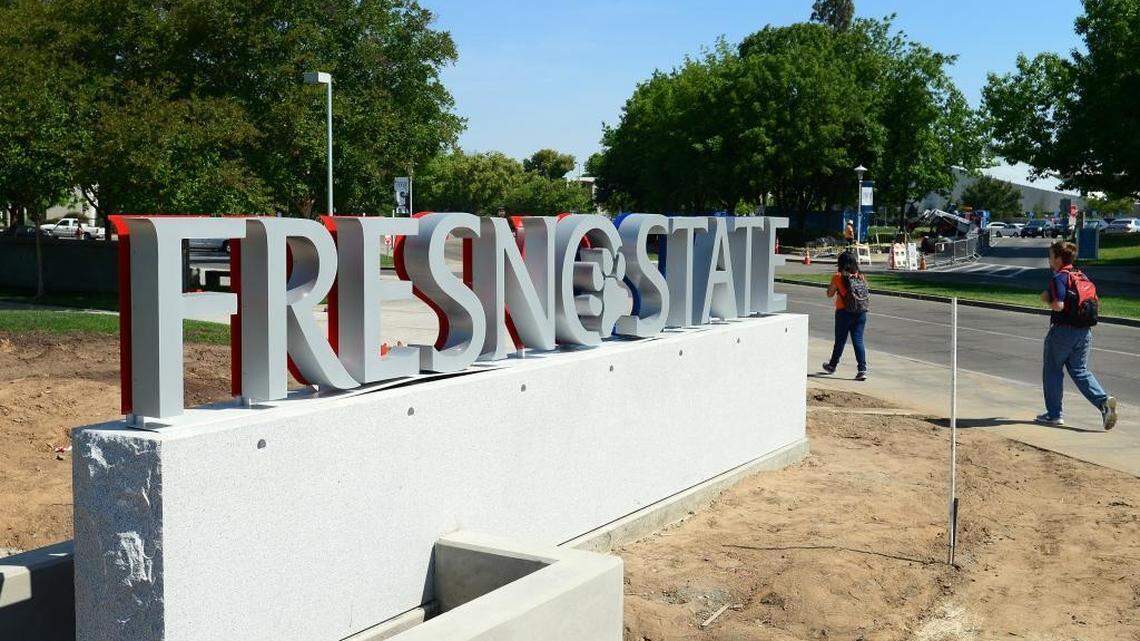
There was no agenda posted online for Thursday’s board meeting of the Fresno State Foundation, the organization that manages more than $300 million in investments, donations and grants for the university. There was no stack of copies of the agenda in the room visibly available to members of the public.
It was the Board of Governors’ first meeting since a January report from the CSU system revealed the foundation’s weak governance and failure to maintain financial controls has put it at risk of fraud. In recent weeks, the foundation has published its planned reforms, which are arranged in bullet point-like sentences in an online dashboard.
During Thursday’s meeting, the group largely avoided publicly discussing how exactly it plans to fix the problems that concerned Fresno State President Saul Jimenez-Sandoval. He requested the CSU’s review and is the only foundation board member who has issued any public statement about its findings.
Jimenez-Sandoval declined an interview about the foundation after Thursday’s meeting. So did Vinci Ricchiuti, chair of the board for 10 years and a board member for more than 30 years.
Immediately after Thursday’s meeting, a reporter with The Fresno Bee caught up to Ricchiuti as she was exiting the building. She said she didn’t have time to answer questions about the foundation because she had a musical event to attend and had to meet her husband.
“All updates are on the website,” Ricchiuti said as she left.
The foundation is a nonprofit corporation that, while operating independently of the public university, is legally tasked with managing Fresno State’s $250 million endowment fund, plus about $65 million in government grants. The auxiliary organization redistributes money to pay for research at Fresno State, student scholarships, employee salary support and other important initiatives.
The CSU review, released in January, found no instances of fraud. It did conclude that the organization’s outdated banking practices exposed the foundation to the potential for financial misstatement and fraud, at least in fiscal 2024, the 12 months of operations that the CSU examined.
Leadership turnover on the foundation’s board and minimal university representation caused “weakened oversight and accountability,” the review found.
How did Fresno State Foundation get here?
The foundation has made some reforms and plans to restructure the 25-member board to include university representation. According to its website, it also plans to reestablish and enforce term limits — something the board decided to end in 2022, after enforcing it loosely for years.
Foundation board members are unpaid and volunteer their time. The CSU review found more than 10 had served on it for over a decade. No foundation board member has ever commented on the problems exposed in January, and the group during Thursday’s meeting did not discuss how it plans to restructure the board or foundation operations.
After Ricchiuti declined to answer questions, a Fresno State spokesperson outside the meeting boardroom told The Bee no other board members wanted to provide an interview.
At a minimum, The Bee wanted to ask the following questions:
Why did this board ignore term limits for years and then decide to end them in 2022?Why was an organization that manages more than $300 million so reliant on manual banking processes?How can Fresno State’s donors be certain fraud did not take place during years not reviewed by the CSU?Nonprofit experts told The Bee the foundation needs leadership change. Will that happen? Is it under consideration?Fresno State Foundation says little during scheduled CSU review update
The board’s separate committees have met since the CSU review was released. But Thursday was the foundation’s first full board meeting of the year, according to the schedule posted on its website. A Bee reporter arrived in the boardroom about 10 minutes early and was told to leave and return at 3 p.m., the meeting’s scheduled start time.
Ricchiuti told the Bee reporter just minutes before she opened the meeting that she wasn’t sure if recording was allowed during the meeting and that she was trying to find out, but she never followed up. The foundation’s bylaws say all board meetings “shall be open and public.”
During the meeting, the board voted to approve “external (certified public accountant) engagement,” and the audit committee discussed requesting proposals from external auditors. Board member A. Emory Wishon said during the meeting that the investment committee is preparing a request for proposals from investment advisors. (The CSU review found the organization used the same external auditing firm and the same investment manager for more than 10 years without engaging a formal bidding process.)
But talk of reforms was otherwise minimal during the meeting.
Board member George Soares, who leads the board’s governance committee, was scheduled to provide an update on items related to the CSU review. Soares said the committee had no actions to report, and did not discuss any reforms.
“But I encourage you to go to the dashboard on our foundation website,” Soares said in his brief statements during the meeting.
During the “Old Business” portion of the meeting, Nicole Lane, Fresno State’s executive director of auxiliary services, was scheduled to provide an update on the CSU review. Like Soares, she only mentioned “the dashboard” in her brief comments.
Ricchiuti closed the meeting shortly afterward.
After the meeting, a Bee reporter asked a Fresno State spokesperson for a hard copy of the agenda, which she provided. The foundation’s bylaws do not say the organization has to post its agenda online prior to the meeting, though it can be requested in writing.
This story was originally published March 27, 2026 at 2:32 PM.
Related Stories from Merced Sun-Star
The Fresno Bee
Erik is a graduate of the Missouri School of Journalism, where he helped launch an effort to better meet the news needs of Spanish-speaking immigrants. Before that, he served as editor-in-chief of his community college student newspaper, Riverside City College Viewpoints, where he covered the impacts of the Salton Sea’s decline on its adjacent farm worker communities in the Southern California desert. Erik’s work is supported through the California Local News Fellowship program.