
There’s so much commotion over building a new high-speed train system to connect the Bay Area and Los Angeles that it’s possible to overlook the passenger rail service that’s connected California for decades.

But a ride on the state-funded Gold Runner train has its setbacks: namely, uncomfortable seats, no food except for bagged snacks, and drinks without ice due to a recent regulation. Ironically, the ride’s comfort level took a back seat despite a recent investment of state funds.
It’s also a long journey, approximately nine hours, and starts in Oakland before eventually reaching Union Station in downtown Los Angeles via a combination of train and bus. In January, I boarded Train 712 in the Bay Area to glimpse the future of California rail. It’s a mixed bag — service is frequent and affordable but sometimes unreliable after maintenance was outsourced to a private company.
Article continues below this ad
At only a few months old, the Gold Runner is the newest addition to California travel, it but seems like a wake-up call for the state’s ambitious rail dreams.
Rebranding a 52-year-old train
Formerly called the San Joaquins, the state-supported passenger trains have bridged the two major metro regions by rail since 1974. The San Joaquin Joint Powers Authority, a state-backed regional rail group, took over administrative control of the service from Caltrans in 2015.
Make SFGATE a preferred source so your search results prioritize writing by actual people, not AI.
Add Preferred Source
Last year, the trains evolved into the Gold Runner. The rebrand was part of a multibillion-dollar deal that Amtrak made with the German manufacturer Siemens Mobility five years ago to produce 73 trains at its factory in Sacramento. Caltrans used federal and state funds to purchase new rail cars worth $132 million. This past year, SJJPA spent $1.5 million on rebranding, with another near $2 million projected over the next two years.
Article continues below this ad
Somewhat unsung, the service suggests that rail works in California, if you’re willing to meal-prep and endure a slower pace.
The Gold Runner stops at 18 train stations in the Central Valley and Bay Area. Amtrak lists it as its sixth busiest route. Although Amtrak’s name is on the trains, the state of California funds the entire system and owns the rail cars and locomotives. Amtrak, the federal corporation that runs intercity U.S. train service, sells tickets and provides train engineers and conductors.
The train service hovered around 900,000 riders in the last two years, and in a promotion clip, passengers gushed about how the train brought them to family in Sacramento, onto Stanford’s campus and into downtown San Francisco. The most popular stations in last year’s ridership report for trains with thruway bus transfers were all in the Central Valley: Bakersfield, Fresno and Stockton saw the most.
Article continues below this ad
A traveler aboard the Gold Runner after its near $150 million rebrand with new train cars.
Courtesy of the San Joaquin Regional Rail Commission
Travelers board the Gold Runner’s thruway bus that shuttles between Bakersfield, Calif., and Los Angeles to complete the trip from the Bay Area.
Courtesy of the San Joaquin Regional Rail Commission
While a $50-$70 coach seat seems like a steal, the trip comes with a few other costs. After the journey on rail terminates in Bakersfield, it’s another two and a half hours by bus over the Grapevine using a Gold Runner-funded bus service. And, despite the recent investment in new rail cars, I thought the seats were firm and uncomfortable. But the real price to pay is that there are no meals. The webpage for booking a trip doesn’t make that abundantly clear, so it’s easy for someone to find themselves locked on board with nothing to really eat besides potato chips.
The San Joaquins once provided a diner lounge — I also remember how the seats were more comfortable — but that changed when the new cars started appearing last year.
Article continues below this ad
California born
As part of the statewide plan to enhance travel between the Bay Area and Los Angeles, partly via high-speed rail that’s set to start by 2033, the Gold Runner rebrand was designed to help riders grasp the opportunities ahead on the 315-mile rail corridor. Those opportunities include cutting the route of the Gold Runner in half, since passengers will transfer to the high-speed line in Merced.
Rail officials hailed the rebrand as “a bold new era” for intercity rail service in California. “The new brand better communicates the full scope of the network, including its extensive Thruway Bus connections, and emphasizes regional identity, improved accessibility, and an enhanced passenger experience,” David Lipari, the interim director of the SJJPA, told Trains.com last year.
Article continues below this ad
Rebrand or not, it’s still a slower way to reach Los Angeles than slogging it by car on Interstate 5, but it’s undeniably a better bargain. I paid $52 for a coach seat and planned ahead by packing a sandwich for the long afternoon.
The Gold Runner train arrived on time at 10:38 a.m. at the Emeryville station, the second stop on the journey from Oakland. The new train cars appeared in a sleek, gold and silver exterior. Inside, the blue seats had an attractive checkerboard pattern.
An Amtrak train engineer talks with ground personnel before leaving the station in Richmond, Calif., in June 2010.
Paul Chinn/The San Francisco Chronicle via Getty Images
But then I sat down. It was rock-hard padding, and the lack of a significant recline was painful. The seats lacked lumbar support, and the recline was clunky because the bottom cushion moved forward. On the positive side, seats have a USB port, an electric outlet and a large tray table.
Article continues below this ad
At first blush, it felt like a downgrade from the older San Joaquins trains, which are slated to phase out completely by midyear and be replaced by the Siemens Venture cars. However, these new cars are ADA-accessible and California-born, since they were manufactured in Sacramento.
Apparently, I’m not alone in voicing comfort concerns. The SJJPA said that it’s looking at what could be done to enhance seat comfort, explained Ahdel Ahmed, the public relations manager for the regional authority.
Ahmed said the SJJPA did not select the seats and that Caltrans purchased the trains. A spokesperson declined to comment on coziness aboard the Gold Runner.
Why there’s no ice on the train
For a Saturday afternoon ride, the train was nearly empty, with maybe 30 of the over 400 seats occupied.
Article continues below this ad
As we pulled away from the Bay Area, I decided to take advantage of a complimentary snack program. There was a variety of sugary choices on the shelves: Doritos, Chex Mix, Fritos, Smartfood Popcorn, Grandma’s Cookies, several soda choices and bottled water.
I grabbed a bag of Doritos and a Diet Coke. But there were no refrigerators for the soda, and the soft drinks grew warmer as we continued into the Central Valley.
A retiring Amtrak service attendant named Earl Daughtry shows off a lapel pin on his final run aboard the San Joaquins in June 2002.
Paul Chinn/The San Francisco Chronicle via Getty Images
Before the Siemens Venture cars, the San Joaquins train cars had cafe service. The food program is still part of the San-Jose-to-Sacramento Capitol Corridor and features my favorite onboard meal: a Hebrew National hot dog along with sandwiches, soda, beer, wine and liquor. It also offers ice for drinks, which until now seemed like a standard. But aboard the Gold Runner, it’s a luxury.
Article continues below this ad
I learned that, in a cost-cutting move, the SJJPA told train car manufacturer Siemens to cut cafes.
Former SJJPA executive director Stacey Mortensen explained to Congress in 2019 that the food and beverage service was repeatedly losing between $2 million to $2.5 million a year. Ahmed later clarified that the total loss was approximately $2.9 million, including both commissary provision costs and labor.
Mortensen’s testimony also lodged criticism against Amtrak over transparency, collaboration and fairness. Last summer, two months before the Gold Runner rebrand, she stepped down after more than 27 years in rail leadership.
There was an attempt to keep the cafes. Throughout 2023, Doug Kerr, representing a group that advocates for train riders, spoke at SJJPA board meetings and questioned the logic behind their removal. He said that the shorter Capital Corridor between San Jose and Sacramento would continue to have cafe cars, while the twice-as-long trains between Oakland and Bakersfield would not. Kerr criticized the use of vending machines and wondered whether the Capital Corridor was allowed to maintain food services because it served a wealthier ridership.
Article continues below this ad
A service attendant on the Capitol Corridor serves a customer in the cafe car on a train headed for Sacramento, Calif., in December 2010.
Carlos Avila Gonzalez/The San Francisco Chronicle via Getty Images
I followed up with Kerr last month. He told me that he can’t think of any other long-distance train in America besides the Gold Runner that doesn’t serve food.
As the train plowed through the food basket of America, with countless rows of almond and pistachio orchards and grape vineyards, I considered the irony that, as of now, the Gold Runner offers no substantial food program.
As we approached Merced, the halfway point to Bakersfield, the turkey sandwich I ate earlier was not holding me over. Originally, the plan was to replace the cafes with vending machines that would offer fresh produce reflecting the region.
Article continues below this ad
Ahmed said the regional authority found a vending machine operator in 2021 but has not been able to find a company to restock the machines daily. He commiserated with me over the warm sodas, admitting how he too prefers his sodas cold.
I then learned the culprit behind these tepid beverages.
The Environmental Protection Agency adopted a policy in 2025 requiring trains to have climate-friendly refrigerators that use only a small amount of flammable elements. Ahmed told me that creates a conflict with another federal agency.
“Flammable refrigerants are presently prohibited by the Federal Railroad Administration for use in refrigeration systems on passenger rail cars,” he said. “Because of this conflict between EPA-approved refrigerants and FRA safety restrictions, we are currently working through the process to get the machines approved.”
Article continues below this ad
Ahmed offered hope for cold drinks and for full meals later this year. Some options under consideration include having food trucks meet the train at various stations or having a simple rolling cart, similar to one on a flight, that would offer food and beverages throughout the train.
The Gold Runner is losing money, generating over $34 million in revenue in fiscal 2024-2025 against $107.7 million in expenses, a 2026 business plan update shows.
The free snacks, soda and bottled water for passengers come at a cost of $3.9 million in annual operating costs — nearly double what the train was losing from a full meal program seven years ago. Ahmed argued that it was still comparatively cheaper. If the Gold Runner had continued using the traditional cafe car model from before, since costs were increasing annually, “we would have estimated cost based on Amtrak billing rates of over $6 million,” he said.
A train platform in Merced, Calif.
diegograndi/Getty Images
Upon arriving in Merced, the train conductor offered some comforting words: “The train is running on time,” he said.
Article continues below this ad
Although this may seem like a standard, the conductor shared how breakdowns on Gold Runner trains have become more frequent and suggested they’re an outcome from part of the system becoming privatized. In September 2025, the SJJPA transferred maintenance to Transit America, a subsidiary of the country’s largest private passenger rail operations and maintenance provider.
Federal Railroad Administration data show how customer on-time performance in November 2025 was nearly 60% on the Gold Runner, a sharp fall from a similar period in 2024 when the San Joaquins ran 77% on time.
The percentage of Gold Runner trains arriving within 15 minutes of the scheduled arrival time was 47% from October through November 2025.
Ahmed said the move away from Amtrak for car maintenance was part of a plan for more localized control over repairs. He said the transition to the new train cars has caused some problems but that they are being worked out.
Article continues below this ad
All deboard
The Merced station looked small and modest from my window. This is where the California High-Speed Rail Authority, in conjunction with the San Joaquin Joint Powers Authority, plans to build a two-story structure to handle connections between the Gold Runner and bullet trains.
Farm fields blended into each other as my back started to hurt and my butt grew numb from the hard seat.
I started plotting an early escape. The idea of an additional two-and-a-half-hour bus ride without food wasn’t very appealing. I decided to hop off in Bakersfield and forgo the bus leg of the trip.
Article continues below this ad
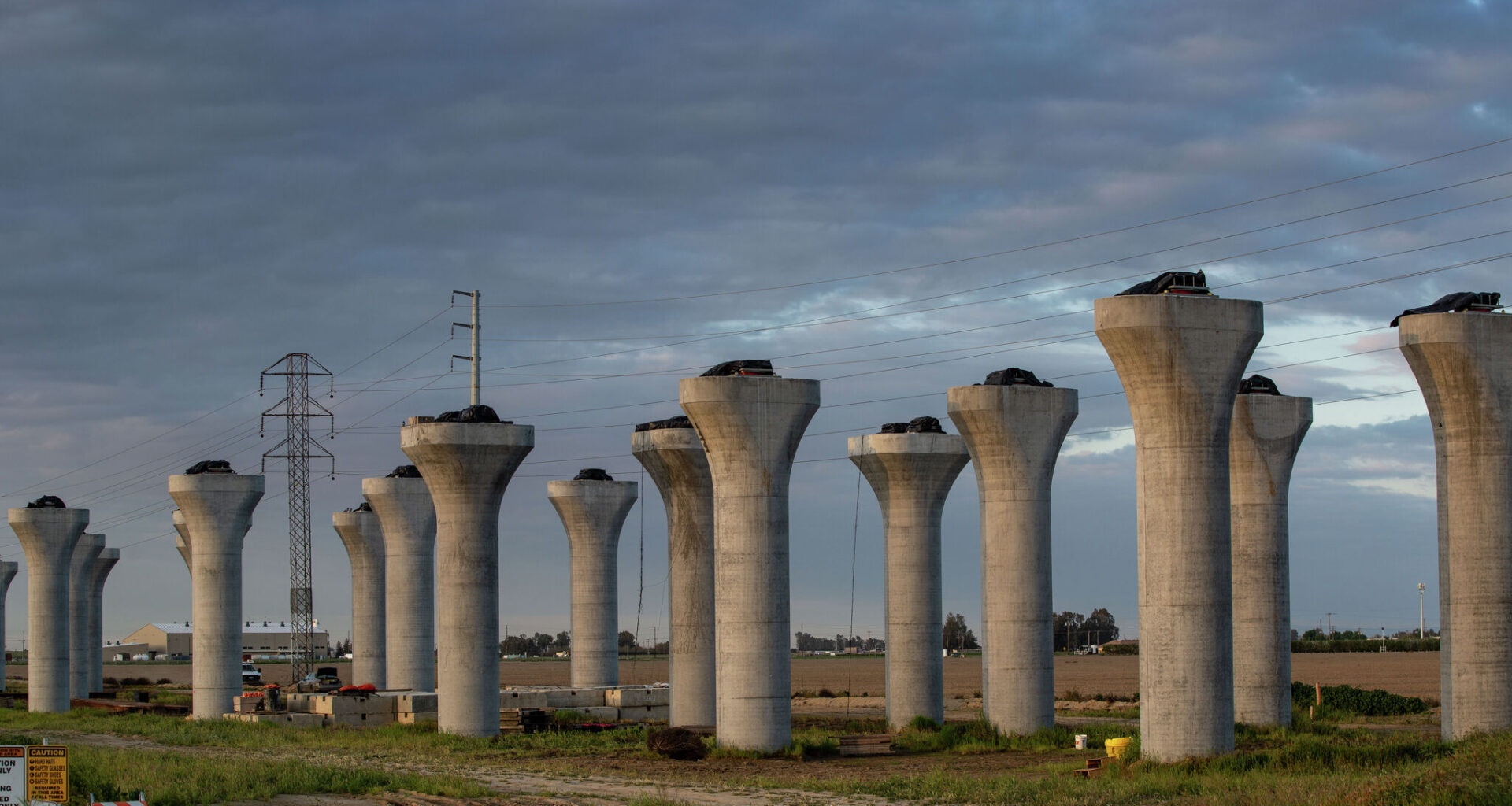
A view of concrete support pillars for California’s planned high-speed rail system between Fresno and Bakersfield, shown in April 2023.
George Rose/Getty Images
There was a rental car station at the Meadows Field Airport. I could Uber from the Bakersfield station to reach the airport, and freedom. There was one hitch. The train was scheduled to arrive at 4:39 p.m. if we continued on time. The rent-a-car counter closed 21 minutes after arriving, and the airport was at least 15 minutes from the train station.
I called the National Car Rental office at the Bakersfield airport, and the agent said they couldn’t stay late. I decided to chance it.
Article continues below this ad
My rideshare was waiting for me at the Bakersfield station, but the train was a few minutes late. It was already 4:45 p.m. He drove fast, and I reached the airport at 4:57 p.m. I dashed into the small terminal and found the car counter.
A few minutes later, I was in a rental car and pondering a trip to Las Vegas. But first things first: I stopped at a fast-food restaurant for Diet Coke, this time with ice.