
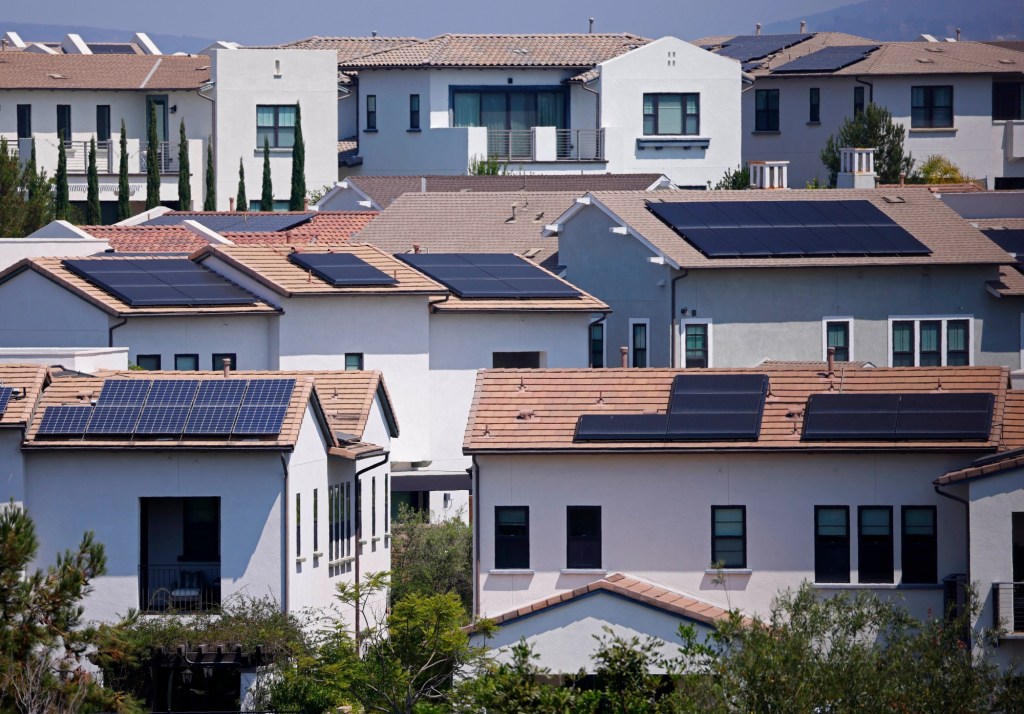
After being turned back earlier this month in their latest attempt to overturn California’s rooftop solar rules, three environmental groups aren’t giving up.
They’ve petitioned for a rehearing, insisting a state appeals court was wrong when it upheld regulations put into place almost three years ago by the California Public Utilities Commission.
A submission from the Center for Biological Diversity, the Environmental Working Group and San Diego-based Protect Our Communities Foundation claims the California First Appellate District Court of Appeals in San Francisco made numerous “omissions and misstatements” when it ruled in the CPUC’s favor earlier this month.
The court of appeals has 30 days to decide whether to hear the case again.
“This case is about giving people greater opportunity to generate solar power and bring down their electric bills, which will get California back on track to meeting our climate targets and stop rewarding corporate profiteers,” said Roger Lin, senior attorney for the Center for Biological Diversity. “A rehearing will give the appeals court a chance to get it right.”
The San Diego Union-Tribune emailed the CPUC, asking for its reaction to the petition, but as of 2 p.m. Friday, the commission did not issue a comment.
The dispute centers on the third iteration of the state’s Net Energy Metering, or NEM, tariff that the CPUC passed in a 5-0 vote in December 2022. Under NEM, customers with rooftop solar receive financial credits that are applied to their utility bills when their systems produce excess power.
Colloquially known as NEM 3.0, the tariff went into effect in April 2023.
The new rules included incentives to encourage customers to pair their solar installations with battery storage systems. But the update also decreed that new rooftop solar customers would no longer be credited at the retail rate of electricity when their systems generated surplus energy. Instead, they get paid at the “actual avoided cost,” which is lower.
CPUC commissioners said the change sent a “more accurate price signals that encourage electrification” across the state. But opponents said reducing the rate of compensation undercuts the incentive for potential customers to put solar on their roofs because it will take longer to recoup the tens of thousands of dollars customers typically spend to install their systems.
The three environmental groups opposed to the NEM 3.0 tariff took their case to court. The California Court of Appeal initially rebuffed their arguments but the California Supreme Court in August 2025 said the lower court afforded the CPUC too much latitude when the commission passed the updated regulations.
The Supreme Court did not conclude that the new solar rules are “correct or incorrect,” and kicked the case back to the lower court.
On March 9, the court of appeals once again sided with the CPUC in a 3-0 decision. Its 33-page ruling said, “we remain unpersuaded that petitioners have shown the Commission’s Decision fell outside its lawmaking authority,” as delegated by the Legislature.
Undeterred, the trio of environmental organizations filed for a rehearing earlier this week, insisting the appeals court made the wrong call.
The 32-page petition targets the CPUC. The state’s three big investor-owned utilities — Pacific Gas & Electric, San Diego Gas & Electric and Southern California Edison — are listed as real parties in interest. In the previous hearings, attorneys for the utilities filed briefs in support of the CPUC.
Among their complaints, the groups say the appeals court ruling did not address whether the CPUC had “not proceeded in the manner required by law.”
They made multiple references to a statute in the Public Utilities Code, Section 2827.1, that requires the CPUC to ensure that “customer-sited renewable distributed generation continues to grow sustainably” across California.
The environmental groups also challenged the notion that rooftop solar leads to a “cost shift.”
Utilities insist that the growing number of installations in California leaves customers who don’t have solar paying an unfair share of the fixed costs that come with maintaining the electric system — substations, transformers, poles and wires, etc.
“But there is no cost shift when customers generate their own electricity,” the environmental organizations said in their petition. “When customers generate their own electricity, it provides benefits to all customers and the electrical system by allowing for increased renewable electricity consumption with privately funded, customer-sited facilities that avoid the need for grid expansions.”
The NEM 3.0 regulations passed by the CPUC apply only to customers with systems installed in April 2023 or later.
Solar customers who had their systems installed under earlier iterations of the tariff still get compensated at the retail rate for 20 years from the time their systems became operational before the new rules affect them.
For example, a customer who had a system installed in 2018 gets credited at the retail rate until 2038. But after that, the customer will be credited at the lower NEM 3.0 rate.