
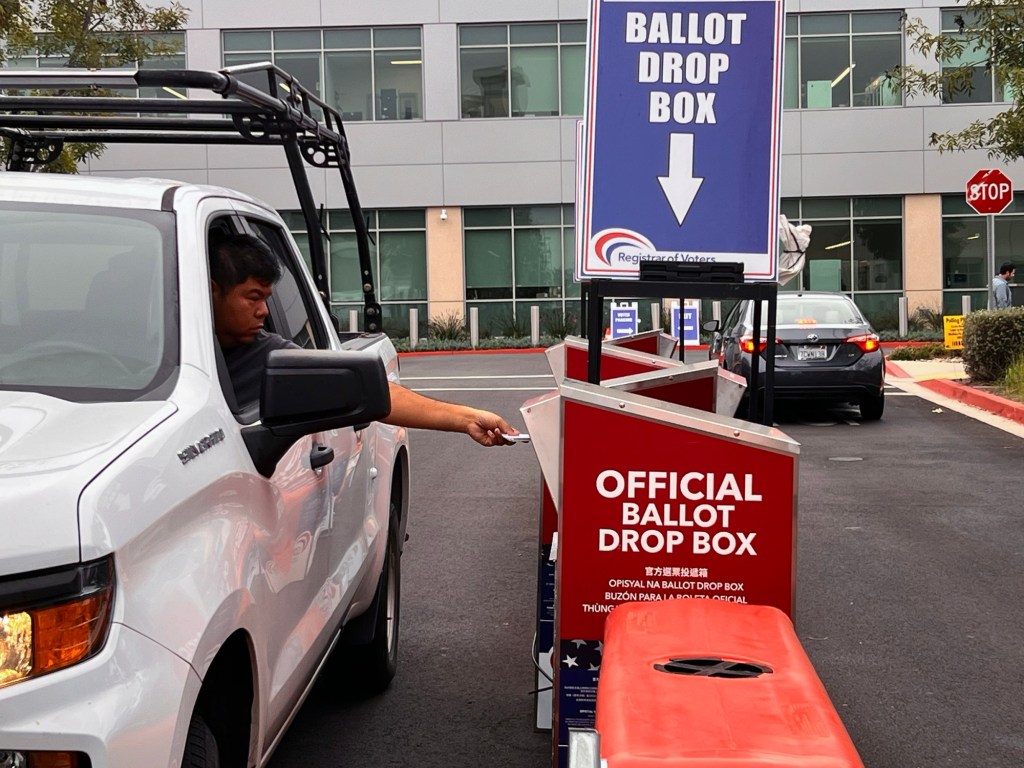
Limits on how ballots get counted and who can cast them are likely coming.
Whether any of the proposed changes are worthy aside, the main argument driving them is not: the notion that there’s been election-changing voting fraud, as President Donald Trump and many of his allies claim. It’s false; simply made up.
There hasn’t been a documented case of that kind of subterfuge in federal elections, at least for a good while. You can look it up.
Neither is there evidence of widespread illegal voting by undocumented immigrants or noncitizens, as the president also repeatedly claims. You can look that up as well.
Voting by mail is not “cheating,” as the evidence-free president — who also has voted by mail — is fond of saying. You can… well, you get the idea.
One in three Americans voted by mail in the 2024 election — cheaters all? — which was actually down from a record 43 percent in 2020 during the height of the COVID pandemic, according to the U.S. Election Assistance Commission.
Elections have never been more secure, transparent and accurate, according to various independent analyses. They’ve been more heavily scrutinized, in large part because of the stream of untruths from Trump and his acolytes. Now there’s a backhanded compliment.
The absence of anything but miniscule, unrelated and inconsequential voting fraud has been pointed out here and elsewhere, including in the Heritage Foundation‘s state-by-state election fraud count. But it bears repeating because the fiction continues. This is not to say any illegal voting shouldn’t be rooted out.
Trump’s bogus claim that the 2020 election was stolen from him has been disproved time and again — in court, recounts, research and investigative reporting.
The same goes for what Trump and his spokesperson said after Californians overwhelmingly approved the Proposition 50 congressional redistricting measure last fall.
White House press secretary Karoline Leavitt seconded the president’s claim that the vote was rigged with, as usual, no proof.
“It is just a fact,” Leavitt said. “They have a universal mail-in voting system, which we know is ripe for fraud … fraudulent ballots that are being mailed in, in the names of other people and the names of illegal aliens who shouldn’t be voting in American elections.”
Such lies are so common they don’t seem to get much pushback these days. Never mind that several other states conduct elections primarily by mail — most of them are Democratic, but the list includes deep-red Utah. Other Republican states allow broad use of mail ballots.
Curious actions have further churned up controversy around elections. The FBI seized 2020 ballots in Fulton County, Ga., in January. Riverside County Sheriff Chad Bianco, a California Republican gubernatorial candidate, did the same in his county after a citizen group claimed a discrepancy in the Proposition 50 election tally.
Meanwhile, Republicans in Congress want to drastically limit the use of mail ballots (at Trump’s insistence), require proof of citizenship to register to vote, and mandate a photo ID to cast a ballot.
People already have to sign under the penalty of perjury that they are U.S. citizens when registering to vote.
Critics say the new citizenship requirement would be particularly onerous because many people don’t have passports or easy access to their birth certificates, the two key documents needed under the proposed SAVE America Act.
Regardless of what happens there, a California initiative spearheaded by Assemblymember Carl DeMaio, R-San Diego, that requires proof of citizenship and a photo ID to vote appears headed for the ballot.
About 12 percent of registered voters nationwide do not have ready access to the types of documentation most likely to satisfy the proposals — that equates to 28.4 million voting-age citizens, according to the Bipartisan Policy Center.
People who have changed their names, particularly married women, would face additional hurdles to qualify to vote.
The measure further causes consternation among Democrats because it also would give the Department of Homeland Security control over voter rolls and determining eligibility. That’s under states’ authority now.
Trump has said passage of the legislation would “guarantee the midterms” for Republicans, allowing him to continue ruling unfettered by a Democratic majority in the House and possibly the Senate. However, there has been increasing analysis that the bill could backfire on the GOP, restricting Republican as well as Democratic voters.
Of all the voting changes floating around, what seems most likely at the moment is an end to or significant limit on counting mail-in ballots after Election Day. By most accounts, the conservative Supreme Court majority this week appeared skeptical of a Mississippi law that allows ballots postmarked by Election Day to be counted if they are received within five business days after the election.
In California, the window is seven days after the election, a law that could be scuttled by the court’s decision.
Despite outside chatter about fraud, the arguments in court focused on whether the law allowed counting late-arriving ballots.
An earlier lawsuit challenging California’s late-ballot counting window by GOP Rep. Darrell Issa of San Diego County also had a partisan angle.
“. . . late-arriving (vote-by-mail) ballots tend to favor Democratic candidates and provide an unfair electoral advantage for opponents of Republican congressional incumbents,” the lawsuit said.
Democrats extended California’s late-count provision and mail balloting to make voting more accessible and to tally all valid ballots. Another motivation was also clear: It might boost Democratic turnout.
Critics fear that if late counting goes away, potentially millions of legitimate votes could be deemed invalid.
One result of the existing system is that vote tabulations in California go on for weeks, something that frustrates the public and the media, and, in the current atmosphere, helps fuel suspicion of electoral skullduggery.
Whether California is forced to stop counting ballots received beyond Election Day or not, maybe it should stop for the sake of good policy — or at least narrow the window. Election results are vital to the public, and people should get them as quickly and as accurately as possible.
Many other states only count ballots received by Election Day. The Golden State is much larger than the others and it would take some doing to replicate that, namely a lot more money.
But the Democrats who control the state and election officials successfully adjusted to the expansive changes in both election processes and politics. Republicans were slower to do so. The roles may be somewhat reversed, but it would seem the state can adapt to the changes ahead.
California may have no choice.
What they said
Mica Rosenberg (@micarosenberg), investigative reporter for ProPublica.
“ProPublica has been able to quantify how many U.S. citizen children have been directly affected by Trump’s immigration crackdown: more than 11,000 kids had a parent detained — and that’s an undercount.”