
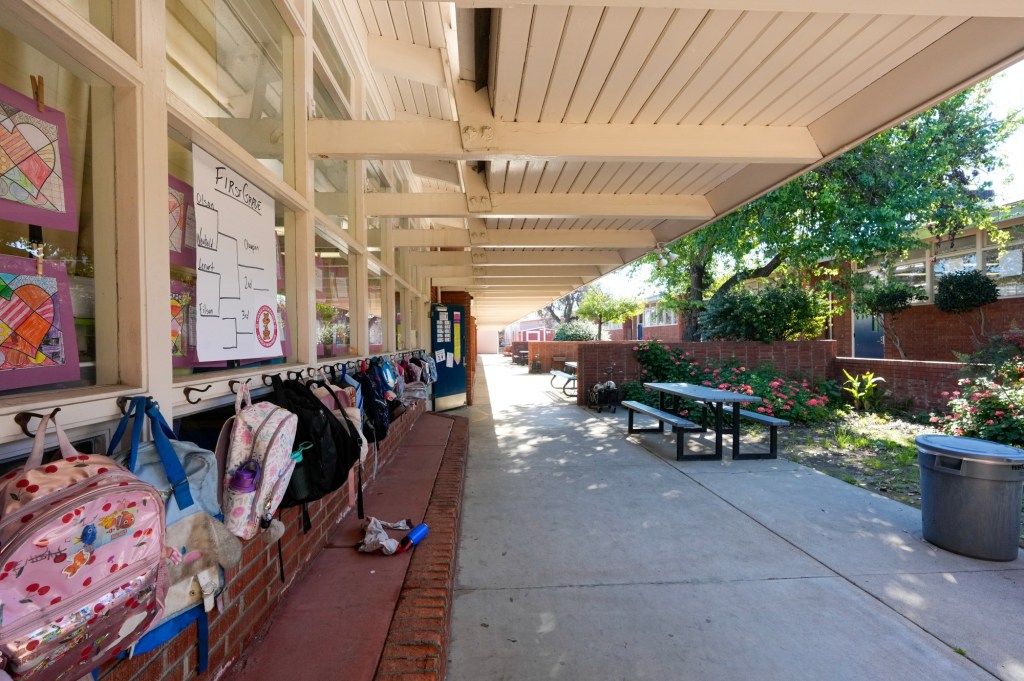
Johnny Heredia expects to spend an upcoming summer digging up pipes at Chase Avenue Elementary School.
As director of facilities, maintenance and operations for Cajon Valley Union School District, he’s the one called when sewage backs up into bathrooms or playgrounds. It happens often.
Digging up the pipes, he acknowledges, would destroy the floors and sidewalks. But those need to be replaced anyway. While he’s at it, he could finally bring the bathrooms into compliance with disabilities law and maybe replace the floors’ terrazzo — it’s expensive, he acknowledges, but it lasts forever.
“You’ve ruined the sidewalks, destroyed the sprinkler system and the grass — and then you start to get into structural issues, as you’re saw-cutting into other things just to replace the sewer system,” he said. “Even though the sewer system’s $1 million, you’ve done $2 million worth of damage.”
If the East County school district could pass a bond, it could address some of these issues at its aging schools. But voters haven’t passed a facilities bond in nearly two decades, and since then, the district’s maintenance budget hasn’t been able to keep up with the needed repairs.
Cajon Valley is a growing elementary school district serving nearly 18,000 students, among them many refugees and recent immigrants. Although the district is centered in El Cajon, it also stretches east and south into rural unincorporated San Diego County areas.
Voters in the district passed a technology bond in 2016, but in two elections since, the district has tried and failed to pass a facilities bond. Measures in 2020 and 2024 both fell short of the 55% support threshold state law requires for many school bonds to pass.
But results in the 2024 election showed support varied widely around the district. Support was markedly lower in more rural areas than in central El Cajon, whose voters overwhelmingly backed the measure.
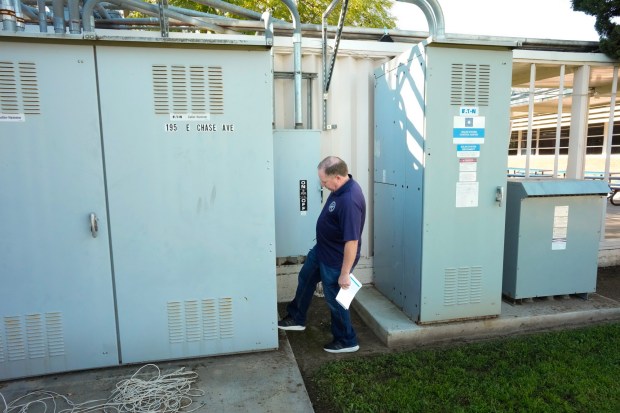 On Thursday, March 12, 2026, Cajon Valley Union School District’s facilities director Johnny Heredia points out how the electrical box where the main feed comes into Chase Avenue Elementary School needs to be replaced. (Nelvin C. Cepeda / The San Diego Union-Tribune)
Now, to meet the still-growing facility needs, the district and its board are turning to an alternative way of voting on bonds: breaking their community into smaller subdistricts. Voters in each subdistrict will get to vote on bonds that will impact only that area and its schools.
With this method, voters will, in theory, better understand the reasons why their neighborhood school needs repairs, and they’ll see the results of their vote up close.
In the meantime, Chase Avenue Elementary is showing its age — and the inevitable issues that come with it.
“Its shelf life is 50 years,” he said about some pipes. “We’re years past that.”
In an effort to secure the funding needed to update its schools, the Cajon Valley school board this month passed a resolution of intent to subdivide the district into what are called school facility improvement districts, or SFIDs. Bonds for all three improvement districts will go before the board in April.
In such an improvement district, voters weigh in on a bond specific to that subdistrict, and any resulting bond money can then be spent only in that area. But if a school’s attendance boundaries are located in more than one improvement district, it can benefit from multiple bonds — for instance, in Cajon Valley, one school is at the corner where all three subdistricts meet and could benefit from any bond.
The arrangement could help some areas benefit from bond money, even if voters across the district are less supportive.
In 2024, when Cajon Valley’s last bond measure failed with 52% overall support, the votes showed a geographic split: Only about 44% of voters in Trustee Area 1 voted yes on Measure W, while more than two-thirds of those in Trustee Area 3 did.
By splitting the district into improvement districts, the hope is that voters will be more likely to support the schools specific to their area, said Scott Buxbaum, the district’s assistant superintendent of business services.
A voter whose children attend a school where sewage routinely backs up is voting — “in theory,” he said — for their family. “Whereas if I’m a voter in, like, Rancho San Diego area, my schools are not as old,” he added.
When improvement districts work
School facility improvement districts aren’t unheard of in San Diego County. But they also aren’t widely used.
Such districts are often formed when a school district is experiencing a burst of development or enrollment growth concentrated in certain areas, explained Erica Gonzales, a managing director at the investment bank Stifel who specializes in California school financing.
Their creation can help school districts tailor their bond programs, and generally, it works well — although they can get complicated if the SFID’s credit rating differs from that of the district as a whole, she added.
But an improvement district can help focus funding on an area of a school district that’s seen substantial growth and needs investment.
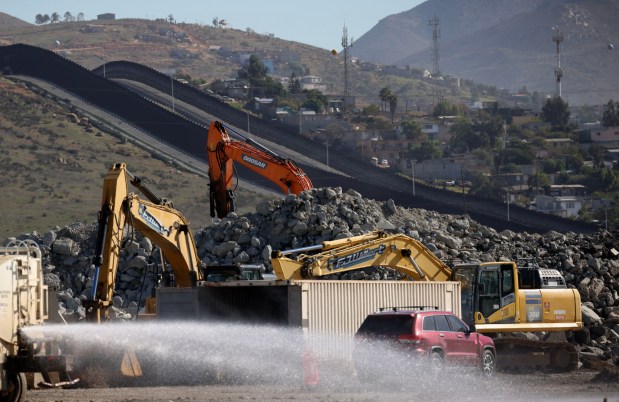 The new Otay Mesa Port of Entry under construction on Tuesday, Nov. 25, 2025. There are plans for significant housing growth in the area, which could further heighten school facilities needs. (Photo by Sandy Huffaker for The San Diego Union-Tribune)
That’s why San Ysidro School District created them. A boom in homebuilding in one area of the district had created a need for new schools, said assistant superintendent Jose Iniguez, and in 2024, voters approved three SFID bonds for school infrastructure.
The district hasn’t decided exactly how to spend the money yet, Iniguez said. It may try to build a new school to serve the fast-growing Otay Mesa population, based on directions from the board. Two schools are already at capacity.
But the cost of construction has risen from $300 per square foot to over $1,000 per square foot in just the last few years, he added.
He estimates building a new school could cost anywhere from $100 million to $200 million.
“Even if you were to combine the three SFIDs, total it up, it wouldn’t altogether cover the cost of a new school,” he said. But he thinks the community understands the need.
Infrastructure needs are critical for students to learn, Iniguez added, which is why the district needs to constantly repair and maintain them — including air conditioning systems.
“Who can learn when it’s really, really hot?” he said.
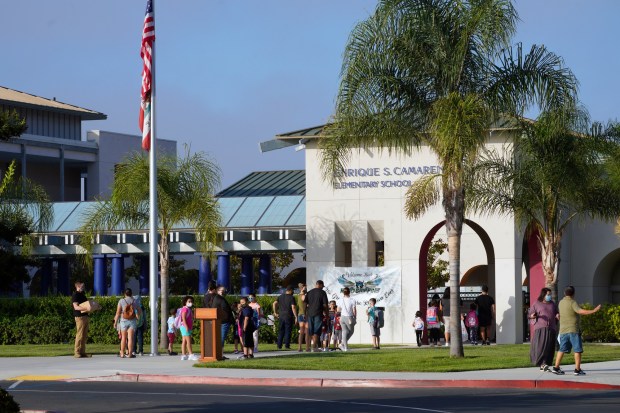 Children arrive at Enrique S. Camarena Elementary School on Wednesday, July 21, 2021, in Chula Vista. (Nelvin C. Cepeda / The San Diego Union-Tribune)
Chula Vista Elementary School District has also turned to improvement districts to improve its schools. Voters there passed a bond for one such district in 2012, with Proposition E.
That measure passed with the support of 69% of voters and has helped fund 31 of the neediest among the district’s 44 schools.
It “allowed the district to improve the educational environment at our neediest campuses substantially,” the district said. “Prop. E’s margin of victory represented the highest level of support for a general obligation bond on the ballot in San Diego County.”
The San Diego County Taxpayers Association hasn’t taken an official position on the use of school facilities improvement districts to fund upgrades — but the group’s new leader expressed support in an interview.
Mark Kersey, the association’s new president and CEO, pointed out that the group had supported San Ysidro’s effort. And it makes sense for school districts struggling to pass bonds as a way for them to work to find better ways to communicate with their communities.
“It still has to go to the voters,” he said.
Short term, high needs
Chase Avenue Elementary and most of Cajon Valley’s other oldest schools are in SFID 1, which includes central El Cajon and the district’s trustee areas 2, 3 and 4. Bond funding would help improve what Buxbaum calls the “bones of the school” — things that can’t usually be addressed with the district’s deferred maintenance program.
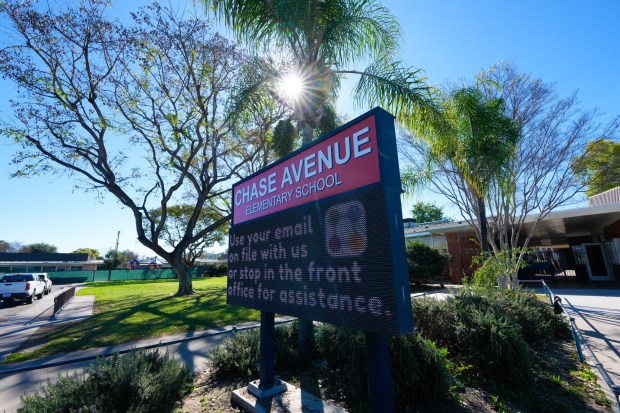 Much of the infrastructure at Chase Avenue Elementary School needs to be replaced, the district’s operations manager says. (Nelvin C. Cepeda / The San Diego Union-Tribune)
Even if voters pass a bond, it won’t be able to fund everything a school like Chase needs. That’s in part because the district is planning to pursue 10-year bonds rather than the typical 20- or 30-year bonds — the board of trustees preferred the shorter term.
“That’s really the direction I’m getting,” Buxbaum said.
Karen Clark-Mejia, the board president and trustee for Area 4, wrote in an email that the board must evaluate long-term facility needs and ensure potential bond proposals are responsible to taxpayers while supporting “safe and modern learning environments for our students.”
“There have been preliminary discussions about different financing structures, including shorter bond terms, because the board is mindful of the long-term financial impact on the community,” she said. “Any decisions would ultimately occur through a public process with community input.”
Lily Schworm — the board’s vice president and the trustee for Area 3, whose voters broke overwhelmingly for a districtwide bond in 2024 — said she was the one who pushed for a shorter bond term. She preferred the lower interest payments over time and felt voters want bonds to benefit current students.
“The short-term bond saves us a significant amount in interest,” she said.
She also doesn’t want debt to be passed down to future generations, she added in a later email. “Those future residents deserve the opportunity to determine their financial and educational priorities for themselves,” she wrote.
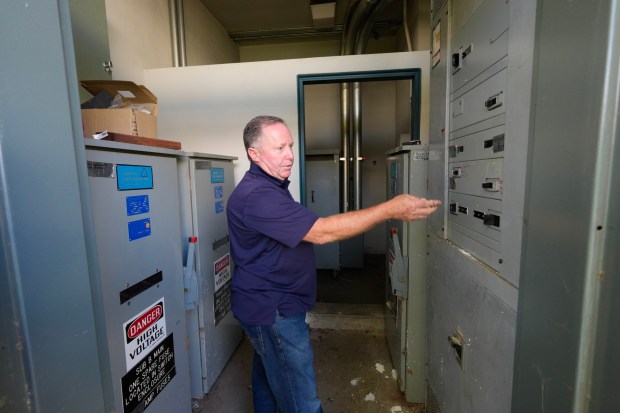 Cajon Valley’s facilities director Johnny Heredia points out the outdated main electrical power box that feeds Greenfield Middle School in El Cajon on March 12, 2026. (Nelvin C. Cepeda / The San Diego Union-Tribune)
But Heredia can’t help but think big about how Chase Elementary could be better.
Walking around campus, he points out what a bigger budget could let him accomplish — projects like adding more classrooms, and getting rid of the trailers that serve as temporary substitutes. For Chase, it would require more than $22 million, he said.
To him, school facilities are as essential a part of the learning process as anything. And it’s not just Chase Elementary that would benefit.
Greenfield Middle School, also in SFID 1, could also use bond funding. Its campus is a mix of older and new buildings. A faulty lawn sprinkler system leaves parts of the campus damp. The bathrooms need work — and really should be the same color. One pipe acts up each week.
But not much else is predictable in Cajon Valley’s day-to-day needs.
“It depends on the school,” Heredia says. “It depends on the moon placement. It depends on the mood of the kids.”