
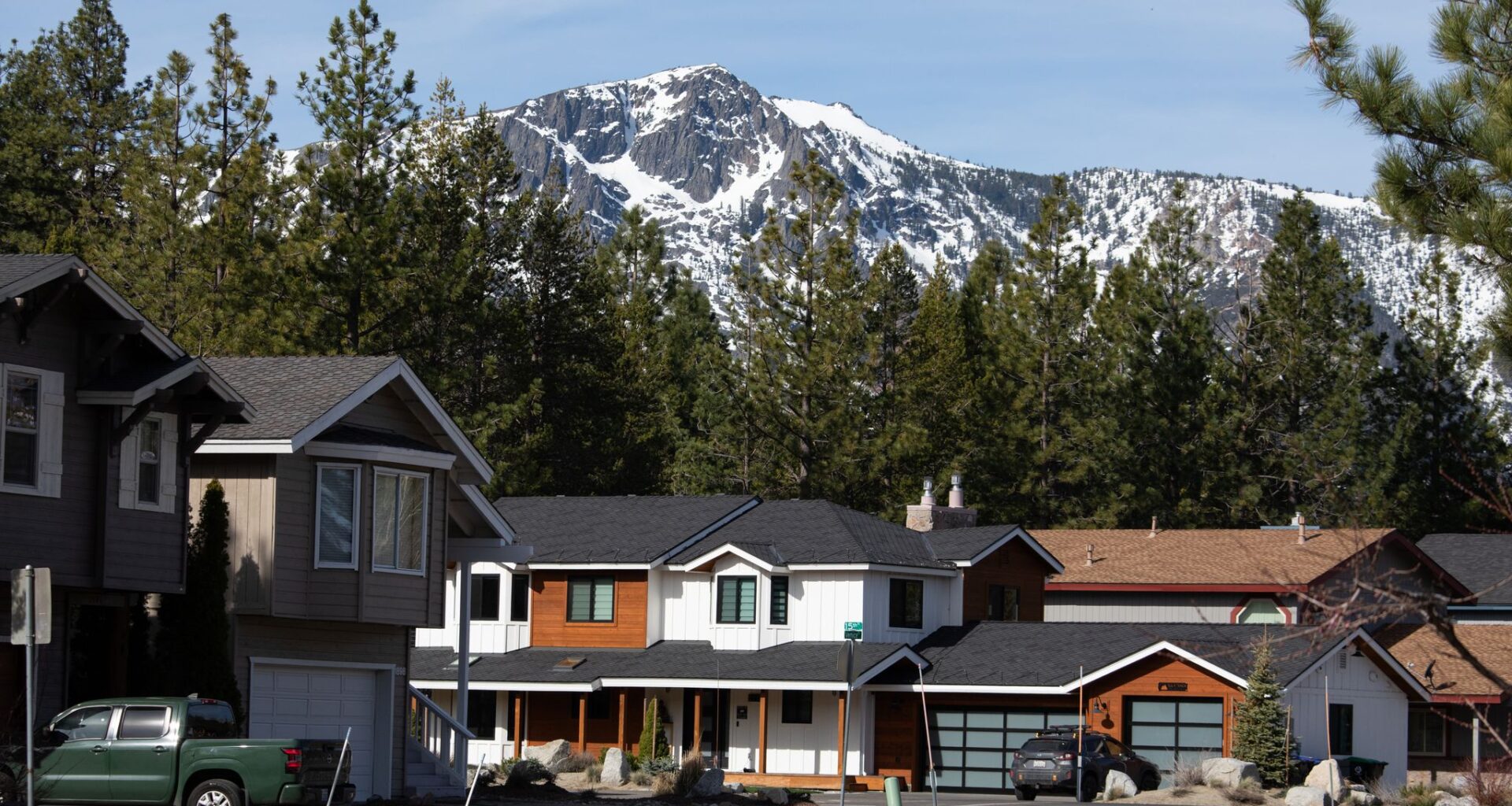
Newer contracted houses are seen near the Tahoe Keys neighborhood. South Lake Tahoe has struggled to balance vacation homes and rentals with affordable housing for workers and full-time residents.
William Hale Irwin/For the S.F. Chronicle
Tahoe locals call them “mushroom homes.”
The vacation houses have sprouted up like a fungus from the woods to the waterfront, and many of them sit empty for much of the year — like nearly half of all housing in South Lake Tahoe, according to federal data. Yet year-round residents struggle to find housing they can afford, even forcing some area workers to live in old motels.
What to do about this housing mismatch has bedeviled Lake Tahoe’s largest city, as it has mountain towns from California to Vermont. A controversial proposal to cap the number of second homes, which would have likely been the first legislation of its kind in the U.S., died in council chambers last month. Meanwhile, the City Council this week loosened limits on short-term vacation rentals, which is expected to add to the vacation rental stock.
Article continues below this ad
On paper, South Lake Tahoe has enough housing for its residents, with about 16,700 housing units for its population of approximately 21,000, according to the most recent U.S. census in 2024. The problem lies with the “predominance” of second homes, according to a city report.
More than 7,100 of the city’s housing units are considered “vacant,” with the vast majority — nearly 6,000 — designated for “seasonal, recreational or occasional” use.
San Francisco Chronicle Logo
Make us a Preferred Source to get more of our news when you search.
Add Preferred Source
Some of the new mushroom houses that fall into this category even look like mushrooms, said Council Member Scott Robbins, with upper levels bulging out over their small garage base to maximize space while complying with land-use laws.
“Families have fled Tahoe to be replaced by retirees and second-home owners who don’t live here,” said Robbins, who proposed the second-home cap. “The result is a reduction in workforce, a reduction in businesses that serve local needs instead of tourist needs, and a catastrophic decline in school funding.”
Article continues below this ad
Scott Robbins, a South Lake Tahoe City Council member, stands in front of a vacant house in his neighborhood. Robbins had proposed a cap on second homes, which has stalled.
William Hale Irwin/For the S.F. Chronicle
Short-term gains
The rise of short-term rental platforms in recent decades has compounded the problem, some community advocates say. Unlike other localities, there is no annual cap on the total days a permitted short-term rental property can be rented out, only that each stay is fewer than 30 days.
The city had approved 382 permits under rules that required them to be 150 feet apart. But council members scrapped that spacing requirement Tuesday under pressure from property owners and managers who called it unfair, replacing it with a residential cap of 900 units. The change is expected to open the door for roughly 300 additional properties that had previously been denied permits.
Ally Giordano, the co-founder of a local vacation rental management company, spoke in favor of the change at this week’s City Council meeting, arguing that many high-end homes shut out by the 150-foot spacing rule had instead sat vacant.
Article continues below this ad
“They will not create any (tax) revenue, no jobs, no real benefit to the community,” Giordano said. “But if that same home operates legally” as a vacation rental, she went on, “it generates tax revenue and supports city services that could help affordable housing and workforce housing programs.”
Tahoe’s fight over short-term rentals and vacation homes is long-standing. Voters approved a 2018 measure that sought to eliminate all short-term rentals outside a central “tourist core area.” At the time, nearly 1,400 licensed vacation rentals operated in residential neighborhoods outside the core.
A vacation rental company’s sign is seen near downtown South Lake Tahoe. Affordable housing for local residents has been a big issue for the City Council, which recently voted to loosen restrictions on short-term vacation rentals.
William Hale Irwin/For the S.F. Chronicle
But last March, a judge struck down the rule. They found that an exception allowing permanent residents to rent their homes violated the Constitution by favoring local residents over those from other states, what’s known as the Dormant Commerce Clause. (A California Court of Appeals is still considering whether the other portions of the measure can be revived, Mayor Cody Bass said.)
Robbins’ second-home proposal would have allowed existing second homes to remain, but required future buyers to get a permit to use the property as a vacation home. He suggested those second homes be capped somewhere between 25% and 30% of the housing stock.
Article continues below this ad
But city staff, including City Attorney Heather Stroud, declined to recommend the cap because they feared the measure would face similar court challenges to the 2018 measure.
“The difficulty in doing this is drawing a line between primary residences and second homes,” Stroud said.
Robbins argued that the cap would have applied equally regardless of residency. But the council decided to take no action on Robbins’ proposal, effectively killing it.
A bigger problem
Many cities and towns throughout the Lake Tahoe Basin face the same conundrum. Parts of the north shore, including the Sunnyside-Tahoe City area, have vacancy rates nearing 70%, according to the most recent census.
Article continues below this ad
As homes shift into seasonal use, it becomes harder for the local workforce to find stable housing, said Amelia Richmond, a South Lake Tahoe resident who co-authored a 2024 ballot measure that would have taxed vacant homes but failed decisively, with 71% of voters opposed.
The vacancy tax campaign drew significant spending from real estate groups. The California Association of Realtors Issues Mobilization PAC donated nearly $335,000 to oppose the measure, according to campaign finance reports, while the National Association of Realtors contributed $625,000.
“There is far, far too much deference to the interest of Realtors who want house prices to keep going up,” Robbins said. “So long as that is what controls local government here in resort towns, we’re not (going to see) meaningful, rigorous solutions to the housing crisis.”
The housing pressures intensified during the pandemic, when a flood of remote workers drove up prices and squeezed supply in mountain towns like South Lake Tahoe, said Zachary Thomas, the city’s director of development services.
Typical home prices spiked from 2020 to mid-2022, rising from roughly $470,000 to nearly $730,000 at its peak, according to rental marketplace Zillow. The typical house price was roughly $640,000 in February, while the median household income was $82,000, according to the census.
The city has acknowledged that the region’s housing stock is used inefficiently, with many workers living in older motel rooms that were never designed for permanent living.
City officials say they are pursuing other strategies to ease the local housing shortage. Sugar Pine Village, an affordable housing development, will add 248 units, with 128 already complete and occupied. Additional homes there are expected to become available this summer, and hundreds of people have expressed interest in a spot, Thomas said.
The city has also offered incentive grants of up to $10,000 to encourage homeowners to rent to moderate-income earners, a program Thomas said has housed 153 people so far.
‘Feast or famine’
Sandra Santané, the owner of café and bookstore Cuppa Tahoe, said she is able to manage fluctuations in customers’ traffic fairly well throughout the year. The far bigger problem, Santané said, is staffing. Several times, she has hired workers who haven’t been able to find stable housing and later had to leave.
Many of her employees have had difficulty securing housing within the city, both because it is hard to even find a long-term rental and the prices are too high, she said.
“This is by far one of the most challenging labor markets that I have seen, and it is due to the housing,” said Santané, a native of the Netherlands, who has worked in the hospitality industry in several countries.
Resort towns across the world face similar pressures, and some European localities have used second-home caps as a way to preserve housing for full-time residents. The Austrian state of Tyrol limits vacation homes per municipality to 8%. In Switzerland, voters decided in 2012 that only 20 percent of residences in any one community in Switzerland can be used as second homes.
But such caps haven’t made their way to the United States, and would likely face strong political resistance, said Margaret Bowes, the executive director of the Colorado Association of Ski Towns.
“Folks with second homes don’t feel like the government should be telling them how to use them,” she said.
A newly renovated house in South Lake Tahoe. The local slang for houses like these is “mushroom homes,” because they have sprung up widely and jut out from their base to maximize space while conforming to land-use regulations.
William Hale Irwin/For the S.F. Chronicle
In some mountain communities, vacation homes make upward of 80% of the housing stock, her organization estimates. And when entire neighborhoods go dark for “the great majority of the year,” local businesses suffer, Bowes said.
“It’s feast or famine,” she said. “We don’t think it is sustainable.”
Sophia Lodigiani, 24, moved to South Lake Tahoe in September intending to live in her late great-grandmother’s home until she could find her own apartment. Lodigiani adores the home, a trove of childhood memories.
But it’s still decorated to the taste of her great-grandmother. Two tweed couches that once supported her great-uncle and his smoking habit still carry a tobacco scent. The heater isn’t strong enough to warm the second floor.
She looked at dozens of places online, hoping to lock down a two-bedroom for under $2,000, to no avail.
“The only thing you can get in Tahoe that’s two bedrooms and $1,500 a month is the scams,” she said. “Almost all of the friends I have here live in houses with many, many people. And that’s just kind of how it works to live in Tahoe.”