
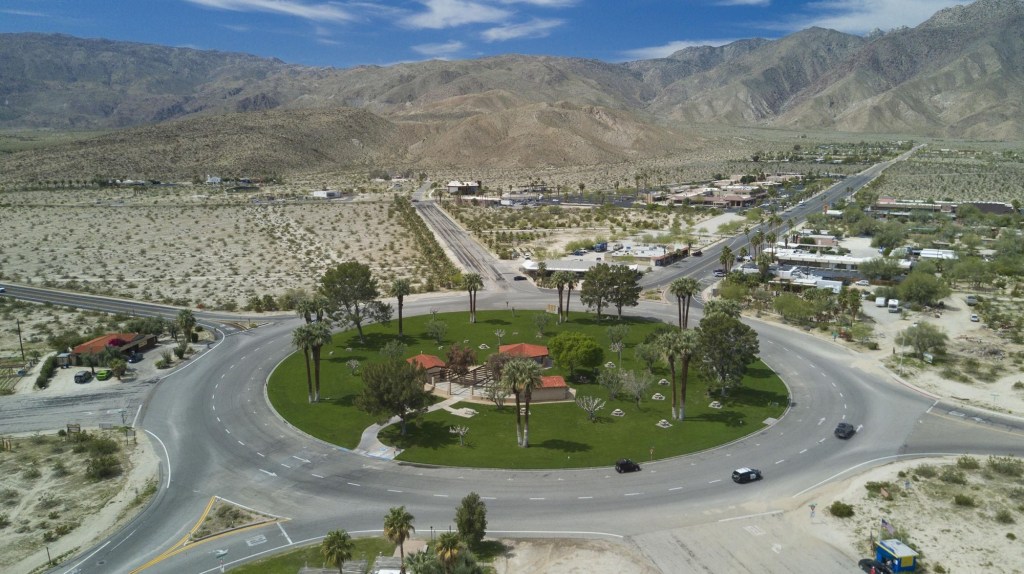
An advisory group in Borrego Springs is asking the county to more strictly regulate short-term rentals in the unincorporated desert town, warning that they are eroding the town’s sense of community and reducing housing availability.
“When homes are occupied by short-term visitors rather than permanent residents, the close-knit character of our community is diminished,” John Petersen, chair of the Borrego Springs Community Sponsor Group, said in a letter to Supervisor Jim Desmond.
The sponsor group acts as a liaison between the unincorporated community and county officials. In the letter, Petersen said it is difficult to identify the true number of short-term rentals, making it hard to measure the impact on the local economy.
Borrego Springs is located about 70 miles northeast of San Diego in the Anza-Borrego Desert State Park. It is a popular destination during the springtime when wildflowers bloom. It is home to around 3,000 full-time residents, most of them senior citizens.
Borrego Springs collected $940,251 in Transient Occupancy Taxes (TOT) during the 2024-2025 fiscal year, according to a report by the Treasurer-Tax Collectors’ office dated August 6.
The tax is often informally referred to as a “bed tax” and is imposed on travelers who stay in short-term rentals for 30 days or less. This applies to hotels, motels, and individual short-term rentals that are listed on sites like AirBnB or VRBO.
The desert town collects a significant amount of TOT compared to most other unincorporated communities in the county. Landlords in unincorporated communities across the county pay an 8% transient occupancy tax on rent.
As of February, there were 164 active short-term rental listings in Borrego Springs, with 99 having active certificates and 85 being non-compliant, according to the Treasurer-Tax Collectors’ office. They are preparing to send out notices to non-compliant operators, according to the letter.
In an email to the sponsor group, officials noted that their tax reports do not differentiate between hotels and short-term rentals.
“In reality, some of the input we have is that there probably is at least twice that or more (short-term rentals in Borrego Springs),” Petersen said, noting it was a rough estimate. “We hear that there’s a lot of people out here with short-term rentals that have not filed for the business license with the county.”
This makes it hard to know the amount of tax revenue the town could be missing out on, he said.
Borrego Springs is experiencing a “critical” shortage of long-term rental housing, Peterson said.
“Teachers, park staff, firefighters, EMTs, hospitality workers, and other essential employees often cannot secure local rental housing and are forced to seek housing near the Salton Sea — far from Borrego Springs and outside San Diego County,” the letter said. “As a result, local businesses, the school district and other entities struggle to hire and retain employees due to the lack of available and affordable housing.”
The Salton Sea is in neighboring Imperial County about a 38-minute drive from Borrego Springs.
The sponsor group believes this is a direct result of the large portion of the rental market being consumed by short-term rentals, especially those owned by individuals who do not live in Borrego Springs.
This issue is not individual to the desert town. Planning group members in the unincorporated community of Julian have raised similar concerns to county officials.
The group asked county officials to take further action to regulate and enforce short-term rental rules.
Besides more strongly enforcing registration and permitting, the group wants Supervisor Desmond to support limiting the number of short-term rentals in unincorporated communities according to a defined percentage of available housing. One suggestion was to operate an annual lottery-based system to determine eligibility to operate.
While short-term rentals are strictly regulated in the City of San Diego, the same restrictions are not applied to unincorporated areas. The group’s proposed changes would significally shift the rental market for communities outside of central San Diego.
A spokesperson for Desmond’s office did not respond to an inquiry by the deadline.
“If we want to deal with regulations of (short-term rentals) in the unincorporated area, unless we have cooperation from the Second and the Fifth (Supervisorial) Districts, we’re not going anywhere,” Petersen said.