
Good Friday, at its core, is not a church service. It is the memory of a state execution — of a teacher labeled a threat, eliminated in the name of law and order. Its raw meaning can be unsettling, even for those sitting in a pew.
As a professor of church history and former pastor, I often remind students and congregations that the crucifixion of Jesus of Nazareth, stripped of ritual familiarity, is difficult to face: a public execution carried out by authorities against someone who challenged both religious and political power. In the context of his time, Jesus was considered a traitor — an enemy of the Roman Empire. His capital offense was not primarily theological but political: refusing to pledge ultimate allegiance to Caesar over God. His death on a Roman cross, alongside countless others condemned by the state, was brutal.
And yet Christians call this day “good.”
Not because of the violence, but because they believe something larger broke through it: a radical vision of love and sacrifice that refuses to draw tight circles around who belongs — and who is left out.
That claim raises a question that feels urgent in San Diego, and across the nation, this week:
Who did Jesus die for — and who do we ignore?
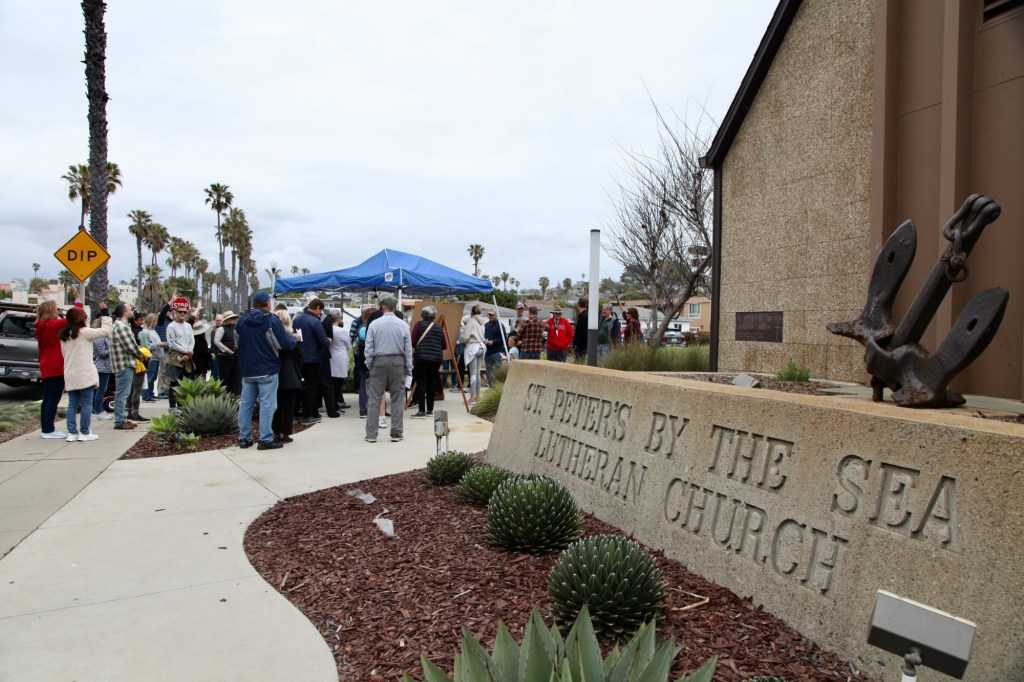
On Good Friday, April 3, from 11 a.m. to 1 p.m., 10 local congregations will take that question to the streets with a second annual “Stations of the Street” walk along Sunset Cliffs Boulevard — Ocean Beach’s historic “Church Row.” The one-mile, self-paced pilgrimage begins at St. Peter’s-by-the-Sea Lutheran Church (Point Loma Avenue and Sunset Cliffs Boulevard) and concludes at Resurrection OB Episcopal Church (Brighton Avenue), with groups departing every 15 minutes or participants walking on their own.
Along the route, nine stations will offer brief moments of reflection, prayer, and meditation on the Cross, each completing the same sentence: “Jesus died for …”
Some answers will sound familiar: for the poor and vulnerable; for the overlooked and marginalized; for children and animals; for all creation.
Others are more provocative: for the rich; for those who doubt; for your neighbor who may not share your views; for those living through wars far from our shores — especially in the Holy Lands; for the healing of the nations.
Last year, nearly 200 people participated in the inaugural walk on Church Row, creating a rare moment of shared reflection across denominational and neighborhood lines. A photo essay by Megan Sweas captured its quiet power and public witness.
San Diegans, like many Americans, are increasingly divided — over immigration reform and the role of agencies like ICE, over voting rights and democratic trust, over war and suffering in the Middle East. It seems easier to sort the world into opposing camps — us and them, right and wrong, deserving and undeserving — than to seek to bridge the divisions.
The Good Friday story confronts ideological divides and transcends one tradition or religion. It insists that the victim of state violence — executed outside the city gate — stands in solidarity with all who are mistreated, excluded, condemned, disappeared or forgotten.
The Ocean Beach walk is not a protest or a political rally. It is a shared act of public reflection at a time when such opportunities are rare. When Catholic, Protestant, evangelical and independent congregations work together, something unusual occurs. Instead of retreating into separate spheres, they step into a common space. Instead of offering a single answer, they pose a question.
Not everyone in San Diego will share the theological convictions behind Good Friday. Nor should they be expected to. But the question it raises belongs to anyone concerned about the kind of community we are becoming:
Who is included in our circle of concern?
Whose suffering counts?
Who belongs — and who remains outside the gate?
On April 3, above the cliffs overlooking the Pacific, on the streets of Ocean Beach, the question of who we include — and who we leave out — will be asked step by step, station by station, as participants reflect on a deeper Good Friday question: Who else did Jesus die for?
Christensen, Ph.D., is a clergy member of the Point Loma Peninsula Faith Leaders and Professor of Theology at Northwind Theological Seminary.