
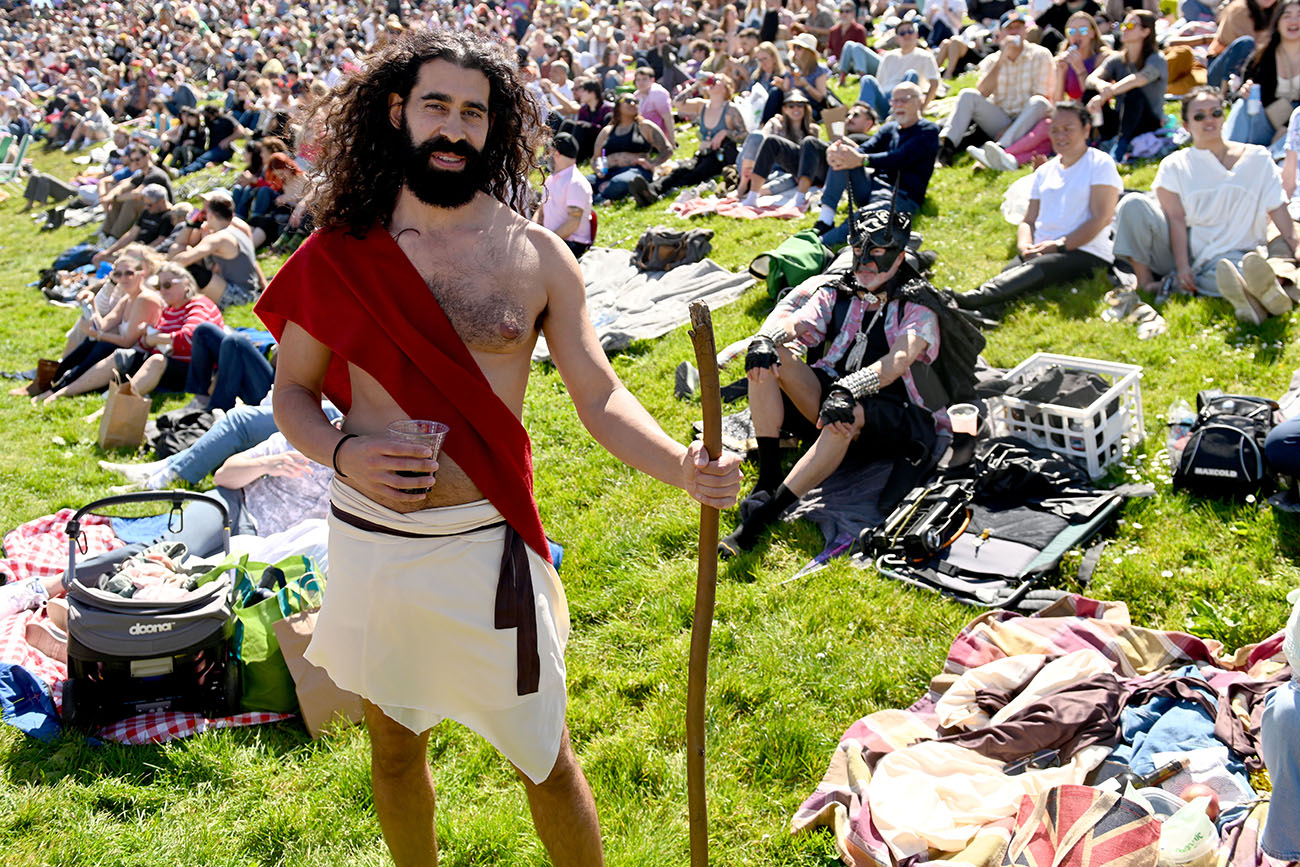
Is there a path to transit salvation through … Hunky Jesus? Signature gatherers for a five-county BART rescue measure are praying for it.
Last week, we wrote about the terrible, awful very bad consequences for BART if voters spurn that potential November revenue measure: Dirtier trains, crappier service, station closures, higher fares — human sacrifice, dogs and cats living together, mass hysteria.
But, as we disclosed, it’s actually worse than that: All of these privations assume BART continues to exist. Without a transfusion of revenue, there’s no reason to believe it will: At long last, the BART tunnels will be free to film the sequel to “THX 1138.” And in transit, misery loves company: The November measure would also provide revenue for Muni, Caltrain and AC Transit. Without it, Muni will slash service deeply and Caltrain and AC Transit are in danger of shuttering — especially Caltrain.
We regret to inform you that it gets even worse. In order to pass with a simple majority instead of a two-thirds vote, this five-county measure is being signature-gathered. That remains a significant challenge: The requirement is 186,000 valid signatures by early June.
“We are feeling good about where we are, but it’s definitely a steep hill to climb,” says Jeff Cretan, the spokesperson for Connect Bay Area, the committee formed to signature-gather this measure and, if things work out, campaign for it.
Lousy weather in February didn’t help. A ton of signature-gatherers for other measures doesn’t help either. That includes a measure to fight the so-called billionaire tax, funded by billionaires. This is driving up the price of paid signature gathering, and, naturally, the paid gatherers are going to be working harder to push the measure for which billionaires are paying $20 a signature.
It remains to be seen if enough signatures can be gleaned from farmers markets and transit stops across five counties. “We’ll be at Giants games,” Cretan notes. We get a sinking feeling that this may be the highlight of many Giants games this year.
And — yes — “we’ll be at Hunky Jesus.”
If the signature-gatherers are forsaken and don’t meet their goal, the measure won’t even appear on November’s ballot. And all the dire outcomes will come to pass — dogs and cats living together — without voters even having a chance to weigh in.
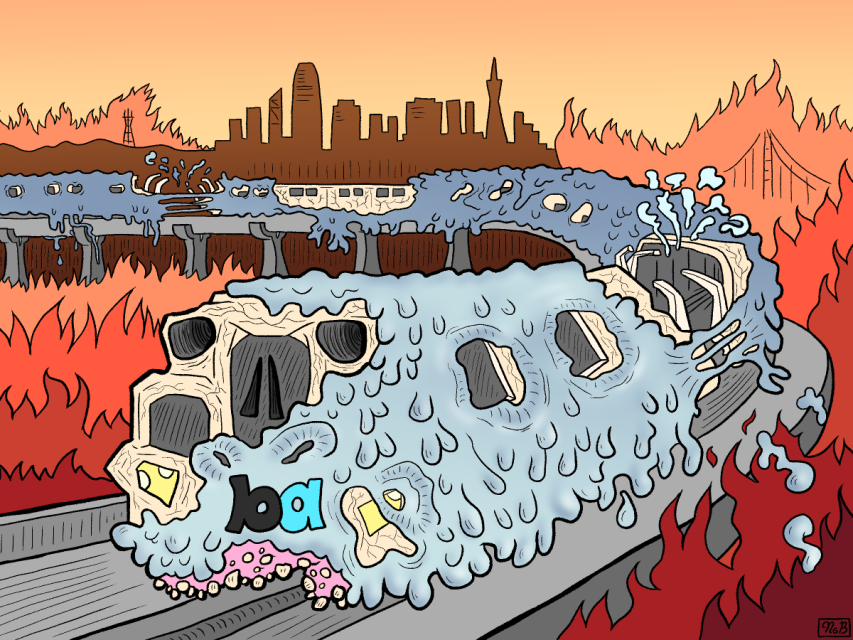 Alas: BART has bigger problems than ill-advised carpeting or trains louder than a Metallica concert. Illustration by Neil Ballard
BART is a system that was, literally, created to ferry workers and shoppers from the outer suburbs to Downtown San Francisco. BART employees in 2019 were worried about too many people taking the train. While transit systems, on average, make back about 17 percent of their operating budget from “farebox recovery,” BART was pulling about four-and-a-half times that.
And then 2020 happened. In inflation-adjusted dollars, BART’s revenues decreased around $371 million in 2024 vs. 2019. And BART’s operating deficit stands at $376 million. Transit funding is complicated, but this isn’t that complicated.
BART’s robust farebox recovery immediately flipped from being a strength to being a weakness. Same goes for Caltrain. But, long before the pandemic, not everyone was thrilled.
“I remember getting into an argument with the Caltrain people who were bragging about 70 to 75 percent farebox recovery,” said Sen. Scott Wiener. “No, no, no! That is not something to be proud of! It means your only option to raise revenue is raising fares. We’ve known since before the pandemic that they need more stable tax revenue.”
But that’s hard. In 2023, Wiener proposed funding transit through raising bridge tolls. That didn’t work out. In 2024, he tried to engineer a nine-county transit revenue measure. That, too, failed to launch. And in 2025, along with Sen. Jesse Arreguín, he engineered the five-county measure presently taking the Hunky Jesus and Giants game signature-gathering path to (potentially) appearing on November’s ballot.
One of the complaints leveled against this measure is that it’s a sales tax — meaning the panhandler outside Oracle Park pays the extra penny for every dollar spent to support transit same as the millionaire ballpayers inside the park. Whatever complaints there are, Wiener has heard them — and thought about them and tried to mitigate them.
A gross receipts tax on big businesses, he says, probably wouldn’t have advanced off the Assembly floor. This sales tax barely did. It also likely would have resulted in Santa Clara and San Mateo leaving the five-county group. It would’ve resulted in an opposition campaign from big business interests — and it didn’t poll high enough to necessarily survive that. And, to top it off, it’s hardly clear that Gov. Gavin Newsom wouldn’t have vetoed a tax on business.
“Senator Arreguín and I made an assessment after a lot of work that the only viable path forward was a sales tax,” Wiener says. “In the end, to me, job No. 1 was making sure BART doesn’t collapse, Muni doesn’t cut service by one-half and AC Transit and Caltrain don’t unravel.”
 At 24th Street Station. Photo by Walter Mackins, August 2021
Our article last week elicited a good deal of chatter and feedback. Mission Local can’t tell you how to vote but it can tell you when your arguments don’t add up. Most of them don’t.
Complaints that BART could just cut its way into right-sizing without additional revenue are nonsensical; recall the revenue numbers vs. deficit listed above. They’re pretty much one-to-one. Complaints that BART has been profligate with its spending also do not add up: On almost any metric, it remains one of the more efficient transit systems in the nation, even in its weakened state.
Complaints that the present management will be left in place assumes that there is someone else who could do better. Say what you will about BART, it is not run uniquely poorly.
Complaints that BART is being held hostage by its drivers’ union are not relevant to the budget deficit on hand. Drivers’ salaries, including overtime, account for between 7.77 and 7.96 percent of BART’s preliminary fiscal 2027 budget of $1.05 billion. That’s a ceiling of around $83.5 million, which is a lot of money, especially if placed in two piles — but a small fraction of the operating deficit.
Complaints BART is overextended and built unnecessary infrastructure are valid — but, again, irrelevant to the budget crisis of the moment. Transit systems run on capital budgets — building stuff, procuring stuff — and operating budgets — day-to-day stuff, paying people’s wages and the electricity bill. The sources for these two budgets are separate and very rarely commingle. Anyone complaining that, if only BART had stuck to core service it wouldn’t be in this predicament, does not understand the most rudimentary elements of transit funding.
Complaints that sales taxes are regressive ignore the fact that transit fares are regressive — you pay the same $2.55 to travel from Embarcadero to Balboa Park that Mark Zuckerberg does. Alas.
Complaints that BART is unaccountable in its budgeting and spending somehow ignore that BART is the rare transit system with an independent inspector general mandated to root out waste, fraud and abuse. The IG is appointed by the governor — meaning she does not answer to BART’s management or its board. To date, the inspector general has, per its own accounting, recovered more than $2 million. That’s great, but it’s budget dust in government terms. BART could run better but it is, evidently, not rife with waste, fraud and abuse.
What’s more, the legislation earmarking sales tax money for transit would mandate BART (as well as Muni, Caltrain and AC Transit) to be subjected to independent financial efficiency reviews by a third-party. They’d be made to prove efficiency measures they’d taken, come up with a plan to implement more — and their money could be withheld if they don’t enact that plan.
Hey, guess what? BART’s revenues in the first two quarters of fiscal 2026 were 10 percent higher than expected. Expenses, meanwhile, were 9 percent lower than expected. That’s kind of what you’d want with a public agency desperately trying to squeeze the most out of every dollar.
We can’t tell people gleefully cheerleading BART’s demise how to vote. But we can tell them that there is no downtown recovery without BART. Anyone happy to let BART fail has to be happy to let Downtown San Francisco fail. There is no daylight here.
Perhaps, in the end, gasoline prices approaching the per-ounce cost of Simpler Times beer will play into BART’s favor. That, along with Hunky Jesus, could be a formidable one-two punch.
And, hey, if the transit system collapses, there’s always that “THX 1138” sequel. As they say, always look on the bright side of life.