
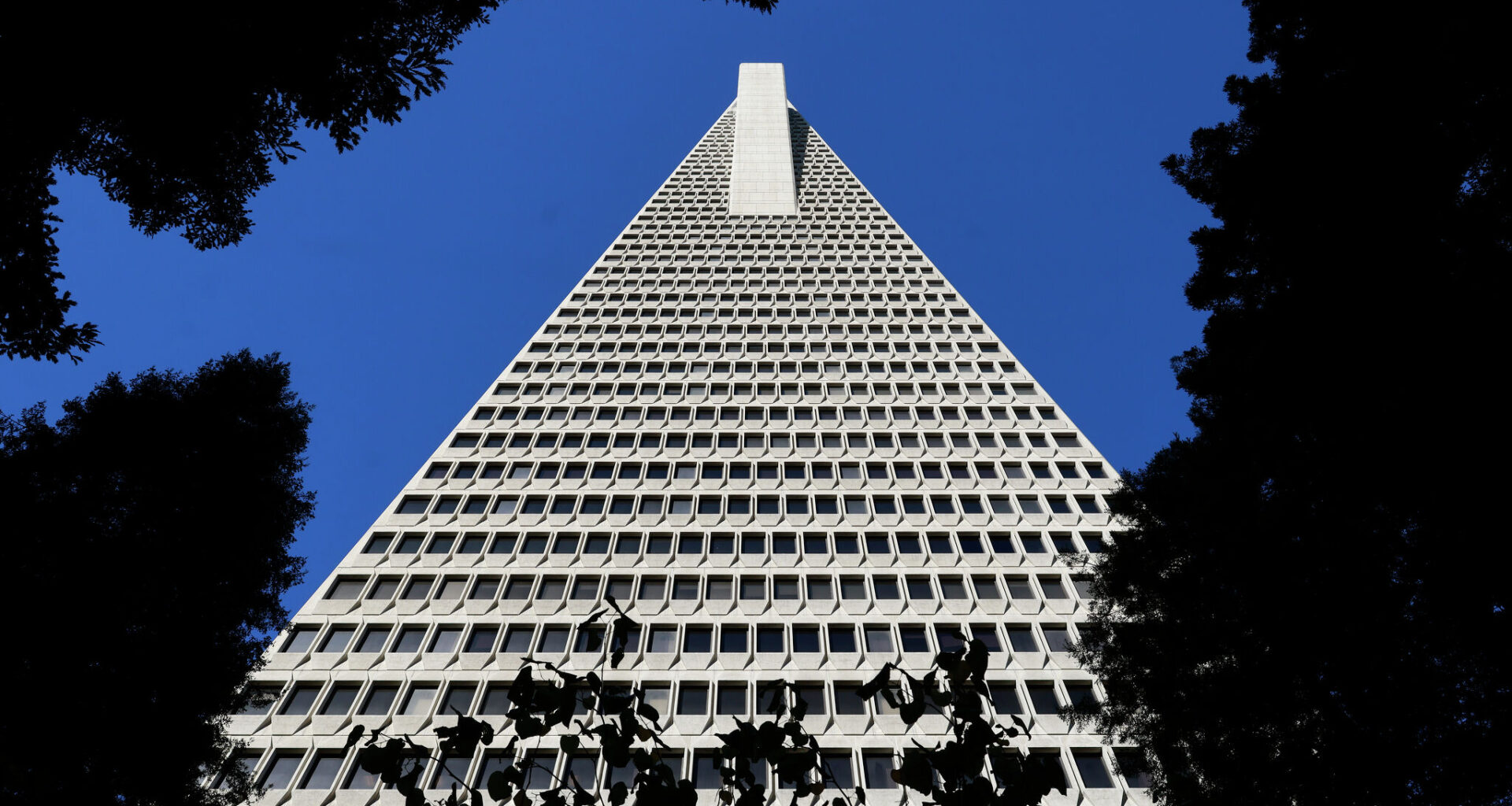
The Transamerica Pyramid has been officially sold to a foreign investor, with the final price tallying $691.6 million.
Jessica Christian/The Chronicle
San Francisco’s most high-profile downtown office deal in years closed Friday, as the Transamerica Pyramid and two adjacent buildings on the same property sold for $691.6 million, public records show. The sale marks the end of Michael Shvo’s time overseeing the iconic building. The New York developer was paid $34 million to have all his involvement with the Pyramid terminated.
The deal means that the buyer — Cypress-based investment firm Yoda Plc — officially took ownership of one of the city’s most recognizable landmarks after a years-long effort by its previous owners to upgrade the 48-story tower at 600 Montgomery St., including costly renovations aimed at attracting tenants back to the city’s core. The group is entering the U.S. real estate market for the first time with its acquisition of theTransamerica Pyramid Center, which includes the Pyramid, a 20-story office tower at 505 Sansome and a much smaller, nine story historic building at 545 Sansome. As of late last year, the property was about 85% leased, according to Shvo, its now former operator.
The sale price comes out to around $933 per square foot for the entire property. Separate deeds recorded for the three buildings show that the Pyramid alone was purchased for $600 million, or $1,170 per square foot.
Article continues below this ad
“We are investing in the United States, the largest and most sophisticated real estate market in the world, on this most sought-after landmark in San Francisco. This investment establishes our presence in a Tier-1 U.S. gateway city through one of the most recognizable commercial assets globally and provides immediate scale and operational infrastructure,” said Alon Bar, CEO of Yoda Plc, in a statement.
Bar added that the transaction is not a “standalone investment” for his company.
San Francisco Chronicle Logo
Make us a Preferred Source to get more of our news when you search.
Add Preferred Source
“The Transamerica Pyramid Center structure will serve as the anchor from which we intend to expand, accelerating the growth of our U.S. portfolio over the coming years,” he said.
For the sellers, that price represents a loss on an investment of close to $1 billion, including renovations, made when the downtown office market’s recovery from the COVID-19 pandemic was elusive, but optimism was high. The sale also highlights ongoing challenges for the broader market: Vacancy continues to impact about one-third of downtown’s offices, even as leasing activity is rebounding, and investors are adjusting expectations for the city. At the same time, the deal shows that prime, iconic buildings still attract attention, including from foreign investors, many of whom had largely retreated from the San Francisco market in the years following the start of the pandemic.Investment bank and brokerage Eastdil Secured advised the selling ownership consortium on the sale.
Article continues below this ad
Notably, it also marks the end of a short-lived but ambitious investment era in San Francisco for Shvo and his German investors, Deutsche Finance America and Bayerische Versorgunksammer (BVK), which has stated publicly that it expects to incur losses on its U.S. investments, including an office portfolio that includes the Pyramid.
But for Shvo, last week’s sale was lucrative: Yoda Plc confirmed in its statement that it spent a total of $725 million on the deal, a price that includes a “final settlement” with Shvo and his affiliated companies, as well as his commission for brokering the sale “for both sides” and a buyout of the developers “right of first offer” agreement on the property.
In total, the payments made to Shvo alone total $34 million, “terminating all his services with his asset management” and his “involvement” with the property, the statement said.
The investors famously purchased the 1972 building in mid-2020 for $650 million, after it was listed for sale for the first time in its history. Since then, they invested some $250 million of a planned $400 million overhaul to make visible improvements to the property. They upgraded the tower’s lobby and common areas, installed new amenities including a fitness center and conference facilities and redesigned the surrounding plaza with enhanced landscaping, seating areas and public art and new dining options — changes aimed at making the Pyramid a more vibrant part of the downtown streetscape.
Under Shvo’s leadership, the small office building at 545 Sansome was entitled for redevelopment, a flashy plan designed by renowned architect Norman Foster that would roughly double its size and add outdoor terraces to every floor.
Article continues below this ad
But Shvo and the German investors — none of whom responded to messages seeking comment on Monday — also faced significant headwinds in San Francisco, including a high‑profile legal battle over a planned members-only social club that never materialized. The Core Club signed a lease to occupy the first three floors of the Pyramid but never opened, and its founders sued the ownership group in 2024 alleging disputes over investment commitments and lease terms. A New York judge recently dismissed the club’s fraud and other major claims, a win for Shvo’s side, though several lesser allegations remain active in court. Representatives for the Core Club have stated that they continue to pursue an amendment complaint with new details accusing Shvo and his German investors of violating the Racketeer Influenced and Corrupt Organizations (RICO) Act in regard to the Pyramid’s acquisition. Portions of the space originally intended for the club have since been listed for direct leasing.
Meanwhile, the planned redevelopment of 545 Sansome never broke ground, leaving the project fully entitled but unbuilt when the Pyramid and its adjacent buildings were sold to Yoda Plc.
The legal drama made waves in Germany, where BVK — the country’s largest pension fund — faced tough questions from lawmakers about its U.S. investments made with Shvo and Deutsche Finance. Officials were pressed to explain why the fund had taken on risky office projects like the Pyramid, especially as some properties underperformed.
What the Cypriot firm that now owns the Transamerica Pyramid Center has planned for the key downtown property remains unknown. But, in a statement, it said, “We believe we have a lot to add to this magnificent asset and make it one of the most desired places in the San Francisco market, especially revitalizing the Transamerica Redwood Park and its existing buildings as well as exploit some 800,000 sqft of development rights in the property.”
Article continues below this ad