
To help offset the cuts, private funders led by the San Diego Foundation awarded more than $2.5 million to programs that provide resources such as medically tailored meals and weekend food kits. Project New Village was able to use $250,000 of this aid for operating its mobile farmers’ market. The nonprofit is otherwise less dependent on federal dollars, powering through with a mix of philanthropic funders, state and city grants, and community‑based donors.
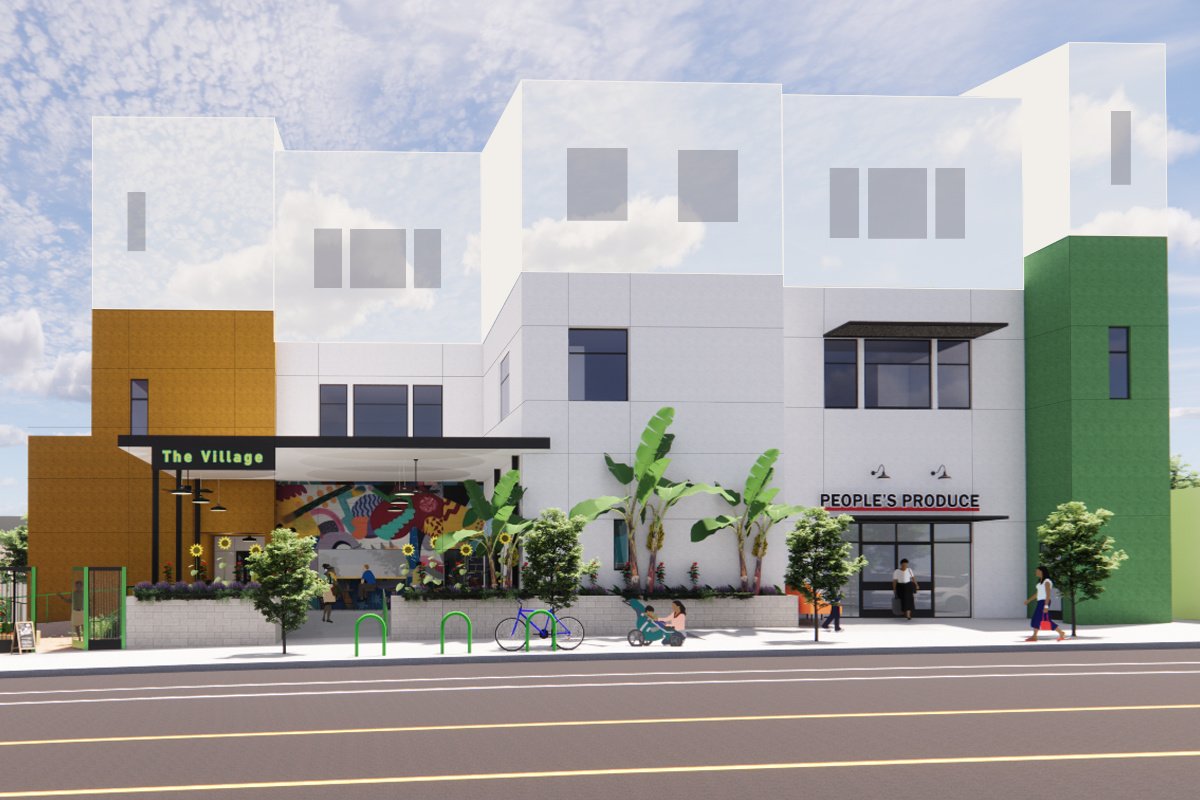
A rendering of The Village, a $10 million project that will integrate the Mt. Hope Community Garden and include a fresh‑food marketplace, prepared‑food vendor stalls, a commercial kitchen, and a community gathering space. (Credit: MW Steele Group)
The Mt. Hope Community Garden, mobile farmers’ market, backyard growers’ network, and future food hub form what Project New Village calls the Good Food District.
The nonprofit is building this community‑owned economic engine through a strategy called Equitable Food-Oriented Development, which focuses on reparative wealth building rather than maximizing investor profit.
The EFOD strategy was formalized in 2019 by a collaborative of nonprofits across the country that had spent decades working to give their communities a say in their food systems, with support from DAISA, an equity-focused consulting firm, and the Kresge Foundation. To date, the collaborative has funded more than 40 BIPOC‑led food and agriculture projects, including the Detroit Food Commons, a national model for community‑owned retail, and El Depa, in Puerto Rico, which advances seed sovereignty and agroecology.
San Diego has few community‑wealth models, according to the San Diego Food System Alliance (SDFSA), a sustainable food nonprofit and Project New Village partner. There are too many barriers, including zoning limits, redevelopment pressure, and sky-high land costs. Cheaper lots often lack water, accessibility, and other features that would make them suitable EFOD candidates.
“Land is the foundation,” says Sona Desai, SDFSA co‑executive director. The organization is developing the county’s first agricultural land trust to help underserved growers secure land.
Project New Village applied for and received an EFOD designation in 2021 and remains the only EFOD organization in San Diego. Membership is highly selective. While designation doesn’t guarantee funding, it opens access to capital designed for community‑owned, non‑extractive food‑system work and strengthens eligibility for other public and private dollars. EFOD is backed by philanthropic, affordable-lending, and community‑investment partners, which still includes the Kresge Foundation.
With a public market, commercial kitchen, healthy food vendors, and event space, The Village will bring the kind of amenities to Southeast San Diego that many communities take for granted.
“The Village project brings food dignity to a community lacking in neighborhood healthy food choices,” says Ami Young, a resident who shops at the produce truck and prioritizes local and organic food.
Most pre‑development milestones for The Village are complete, and the team is awaiting city approval of construction permits. EFOD funds supported early consulting work; now a capital campaign is underway to secure the remaining $4 million for construction and operations. Meanwhile, the garden, where it all began, along with the mobile farmers’ market truck and backyard growers’ network, will continue its important work.
When you ask Moss about the challenge of overcoming the funding gap, her answer is calm. Project New Village plans to pursue public and private grants and equity loans, Moss explains, while further cultivating its donor base.
“If needed, we can approach the construction in phases, and the timeline would need to be adjusted,” she says. “Ours has been a journey of small miracles, and we can see the finish line.”