
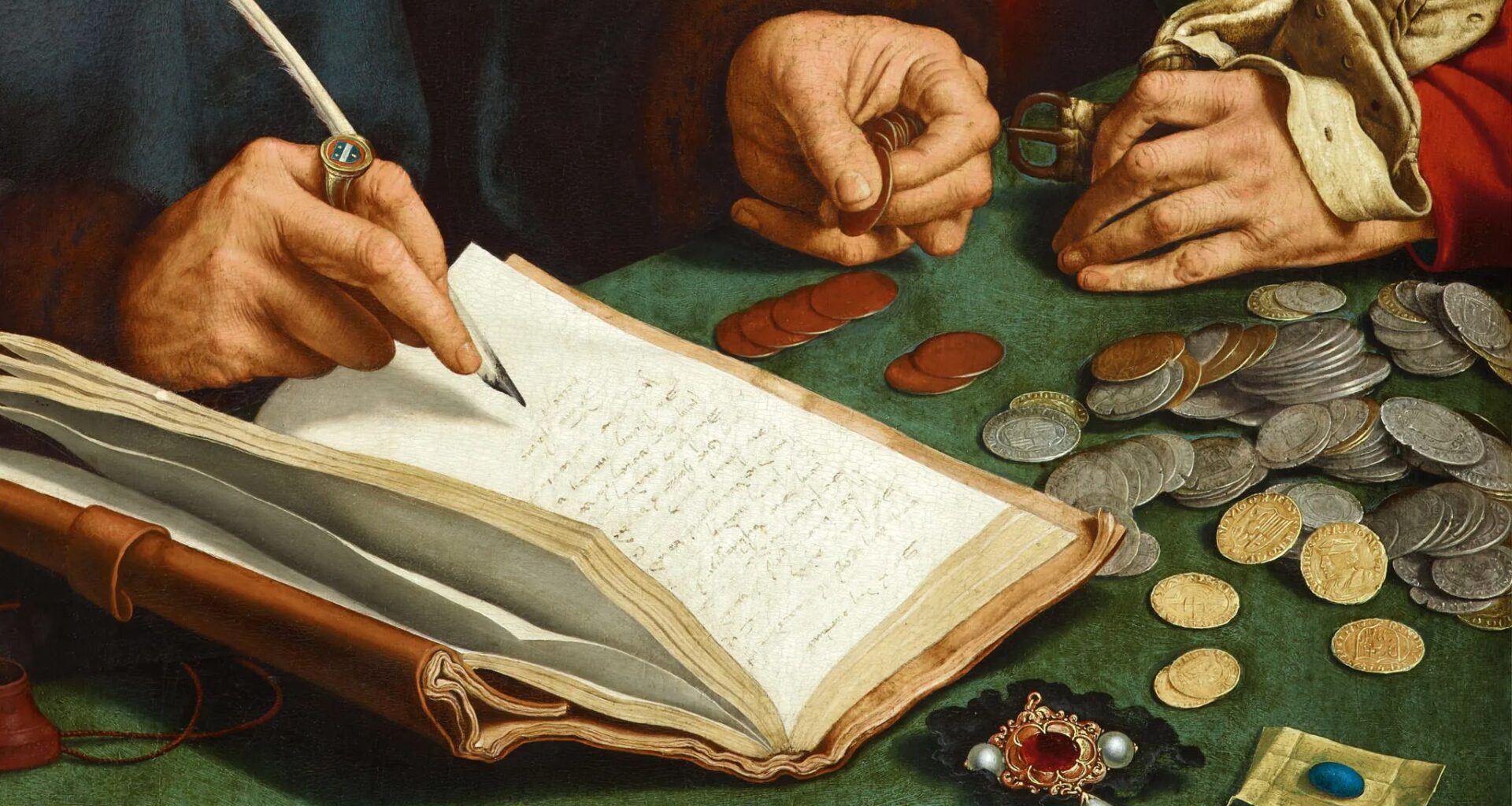
Asked if his new book on the history of capitalism is hopeful, Trevor Jackson outright laughs. The UC Berkeley history professor has spent his career documenting the rise of the economic system that orders the lives of most people on the planet.
The resulting book, The Insatiable Machine: How Capitalism Conquered the World, is rife with tales of precipitous inequality, bloodshed and environmental destruction, which Jackson shows are all inextricably linked to the pursuit of profit. But despite capitalism’s flaws, he writes on Page 1, “There is no credible alternative system on the horizon.”
The Insatiable Machine is not wholly fatalistic. By detailing the many steps that led to capitalism, Jackson aims to illustrate that “much more radical change is thinkable and possible than we realize,” he said. Again and again, he underscores that capitalism’s rise was not an inevitable or even intentional outcome. The book also highlights the 16-fold improvement in quality of life that capitalism unlocked, like increased lifespans, widespread electricity and modern consumer culture.
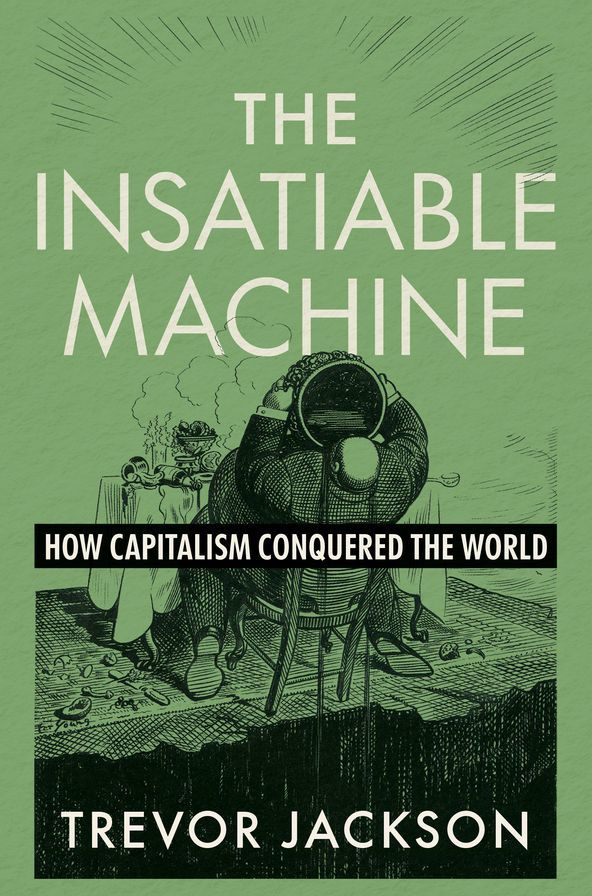 A cartoon from the left-leaning artist Art Young in 1911 — a time of high inequality and deep class conflict — is on the cover of Jackson’s book.
W. W. Norton
Jackson begins his account earlier than some historians, zeroing in on how New World exploration led to the global use of silver currency, and concludes his narrative in 1933, when capitalism prevailed in spite of the suffering brought by the Great Depression and the seemingly viable alternative presented by the USSR. In between, he details key developments, like world trade routes creating the conditions for systems of debt and finance to emerge; the creation of private property rights; and the Industrial Revolution and its discontents. Imperial disarray, war and the extraction of natural resources appear at nearly every stage of his story.
“I’m hoping that I can translate the work that economists do into something that historians will find valuable,” said Jackson.
In particular, he wants to merge economics’ focus on quantifiable, cause-and-effect analysis with historical nuance. The book has charts, yes, but also contains anecdotes about regular folks caught up in historical upheaval or a joke about Protestant reformer Martin Luther’s intestinal distress.
The Insatiable Machine might end a century before its publication date, but what seems like distant history has urgent and obvious relevance today. That’s apparent to Jackson on Berkeley’s campus, where he is a core faculty member for the popular political economy major. The economics course he once taught as a graduate student has swelled from 36 students interested in the creation of capitalism to more than 150. “Late-stage capitalism” is a refrain in online gripes about the state of things.
UC Berkeley News spoke with Jackson about how the “machine” of capitalism was built, how his book contributes to scholarly debates around the subject and whether parallels between our time and earlier eras hold water.
UC Berkeley News: What does “late-stage capitalism” really mean? Are we misusing it in popular parlance?
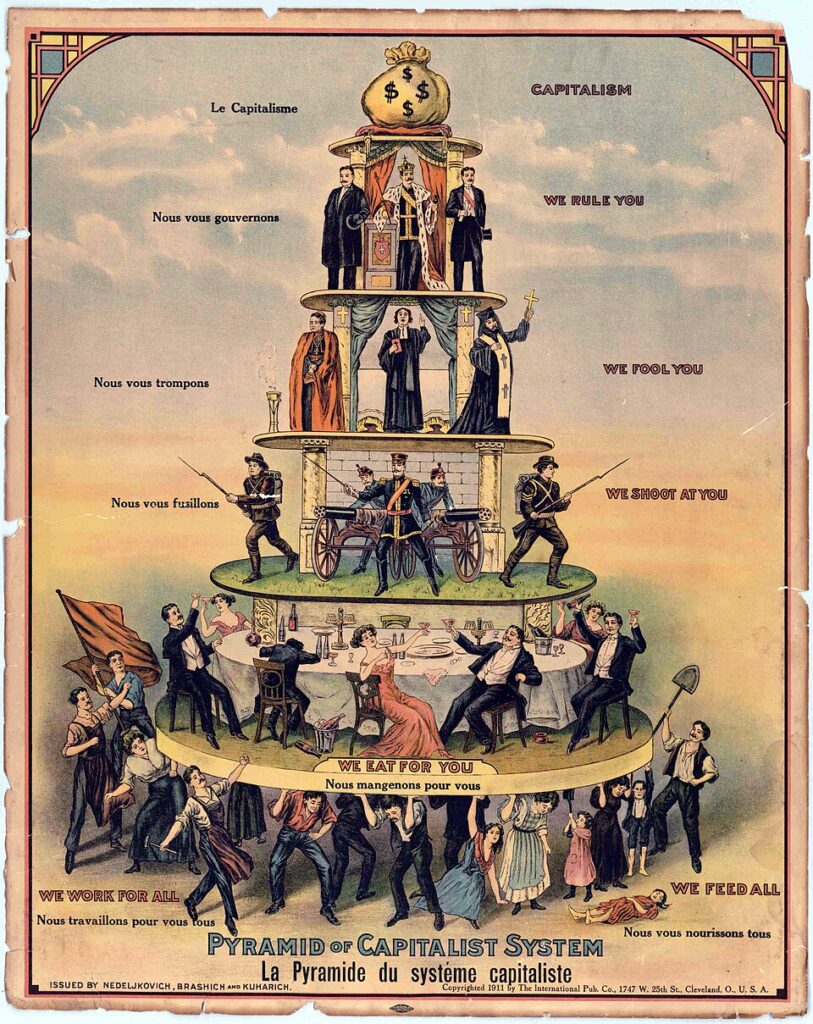 A cartoon published in an International Workers of the World publication in 1911.
Wikimedia Commons
Trevor Jackson: Capitalism has been late for a long time. Marx first thought capitalism was going to collapse in 1848. In the 1890s, Eduard Bernstein wrote about a “later capitalism” or a “mature capitalism.” Usually, we associate the term with Ernest Mandel, a Marxist economist who wrote a very turgid book called Late Capitalism, thinking the 1970s was this moment of crisis. There are continual predictions that the end is coming, and it can’t go on like this, yet capitalism continues. One of the definitive facts about capitalism is its incredible ability to survive, mutate and grow.
There’s one part of me that wants to say capitalism is only ever late-stage. But there is no way of claiming the capitalism of the Venetian Republic in the 16th century was late. By the 19th century and industrialization, that’s late capitalism.
Post-1970s late capitalism is characterized by a sense that something has been and continues to be profoundly broken. I’m very fond of the term “hauntology”: the idea that we are surrounded by the wreckage of intended futures that never came to pass. The expectation was that by the time we got here, this wouldn’t be the capitalism we had. We would have flying cars or something better. When I see people referring to “late-stage capitalism,” I think they’re expressing that sense of melancholia, of being surrounded by a loss that we can’t quite articulate.
Are there historical parallels between today and the turn of the 20th century?
I have doubts about the idea that we are in a second Gilded Age. The 1870s through 1914 was a moment of very high inequality. There’s high inequality now. There was a problem of robber-baron oligarchs then and now. Those parallels seem profound.
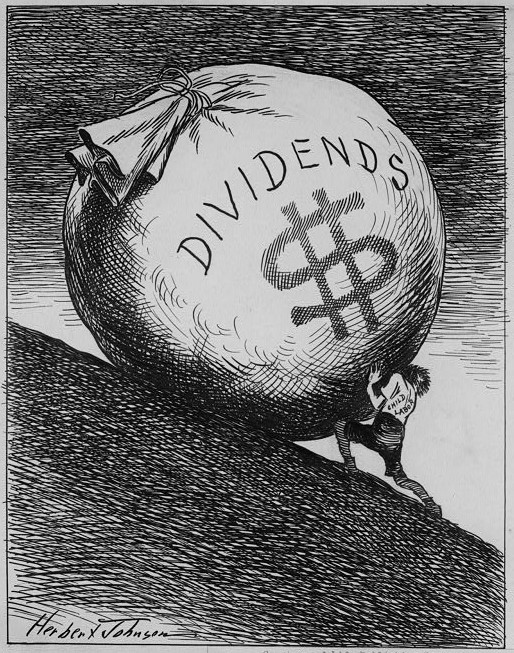 A political cartoon from 1913, in the thick of the Gilded Age.
Herbert Johnson/Life Publishing Company via Library of Congress
But I’m skeptical for a couple reasons. One reason is the balance of class forces. In the U.S., in the 1870s through 1919, there was a powerful, organized, militant working-class political presence, in the form of unions and other political organizations. Oklahoma had 40 socialist newspapers in the 1890s. Anarchists bombed Wall Street. This is large-scale social conflict that I just don’t think exists today.
The Gilded Age felt false and inauthentic, but economic growth and median wage growth were relatively robust. People’s lives were dramatically changing in ways I just don’t think we’ll see anything remotely comparable to today.
For the U.S., 1870 through 1970 was the era of technological change and growth. We think of ourselves as living in a time of high rates of economic growth and technological change, but we’re not. Think of a kitchen in 1950 versus 1900, 2000 or 2025. In 1950, you’d have a kitchen with running hot and cold water, a refrigerator, an electric or gas oven, a dishwasher and various appliances. In 1900, a kitchen would have had none of those. In 2000, it has all those same things.
The peak replacement of workers by technology was actually the 1950s, as shorthand secretaries got replaced by people who could type, or switchboard operators by electronic phone relays. There were a quarter of a million elevator operators in the United States in the 1950s who got wiped out by electronic elevators. The pace today is, I think, far less.
You write at length about slavery’s role in the development of capitalism, and some scholars interested in the “new history of capitalism” argue that its emergence in America cannot be separated from race-based slavery. What’s important to understand about the relationship between the two?
The connection of slavery and capitalism has been arguably the biggest debate in economic history for almost 100 years, so there’s a lot to say here. You needed the prior creation of the legal concept of property in order to have people as property. Governments and laws — like the Barbados Slave Code of 1665 or the Virginia Slave Code in 1705, which distinguished between white indentured servants and enslaved Black people — create and uncreate “property” and therefore markets for it. So I think we have to start with the prior history of capitalist property.
The next thing that’s important: Atlantic slavery was about sugar, not cotton. There were 150 to 200 years of the slave trade in the Atlantic for economic profit before the focus on cotton in the U.S. Brazil was the main destination of enslaved people from Africa, not the U.S. Ignoring sugar in Barbados, Jamaica and Brazil makes a kind of parochial story.
One of the definitive facts about capitalism is its incredible ability to survive, mutate and grow.”
Trevor Jackson
If we look at slavery before cotton and the Industrial Revolution, Berkeley historian Jan de Vries would say it’s connected to capitalism because new luxuries coming from the labor of enslaved people in the New World, like sugar and tobacco, motivated people to work for extra money to afford them. This was a big change in terms of working for pay to fuel consumption. His “industrious revolution” idea explains both the origin of the modern labor force and the origin of modern consumer culture, connecting both to this Atlantic triangular trade.
The “new history of capitalism” focus on racial categories has meant we missed what you might call within-race class categories. That has produced a distorted vision of how the slave trade worked as a capitalist institution. There were professional, profit-driven African slave merchants whose job was buying and selling human beings in Africa, and they made a lot of money doing it. We can try to interpret that through a racial lens, and there is a power to that. But to my mind, that suggests those African enslavers were capitalists, and the slave trade, beginning to end, is a capitalist creation.
Was there a particular time period or turning point in this history you feel has been underemphasized and wanted to highlight in your book?
There are three. The biggest is where the book starts: the creation of the international monetary system. What could be more capitalist than money and prices, and where do those come from?
In a pre-capitalist world, there was never enough money, money was a very high denomination — imagine only carrying $500 bills — and most things were not monetized. During the conquest of the New World, the Spanish discover silver there, and this enormous wave of silver floods the entire world. That produces what we call the Price Revolution. Things become denominated in prices and money. Instead of you paying your landlord with chickens, now you pay your landlord with money. There’s also about 150 years of inflation as silver spreads around the globe, which has the effect of deranging different economies. The Spanish economy collapses.
And not all prices increase at the same speed. If you were somebody getting paid rent or selling commodities, you did well. If you had to pay for those things, you did badly. The Price Revolution scrambled world power, and it produced a class differentiation.
The second point I wish more people knew about is the Haitian Revolution. It’s such a powerful story of financial imperialism. After the first successful rebellion of enslaved people in history, Haitians were forced to repay the cost of their own liberation to the French. They kept paying that loan, to Citibank and others, until the 20th century.
 Trevor Jackson, an associate professor of history.
Rebecca Jackson
Lastly, most people don’t realize that the interwar period, 1917 to 1933, was a moment when most observers thought capitalism was done. Capitalism blundered into World War I and couldn’t get out of it. Capitalism had the Great Depression at the same time the Soviet Union had record economic growth. The Soviets completed their first Five Year Plan in only four years.
We think of capitalism as this efficient, innovative thing, but within a human lifetime, people thought that capitalism was the system of the 19th century and would be replaced by something more modern and mostly horrible — Soviet communism or fascism. They thought capitalism was backwards, inefficient, anarchic and that it couldn’t solve its own problems. If capitalism was going to collapse under its own accord and be replaced by something else, that’s when it would have happened. It didn’t.
Would you say your book is hopeful?
[Laughs] The first version of the conclusion was something like: “The world has already ended, but we don’t realize it. If history has anything to teach us, it’s the history of the Banda and the Taíno and other people who have been exterminated by capitalism.”
I tried to reach for something hopeful in the final version. I want people to think more ambitiously about enormous, sweeping social change. We think on much too short of a time horizon, much too narrow of a range of possibilities. The difference from feudalism to capitalism is so huge, took so long and was so unintended. Can we think on that sort of scale? I don’t know if that’s hopeful, because that’s a timescale that’s almost inhuman. But I don’t think things are going to continue this way. Kafka said, “There is hope, just not for us.”
This interview has been condensed and edited for clarity.