
The end of the eras came, in double-whammy fashion, over a mere 42 hours. The first was an unexpected exit: Gonzaga’s second-round loss to Texas in its final appearance as a member of the West Coast Conference. The second, a feared departure: Randy Bennett leaving Saint Mary’s for Arizona State.
Just like that, the WCC’s twin pillars, its dominant basketball brand and the coach who created a worthy foil, were gone.
Days later, commissioner Stu Jackson turned his gaze to what comes next.
“It’s a giant window of opportunity for everyone,” Jackson said last week. “I’m very bullish on the future, but we have work to do.”
Hard work.
Expensive work.
Essential work.
The WCC, which has long included the University of San Diego and will add UC San Diego in 2027, isn’t on the brink of extinction. It’s not the Pac-12 in the summer of 2023, after 10 schools found new homes, or the Mountain West in the fall of 2024, after the loss of five members to the Pac-12.
But the 73-year-old conference is entering a new chapter with a depleted lineup after a series of unfortunate events:
• Gonzaga’s decision, in October 2024, to join the Pac-12 starting this summer.
• Grand Canyon’s decision a month later to abandon its commitment to the WCC and instead join the Mountain West.
• Bennett’s acceptance of the ASU job after 25 masterful years at Saint Mary’s.
(Bennett is not a program or a school, but he was Saint Mary’s basketball. And it’s hardly unreasonable to question whether the Gaels can maintain their competitive success without him.)
Conference executives have been as proactive as possible since the Pac-12’s implosion. Aware that the Zags and others might be lured away, the WCC secured its future by adding UCSD, Seattle, Denver and, for a few months, Grand Canyon.
The end result of all the turnover will be a 10-team conference next season, with Denver joining and Gonzaga moving over to the rebuilt Pac-12 along with Washington State and Oregon State.
But in 2027-28, the WCC will add the Tritons from the Big West to create an 11-school league.
“We’d like to add a 12th to provide stability,” Jackson said.
Just as the Pac-12 and Mountain West raided the WCC to fortify their existence, so, too, has the WCC turned its attention to the Big West.
After poaching UC San Diego, it has both UC Irvine and UC Santa Barbara atop its target list, according to multiple sources.
“Our profile (for new members) is schools that care about basketball and are willing to invest,” said Jackson, who did not discuss specific expansion candidates. “And schools that are academically aligned with our institutions.”
Yes, there’s a void at the top of the conference hierarchy. But it’s not enough for remaining or incoming members to aspire to replace Gonzaga. It’s not enough for Saint Mary’s to assume success will come post-Bennett. (The Gaels have promoted assistant Mickey McConnell to the permanent position.)
The campuses must invest in people and operations and create the conditions for success, year after year after year.
“What Gonzaga did is extraordinary,” Jackson said. “They took a risk and invested heavily in basketball to illuminate their brand. It didn’t just happen.
“Basketball, men’s and women’s, is our greatest asset. There are a lot of signs that the presidents are listening.”
Someone needs to. Gonzaga and Saint Mary’s have accounted for the overwhelming majority of NCAA Tournament appearances this century. In the past 12 years, they are responsible for all but two: USF qualified in 2022, while Santa Clara made the field this season.
Of all the schools set to compete in the WCC next season, the Broncos seem best positioned to take advantage of Gonzaga’s departure. They have sound NIL support and a quality coach, Herb Sendek, who has adeptly navigated the transfer era.
Pacific is showing signs of an upturn, having doubled its victory total under second-year coach Dave Smart.
Seattle has potential because of its location, but the on-campus arena, Redhawk Center, is 67 years old and seats just 1,000 people.
What about Portland or USD?
Schools that viewed a dollar invested as a dollar wasted — because they could never compete with Gonzaga — now possess a path to the top.
But the black hole in Southern California is a major issue for the WCC.
Loyola Marymount has been under .500 in conference play for three consecutive seasons under Stan Johnson.
And Pepperdine, which is also struggling on the court, just hired a coach (Griff Aldrich) with no ties to the West Coast.
(The Waves are investing, however. In 2023, they broke ground on a $250 million athletic complex that will include a new arena and is scheduled to open in the fall.)
It could take years for a new hierarchy to form. The chances of Gonzaga 2.0 emerging are slim, but there could be a new Saint Mary’s. Perhaps the Gaels themselves will fill the void.
But extinction isn’t a concern — not now and probably not for years to come.
In that regard, the WCC has no reason to panic despite the end of two eras that have defined the conference for decades.
Box: USD’s new coach hires first assistant
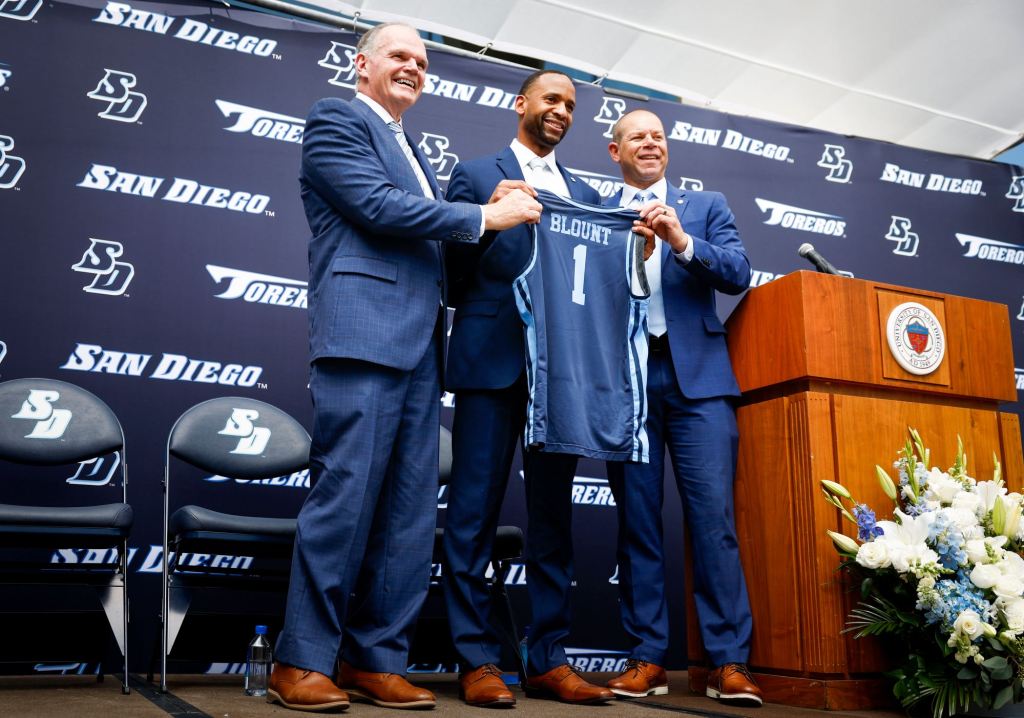
New USD men’s basketball coach JR Blount wasted little time in adding his first assistant coach.
Jeremy Pope was announced Monday as the first member of Blount’s USD staff.
A Compton native who played collegiately at Cerritos College, San Jose State and Biola and owns a degree from Cal State LA, Pope joins the Toreros after spending three seasons as an assistant coach at UT Arlington. Before that, he spent time as an assistant at the University of Portland; as a coach at AZ Compass Prep in Phoenix in Chandler, Ariz. and Orangeville Prep in Canada; and as coach of Boeheim’s Army in The Basketball Tournament.
Pope also spent time as a graduate assistant under Mike Hopkins at the University of Washington.
Blount, a former assistant coach at Iowa State, was hired March 9 to replace Steve Lavin.
Blount arrived on USD’s campus on Monday after the Cyclones were eliminated from the NCAA Tournament’s Round of 16. He is expected to announce his full staff over the next few weeks.
— RYAN FINLEY