
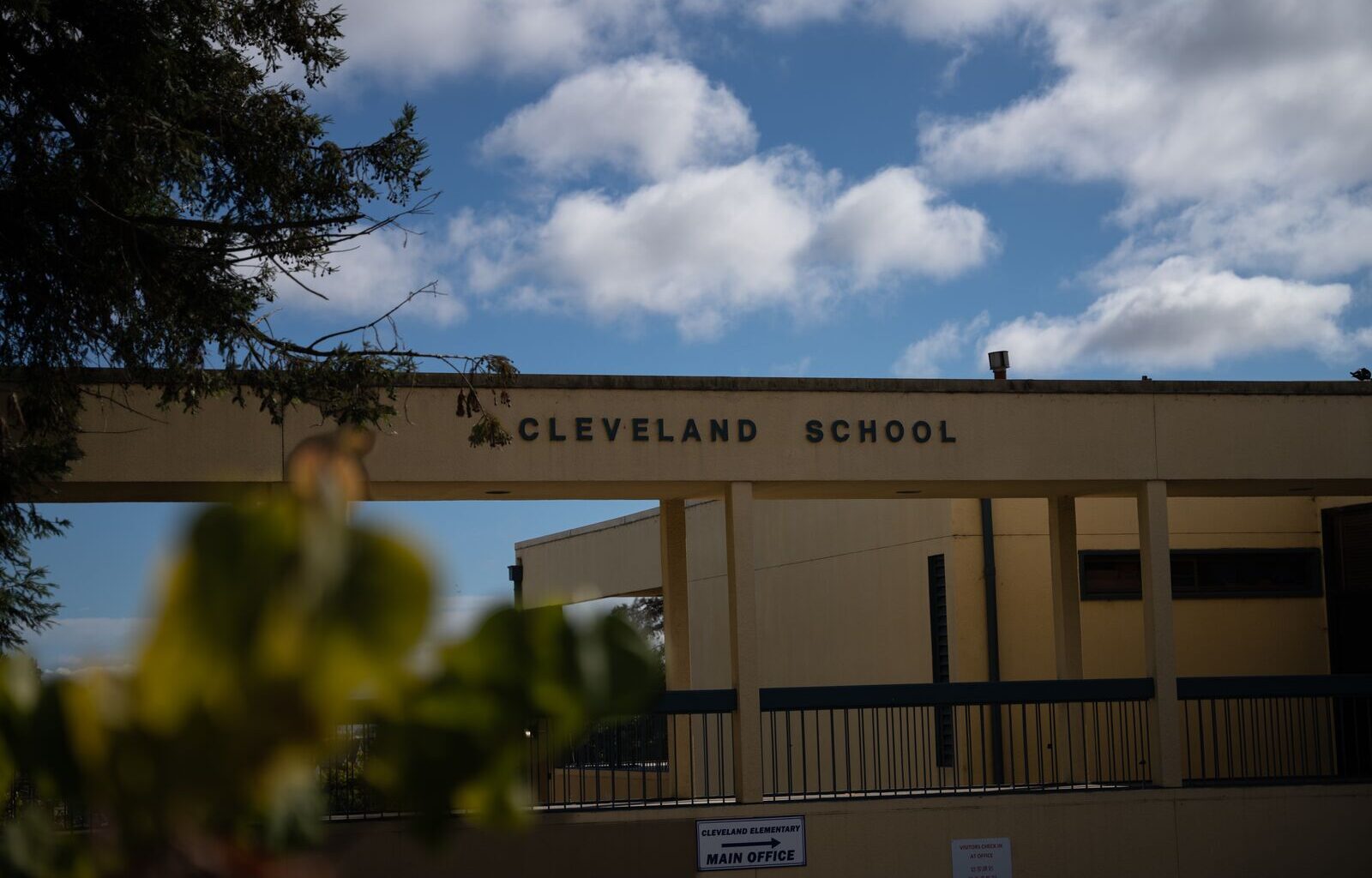
Out of thousands of faucets and fountains across Oakland public schools, only two remain out of service over lead contamination.
Eighteen months after Oakland Unified School District’s lead contamination crisis broke into public view — when it turned out dozens of schools had water sources measuring many times higher than the district’s allowable limit for lead — the district has addressed almost all of the faulty fixtures. It’s a remarkable turnaround for the district, which at the depths of the lead crisis in August 2024 had discovered unsafe lead levels at 43 schools, some of them with levels 20 times higher than what the district considered safe.
“We only have two today that are still elevated,” Nilufar Abdul, assistant manager of systems and services in OUSD, said during a facilities committee meeting this month.
OUSD has also added new transparency measures so that families and school staff can keep track of testing and mitigation efforts.
In early March, OUSD rolled out a new water quality testing dashboard that displays a map of every site in the district and its latest water testing results. The dashboard allows users to filter by school site and view a list of every fixture that has been tested, along with the date and results of those tests. The school-specific view was the most highly requested feature from staff and parents, Abdul said, alongside translating technical lab reports into a more easily digestible format.
The district’s policy is that if a drinking water source, such as a water fountain or kitchen faucet, has lead levels higher than 5 parts per billion, it will be taken out of service until the source of the problem is identified and repaired. Once a fixture is repaired or a filter added, and re-tests below the limit, it will be brought back into service.
Updated every morning at 6 a.m., the dashboard currently shows that only one faucet at Sequoia Elementary in the Dimond and one at Harriet Tubman Child Development Center in West Oakland are out of service.
Every other fixture in the district appears to have tested below the threshold.
“With the amount of work that was put into water quality and the complexity of this work, it requires ongoing maintenance,” Abdul said during the facilities committee meeting on March 19. “It requires filter replacements, fixtures, repairs, and equipment to be unkempt. The testing needs to be continued to verify that our standards are still up to date and we’re still providing as safe water as we can.”
In spring 2024, when lead contamination was still widespread, one person on the district’s risk management team was responsible for monitoring water testing across OUSD campuses, initiating repairs with the facilities team, and informing school site staff about the test results and repairs, as the district has confirmed. Most school leaders, students, and families did not find out about the lead contamination until that fall, alarming school communities concerned that contaminated water could have been accessible for months.
Since then, the district has put a cross-departmental team in place to manage lead testing and has committed to greater transparency efforts, such as the testing dashboard, to reassure the public with complete and up-to-date information about lead in Oakland schools.
OUSD has also added new water fountains and filtering stations across the district. The district’s goal is to reach a 200:1 ratio, or lower, of students to filtered water stations at every school. Right now, 10 schools remain above that ratio.
During the March facilities meeting, staff also gave an update on a grant from Cal Fire, the state fire prevention agency, that the district will use to fund the installation of additional filtered water stations at 16 schools, with a goal of reaching a 100:1 ratio at those schools, as well as more outdoor water fountains.
The facilities master plan, a document outlining maintenance needs at all the district’s properties, addresses lead mitigation efforts. That report recommends additional long-term investments, such as prioritizing plumbing replacement when schools are up for major campus renovation projects, though its recommendations are subject to board approval.
The district’s testing process has identified many sources of lead contamination that could be repaired by replacing the fixture or adding a filter, but some repeated tests have shown that the problem is in the pipes, “highlight[ing] where plumbing renewal should be considered as part of larger capital projects rather than addressed through repeated operational fixes,” the report said.
“*” indicates required fields