
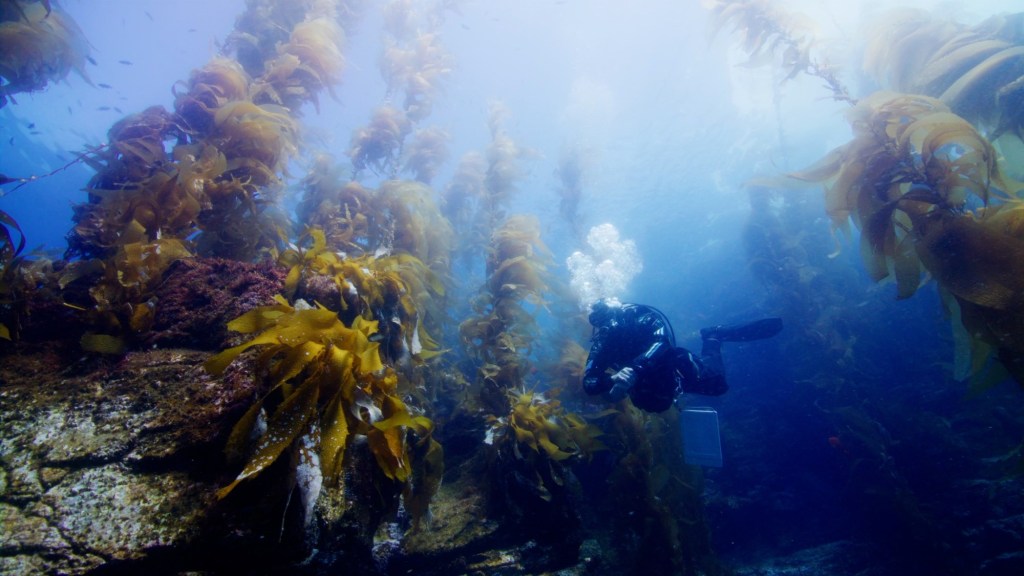
In a city built on biotechnology innovation, some of our most important scientific questions remain unanswered beneath the surface of the ocean. Giant kelp forests once defined much of San Diego’s coastline: towering marine canopies that shelter fish populations, buffer wave energy and anchor one of the most productive ecosystems on Earth. Amidst such beauty, many of us are unaware of the arduous fight against its decline over the last decade, and the subsequent consequences if it continues.
A study published earlier this year by researchers at Scripps Institution of Oceanography analyzed more than 40 years of kelp monitoring along the San Diego coast, tracking over 14,000 individual plants, and found a steady decline in resilience. This work underpins much of the field’s efforts to reverse this trend, including that of marine researcher Mohammad Sedarat in Jennifer Smith’s lab at Scripps.
On a clear Tuesday morning in mid-March, I took a break from my work as a health care researcher to sit and chat on the edge of Scripps Pier with Sedarat. Beneath us, the Pacific sat atop one of the most topographically and ecologically interesting sections of San Diego’s coast. Here, the seafloor drops into a series of submarine canyons that amplify swell energy, leading not only to legendary overhead slabs at nearby Black’s Beach, but also thorough mixing of warmer surface water with colder depths. The result is a pocket of ocean that runs a few degrees warmer than surrounding waters, a subtle shift that may help explain why La Jolla’s kelp forests have struggled to recover since the 2015-2016 El Niño.
Sedarat’s work focuses on a simple question: What makes some strains of kelp more heat-tolerant than others? By studying the genetic diversity of giant kelp populations along the California coast, Mo hopes to guide restoration efforts and cultivate kelp populations better suited for a warming ocean. One of his current projects examines whether kelp seedlings remain viable after cryogenic preservation, a foundational question for seed banking that, while well-established in human biology for nearly a century, is only now being explored in marine systems. Many of his experiments bore an uncanny resemblance to ones conducted in my own field, by figures like Louis Pasteur and Ferdinand Cohn in the mid-1800s. It seemed the cutting edge of kelp restoration research was (and is) still anchored in nascent stages of basic understanding. And yet, despite great potential in discoveries, work like Sedarat’s has been chronically underfunded.
Much of Sedarat’s research career has been shaped by piecing together grants to pursue work that, while critical for ecosystem recovery, rarely attracts the same financial attention as flashier frontiers like health care. My own experience securing research funding was smooth; fringe, hyper-specific, and largely proof-of-concept pursuits in medicine still offer payouts in the form of patents and profit. In the United States, every $1 in National Institutes of Health funding generates roughly $2.64 in economic activity; unsurprisingly, life sciences receive nearly half of all federal research funding, while environmental research receives about 6%. Consequently, Sedarat spent much of his time defending the validity of his scientific efforts, rather than doing the science itself.
Our research priorities tend to follow an anthropocentric logic: We invest heavily in technologies that promise incremental improvements in human health and immediate quality of life, while neglecting to support the environmental systems that ultimately sustain us. Kelp forests exemplify this imbalance, supporting fisheries, stabilizing coastlines, and helping regulate carbon in the ocean, yet receiving only a fraction of the attention and funding directed toward biomedical innovation.
In a city widely known as a fertile crescent of biotechnology innovation, in an age of mounting and irrefutable evidence of environmental change, I sat on the pier that morning struck by the cognitive dissonance before me: We have begun to mistake monetary return for intrinsic value in the research we choose to fund. Scientists like Sedarat continue to ask the patient, fundamental questions that ecosystems depend on, but their work cannot rely on passion alone. Responsibility ultimately falls to the priorities we set as a society, recognizing that the most important discoveries are often the ones that quietly keep the world intact.
O’Connor is a Ph.D. candidate in the bioengineering department at UC San Diego and lives in La Jolla.