
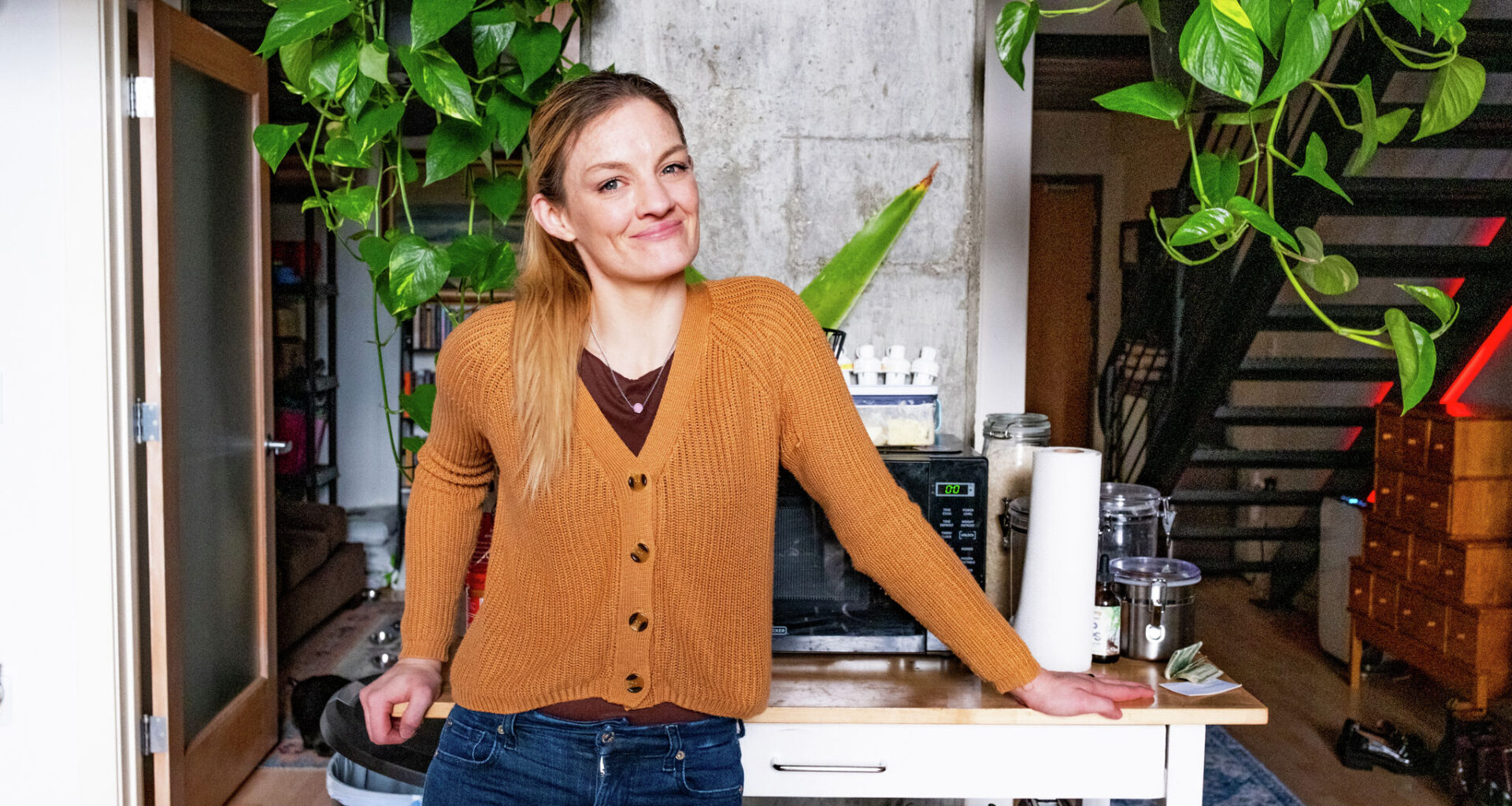
Amber Richmond, a San Francisco woman who struggled with addiction while living in city supportive housing and got sober last year, poses for a portrait in her loft apartment in SoMa.
Camille Cohen/For the S.F. Chronicle
Standing in the doorway of her new San Francisco apartment, Amber Richmond felt like her luck had finally changed.
It was the summer of 2020, just before her 28th birthday. After years cycling between homeless shelters, hotels and the streets as she struggled with opioid addiction, she was finally moving into a studio in Lower Nob Hill thanks to a federal housing voucher.
Amber was still using heroin and crystal meth, which she paid for by reselling cosmetics she shoplifted. She wasn’t sure how to find her way back to the kind of person she used to be — a star cheerleader and protective older sister who loved animals and Taylor Swift. But the apartment was a good start.
“In my mind, I was like, ‘I’m going to stop doing drugs. I’m going to do this, I’m going to do that,’” said Amber, now 33. “And then nothing changed.”
Article continues below this ad
For many of the homeless San Franciscans who struggle with addiction, the move into stable housing can be a turning point on the way to recovery. But not for Amber. Once inside her apartment, her addiction only deepened — exposing what she considers an oversight in the city’s traditional “housing-first” approach, which has prioritized immediate access to shelter over drug treatment or sobriety.
On the street, when she’d overdosed, people had administered Narcan or called an ambulance. Now, Amber was overdosing alone, waking up with only her dog, Duchess, curled next to her and no idea how long she’d been unconscious.
Amber weaned herself off crystal meth with the help of the outpatient program at Heart Plus, an SF General clinic for drug users with heart conditions. Earlier this spring, she got a job staffing the sobering center the city plans to open in May, honestly passing a drug test for the first time.
Camille Cohen/For the S.F. Chronicle
San Francisco funds thousands of supportive housing units designed to help people like Amber when they move indoors, often including case management, freely available Narcan and in-unit emergency call systems. Because the first housing available to Amber came through the federal Section 8 program, it didn’t offer those built-in resources.
San Francisco Chronicle Logo
Make us a Preferred Source to get more of our news when you search.
Add Preferred Source
Her addiction wasn’t a secret — she disclosed it along with the heart condition she developed from injecting drugs every time she applied for federal or city services. But once Amber was indoors, she said, outreach from the city dropped off while opioids remained easily available on the street.
Housing-first advocates argue that treatment shouldn’t be a prerequisite to housing, and that while some people like Amber still struggle, it’s easier for most to get sober once they’re off the streets. Studies consistently show that providing housing with no requirement to enter treatment is life-saving and cost-effective.
Article continues below this ad
But on social media, where she’s gained a following chronicling her recovery, Amber has thrown her support behind the recent movement to expand abstinence-based housing, which she thinks could have gotten her out of addiction sooner.
Amber’s loft is big enough that her stepdad and four of his friends could spend the night there last fall.
Camille Cohen/For the S.F. Chronicle
In long social media posts, and an essay in the conservative-leaning Voice of San Francisco, she’s criticized a system that she says writes off formerly homeless people as success stories once they move indoors. And while she knows she doesn’t have all the answers to the city’s drug and homelessness crises, she’s been identifying the ones that didn’t work for her — like unfettered access to clean drug supplies and subsidized housing without a focus on sobriety.
Amber has faced some blowback from critics who say this narrative could ultimately make it harder for people in recovery to get the housing they urgently need. Others, especially parents who have lost children to overdoses, have urged her to keep sharing her experiences.
The abstinence-based approach — generally backed by Mayor Daniel Lurie — has gained traction with the opening of San Francisco’s first sober shelter last fall. The 58-bed site, which has a no-tolerance policy for drug and alcohol use, was near capacity a few months after opening.
Article continues below this ad
The Board of Supervisors is also considering an ordinance that would encourage the expansion of drug-free supportive housing around the city — although a state bill that would have empowered local governments to spend more state funding on sober housing was vetoed by Gov. Gavin Newsom last fall.
Now, Amber looks back on her first summer in the apartment as a lost chance to get into recovery.
“I was inside this apartment, but with the same addiction,” Amber said. “Nobody checked on me. Nobody asked if I was okay.”
“I am never leaving here”
Amber has a vivid early memory of looking over the edge of her bunk bed to see her mother using crystal meth.
Article continues below this ad
Addiction, though never discussed, shadowed her childhood. The family was frequently evicted, moving around the Bay Area and Central Valley in search of housing. Amber often sat outside school for hours waiting to be picked up. Her brother, Andrew Garza, said Amber would steal Lunchables from gas stations to feed her younger siblings.
Amber’s father was in prison for most of her childhood, and their contact was limited. Jason Shirley, who would become Amber’s stepfather, first met her when he was 19 and walked into a drug house near Chico where six-month-old Amber was propped up in her carseat on the floor.
Amber Richmond as a cheerleader in her youth. As a child, she was a “flyer” — the focal point of the team, often airborne.
Amber Richmond
“She was this perfect little baby, sitting in the middle of this really bad spot,” Shirley said. He appointed himself Amber’s caretaker for the first years of her life, but mostly lost touch with her when she was seven, after his relationship with her mother ended.
The family eventually moved in with her grandmother in Auburn, where Amber joined her new high school’s cheerleading team. She was a flyer — the focal point of the team, often airborne — confident and skilled. Amber was a “cool sister,” Garza said, who drove her siblings around, coached younger cheerleaders and befriended football players.
Article continues below this ad
In her sophomore year, Amber started dating a boy who abused prescription painkillers. After she tried them herself, it quickly became a habit. Amber started finding excuses to go to the locker room during pep rallies to steal money from her teammates — spending it first on OxyContin, then on heroin. Over the next few years, she bounced from juvenile hall to a group foster home, then county jail.
Left: Amber eventually moved in with her grandmother in Auburn, where she joined her new high school’s cheerleading team. Right: Amber at a graduation party.
Courtesy of Amber Richmond
Above: Amber eventually moved in with her grandmother in Auburn, where she joined her new high school’s cheerleading team. Below: Amber at a graduation party.
Courtesy of Amber Richmond
She got out when she was 21, attending Narcotic Anonymous meetings and determined to stay sober. But when her mother started asking her to buy drugs for her, Amber started using again.
Their relationship grew rocky, and in 2015, Amber left with her boyfriend to stay with an uncle in San Francisco. Early in the visit, her uncle’s girlfriend took her to Union Square, where Amber saw people using drugs in public for the first time.
“She gives me some heroin, I shoot up,” she said. “And I thought, ‘I am never leaving here.’”
“I knew it was killing me”
Her uncle’s girlfriend taught Amber to “boost” shoplifted items for cash. She spent it on drugs, injecting a cocktail of heroin and crystal meth that people on the street called “goofballs.” She crashed with friends, saved up for cheap hotel rooms or slept outside around the Civic Center neighborhood.
Austin Abbott, the boyfriend who came to the city with Amber, said he revived her from at least 15 overdoses during their first years in the city. In 2017, when Amber was in her mid-twenties, she was trying to steal packages from a building lobby when she felt suddenly weak, with a searing pain in her back.
She went to the hospital, fading in and out of consciousness. “They took my blood, and next thing you know, I wake up and I’m in a different hospital. And they told me, ‘You need to have open heart surgery.’”
Amber had endocarditis, a life-threatening heart infection often caused by injecting drugs. She had another emergency surgery a few weeks later, then spent three months in an inpatient facility. Her doctors gave her methadone daily. When that wasn’t enough to supplement Amber’s cravings, she had friends bring heroin when they came to visit.
In early 2019, Amber lost her mother to the same heart condition. By the time Amber moved into her first apartment a year later, she felt ready to quit. “I knew it was killing me,” she said.
But inside the apartment, she felt severed from her friends and the city resources that had been offered when she was homeless.
Amber inspects a laptop that was donated to her as she sits in her room at the Hotel Minna on Monday, May 25, 2020. Richmond was homeless and said she was renting a room in a hotel after losing her spot at a Navigation Center.
Lea Suzuki/S.F. Chronicle
It’s not typical for addiction to worsen after people are housed, said Jennifer Friedenbach of the Coalition on Homelessness, but the experience is not unheard of.
“Generally, it’s much easier to recover when you’re in housing,” Friedenbach said. “Of course, there’s going to be some exceptions. And in some cases, people have communities out on the streets, and when they get housing, there’s a fair amount of isolation.”
Many of the city’s supportive housing options offer community activities and mental health services for this reason. Emily Cohen, a spokesperson for San Francisco’s homelessness department, said the city was working to offer recovery resources to people “inside and outside” permanent supportive housing.
“Ensuring that individuals, regardless of their housing situation, can receive the assistance they need to facilitate their recovery journey is an ideal to strive for,” Cohen said.
It can be harder to make those city resources available to people whose housing is federally funded. The city experimented with expanding case management resources to federally-funded housing during the pandemic, although that pilot operated on a far smaller scale than the national Section 8 program.
Amber points to a sign she made to encourage hand washing on the front door of the Bryant Navigation Center on Thursday, March 19, 2020. Richmond said after she made the sign, the staff made 20 copies which she placed around the center.
Lea Suzuki/S.F. Chronicle
But even if Amber had been placed in supportive housing instead, she’s not sure she would have been able to recover any faster. Many of the city-funded units she stayed in with friends were “drug dens,” she said — a Chronicle investigation found that 166 people fatally overdosed in city-funded hotels in 2020 and 2021, around the time when Amber was moving into her first apartment.
She wishes now that abstinence-based housing had been one of the options offered to her. Still, Amber felt lucky to be in her own place, she told the Chronicle at the time. In 2023, she used her housing voucher to move to a new building in SoMa, hoping for a fresh start.
“I’m never going to use in this apartment,” she promised herself. But again, she relapsed.
Amber could still be a “functioning addict,” indoors, she now understood. She started looking for a different reason to quit.
A new era
In the summer of 2024, her then-boyfriend offered her a ticket to the London stop on Taylor Swift’s Eras Tour. Amber ran with it, starting a monthly buprenorphine shot so she wouldn’t get withdrawal symptoms on her trip.
The concert was her first chance to leave the country, something she wouldn’t have been able to afford on her own. And it felt significant to Amber, who could map each of Swift’s albums back to where she first heard them — driving to cheer practice, folding laundry in the county jail, sitting in her new apartment.
She started to cry when she walked into Wembley Stadium. She still tears up when she talks about it now.
“When you’re high, stuff’s exciting, but you don’t really feel it,” she said. “I would never get emotional about anything. My emotions were off for the longest time. At the concert, I was just bawling.”
When she got back to San Francisco, Amber’s problems didn’t go away: she was still using crystal meth and committed to a relationship that had its roots in mutual addiction. But slowly, she began to solve them.
She kept taking the buprenorphine shot after the concert. Last winter, she broke up with her boyfriend, who was still using drugs. Then she weaned herself off crystal meth with the help of the outpatient program at Heart Plus, an SF General clinic for drug users with heart conditions. Earlier this spring, she got a job staffing the sobering center the city plans to open in May, honestly passing a drug test for the first time.
“I’m excited about that,” Amber said. The center is designed as a place where people arrested for public intoxication can sober up, but also get connected with treatment and shelter.
Amber is back in contact with her younger brother, Andrew. Their relationship had been rocky, but they also reconciled after Amber wrote him a few months ago apologizing for how her addiction had hurt him.
Camille Cohen/For the S.F. Chronicle
Amber has been settled inside a different apartment in SoMa for more than a year — she keeps the keys on an Eras Tour lanyard, a reminder of the night things changed for her. The loft is big enough that her stepdad, Shirley, and four of his friends could spend the night there last fall. The two have reconnected in recent years; it meant a lot to both that she was stable enough to host him.
Amber is also back in contact with her younger brother, Andrew. Their relationship had been rocky, but they reconciled after Amber wrote him a few months ago apologizing for how her addiction had hurt him.
“She looks like the sister I used to know,” he said. “We’re really good friends.”
Amber still gets lonely and “so bored,” now that she has to fill time without using drugs. She takes care of the menagerie of pets in her apartment — one dog, six cats and at least 12 fish, on top of the dogs she’s started fostering. She dreams about buying a house outside the city and opening an animal sanctuary.
“It’s cool to be able to be depended on,” Amber said, pulling her Siamese cat, Tigerlily, into her lap. “Before, I would sit there and do drugs and have my cats just staring at me.” Now, she went on,“They just look at me like I’m crazy because I’m blasting music and dancing around the house.”
Much of Amber’s life now revolves around her love for animals, and she and cares for the dog she had while homeless and takes in foster pets.
Camille Cohen/For the S.F. Chronicle