
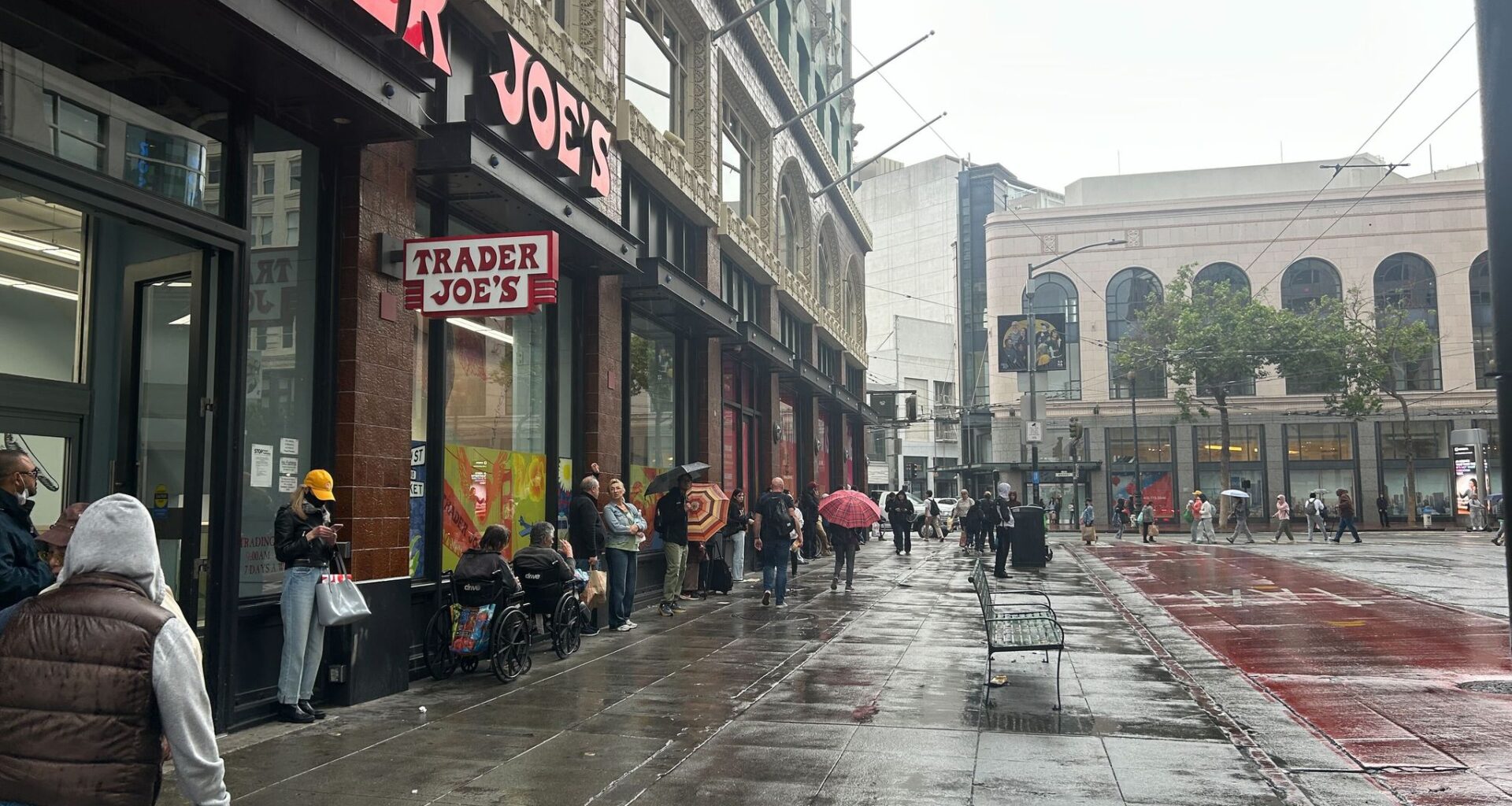
People wait in the rain for Muni buses at the stop at Fourth and Mission on March 31, 2026. The stop is the busiest in the city that does not have a bus shelter.
Danielle Echeverria
People wait in the rain for Muni buses at the stop at Fourth and Mission on March 31, 2026. The stop is the busiest in the city that does not have a bus shelter.
Danielle Echeverria
People board a Muni bus at the stop at Fourth and Mission on March 31, 2026. The stop is the busiest in the city that does not have a bus shelter.
Danielle Echeverria
On Tuesday afternoon, a fluctuating group of more than a dozen people hugged the sides of the Trader Joe’s on Fourth and Market streets, seeking refuge from the rain as they waited for the bus under the very small awnings along the building’s facade.
That’s because unlike most of the city’s busiest bus stops, the one on Fourth and Market lacks a ubiquitous feature: a wavy red- or yellow-roofed shelter. Instead, the stretch of sidewalk that juts out to meet the red-painted transit only lane offers a dark green bench, with seating for about three or four people.
On Tuesday, that meant that as people left their posts under the awnings and wiggled their way onto crowded buses, others took their places as they tried to stay dry. Meanwhile, the bench mostly sat unused and wet.
Article continues below this ad
Muni buses stop at more than 3,000 places throughout San Francisco (and at some locations in adjoining places like Daly City). About 1,200 of these street corners offer any kind of shelter for waiting passengers. Most of the unsheltered stops are minor, served by maybe one bus line a couple times an hour. But plenty of them see hundreds or even thousands of passengers boarding every day — like the one at Fourth and Market, which averaged 3,000 passengers on weekdays last October.
Those unsheltered stops represent an SFMTA goal unmet. On its website, the agency says it aims “to provide shelters at all high ridership bus stops, defined as 125 or more riders boarding daily.” Not only do the shelters keep waiting riders “protected from the elements”, the agency said, they also “fulfill an important wayfinding function” by providing maps, directions, ETAs, and visible stop locations.
San Francisco Chronicle Logo
Make us a Preferred Source to get more of our news when you search.
Add Preferred Source
So why doesn’t a stop as busy as Fourth and Mission get a shelter? The Chronicle didn’t quite get a straight answer.
Article continues below this ad
SFMTA spokesperson Erica Kato said in an email that bus shelter placement is based on ridership numbers as well as community requests. In the case of busy stops with no shelter, she said, it’s most likely because of a “spacing issue.”
Among the many conditions that must be met, she said, shelters cannot be within four feet of a tree well or pole, or within two and a half feet of an awning or fire escape. Likewise, a shelter also needs to allow at least four feet for pedestrians to pass behind it, and it can’t be any closer than two and a half feet from the edge of a curb.
None of those obviously explain what prohibits a shelter at Fourth and Market, where the sidewalk is very wide with few obstructions.
Kato did not directly address what’s stopping a shelter there, but she did note that the dark green bench is part of a pilot project for alternative seating options in places where shelter installation isn’t possible.
The governance of bus shelters is complex. While SFMTA initiates the process to request new shelters, it must get a permit to install one from the Department of Public Works, which requires “either a public hearing or the consent of all fronting property owners within 100 feet of the proposed site.” A review of transit shelter permits through DPW shows that most are approved, and the last denial was a decade ago.
Article continues below this ad
There also did not appear to be a permit filed for a shelter at Fourth and Market, though 311 data showed that there was one public request for a new transit shelter there through Twitter in 2022.
What’s more, SFMTA is also not in charge of installing and maintaining shelters. That’s done by Clear Channel Outdoor, the company that places the advertisements on shelters, which gets ad revenue from the shelters in exchange for upkeep.
SFMTA policy does dictate the removal of transit shelters, however. The agency tries to keep all shelters that have been installed in place, and only considers removal in cases where there is a construction project, access issue or other “hazardous situation” that can’t be addressed through enforcement. Still, any removal request must go through a public hearing to ensure that people who rely on the shelter have the opportunity to weigh in.
For example, in 2023, a Muni bus crashed into a transit shelter in Nob Hill, prompting the city to remove it. Though some local merchants pushed to keep the shelter permanently removed, saying it attracted dumping and illegal drug use, the city has since replaced it.
Article continues below this ad