
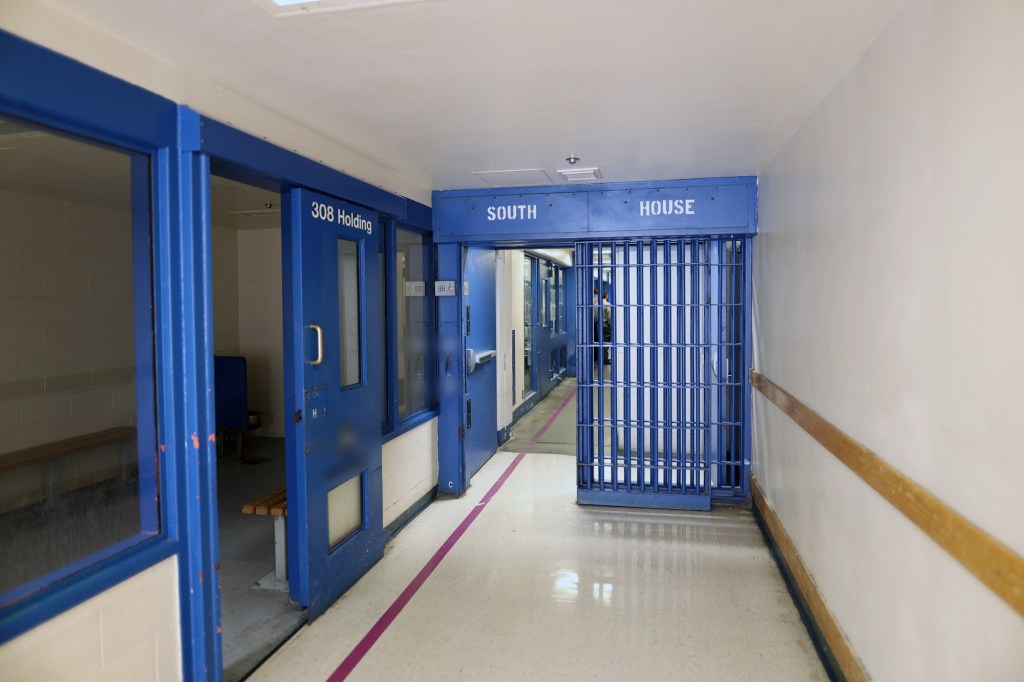
In the last hours of his life, Bobby Ray Patton Jr. was moaning loudly from inside his cell at the Vista Detention Facility.
He had been diagnosed with the flu days earlier and was also being treated for suspected pneumonia. A deputy had escorted him to the jail’s medical clinic less than eight hours earlier.
This time, the same deputy, standing just outside Patton’s cell the morning of Dec. 28, 2024, failed to respond to his repeated requests for help.
The deputy’s body-worn camera captured those pleas.
“I can’t breathe,” Patton said. “I’m having chest pain so bad.”
According to preliminary findings by an investigator with the county’s Citizens’ Law Enforcement Review Board, or CLERB, “Deputy 3 looked through the cell door window while Patton continued audibly moaning. Deputy 3 then turned away from the cell and continued toward the exit of the module.”
Then this: “As Deputy 3 walked away from the cell door, Patton said, ‘Please help me.’ Deputy 3 exited the module shortly thereafter and turned off their (bodyworn camera).”
Patton died less than three hours later.
Review board investigators recommended sustained findings on multiple allegations — meaning they found sufficient evidence to support them — and concluded that Deputy 3 engaged in criminal conduct by failing to respond. A separate allegation involving another deputy was not sustained due to insufficient evidence.
“A person acts with criminal negligence when he or she acts in a reckless way that creates a high risk of death or great bodily injury, and a reasonable person would have known that acting in that way would create such a risk,” the finding says, citing case law.
The report notes that the burden of proof for CLERB to issue such a decision is a preponderance of the evidence — a lower threshold than that required in a criminal case, which needs proof beyond a reasonable doubt.
The all-volunteer review board is expected to consider the report at a meeting Thursday night and vote on whether to sustain the findings.
It’s unclear what the criminal conduct finding means. There is no record of the board ever sustaining such an allegation.
CLERB Executive Officer Brett Kalina did not respond to questions from The San Diego Union-Tribune.
Even if the allegations are sustained, CLERB’s findings are advisory. The board can recommend policy changes or discipline, but Sheriff Kelly Martinez is not legally required to act on them.
A spokesperson for Martinez rejected any notion that Deputy 3 committed any crime.
“SDSO Homicide Unit completed an investigation in this case and during the investigation the medical examiner determined Mr. Patton’s death was accidental related to health complications,” Lt. David Collins said by email.
“Additionally, the investigation revealed no evidence of criminal conduct,” he wrote. “Therefore the case was not referred to the DA’s Office.”
In a statement, a spokesperson for District Attorney Summer Stephan said that, generally, not all criminal cases begin with a referral from a police or sheriff’s department.
“While most of the cases the D.A.’s Office reviews for criminal violations on a beyond-a-reasonable-doubt standard are referred by the sheriff or another law enforcement agency, we do review cases based on community referrals, video evidence shared by media or directly with us, or other non-law enforcement sources such as CLERB,” spokesperson Tanya Sierra said in an email.
Separately, the sheriff’s own internal Critical Incident Review Board issued a brief summary of the circumstances surrounding Patton’s death.
“The CIRB conducted a final review of this incident on Aug. 13, 2025,” a summary states. “Pending the final CIRB report, there are no action items at this time.”
No final report has been posted on the sheriff’s website.
Collins said CIRB is not an investigative body and does not make findings of misconduct.
“The focus of CIRB is to assess the Sheriff’s Office civil exposure,” he said. “The fact that there are no ‘action items’ does not mean there were no issues.”
“Issues are regularly identified and acted upon prior to the CIRB reviewing the matter,” Collins said.
A 2022 state audit that deemed San Diego jails the deadliest among California’s large county lockups urged the Sheriff’s Office to be more transparent about the findings of its internal reviews of in-custody deaths.
“(T)he legislature should require the department to make public the facts and recommendations discussed in Critical Incident Review Board meetings,” the audit said.
Criminal or not, the circumstances of Patton’s death raise questions about reforms Martinez has implemented since becoming sheriff in January 2023. Dozens of people have died in custody on her watch and the county has paid tens of millions of dollars in legal settlements to grieving families.
George C. Klein, a former FBI researcher and retired criminal justice professor at Oakmont College in Illinois, reviewed CLERB’s findings in the Patton case and said it was clear that deputies violated department policies.
“Deputy 3 did not conduct a safety check,” he said. “This is important because if government agencies act recklessly, intentionally or with gross negligence, they are acting with ‘deliberate indifference’ and are legally liable.”
Klein said he has seen similar negligence over many years, and the lapses share commonalities.
“I have found that violence, lack of adequate healthcare and staff shortages are common in jails and prisons,” he said. “However, one factor that is often overlooked is indifference. That is, individuals are seen by the staff as ‘inmates’ and not human beings.”
The San Diego Union-Tribune contacted several of Patton’s relatives but did not hear back.
According to the investigative report accompanying his autopsy, Patton was arrested by Riverside County deputies on Nov. 25, 2024, on a probation violation warrant and transferred the same day to San Diego County custody, where he was booked into the Vista jail.
During booking, he reported a history of fentanyl use and said he was enrolled in a methadone treatment program.
The autopsy report says he was notified of possible exposure to influenza A on Dec. 19.
Days later, he developed symptoms including headache, chills, runny nose, body aches and a cough. A test confirmed influenza A.
On Dec. 27, Patton again reported chest pain and shortness of breath and was taken to the clinic. An X-ray showed fluid in his lungs, and he was prescribed antibiotics for suspected pneumonia.
He was returned to his cell. At 9:45 p.m., he pressed the intercom again, reporting severe chest pain and difficulty breathing. He was taken back to the clinic and later returned to housing.
“(Bodyworn camera) footage and reports documented that Deputy 3 was involved in escorting Patton to the clinic for this evaluation,” investigators wrote. “Medical documentation indicated that after the evaluation, Patton was returned to housing.”
Early the next morning, about an hour after Deputy 3 ignored Patton’s plea for help, another deputy also failed to act, CLERB investigators found.
“At approximately 6:55 a.m., Deputy 1 conducted a safety check and briefly looked into Patton’s cell while audible moaning was heard,” the report states. “The footage showed Deputy 1 continued with the safety check of the module.”
Only after another round of checks did a deputy return and interact with Patton, then leave again, returning at 8:13 a.m. with members of the medication-assisted treatment team.
By then, it was too late.
“During the interaction, Patton became unresponsive,” the report says. “A nurse assessed for a pulse and initiated CPR when she did not detect one. Deputies administered Narcan and provided rescue breaths.”
Paramedics arrived around 8:30 a.m., and Patton was pronounced dead at 8:45 a.m.
In all, investigators recommended sustained findings against Deputy 3 for failing to respond to a medical emergency and failing to complete a safety check, along with a finding of criminal negligence.
Deputy 1 was singled out for failing to recognize or respond to a medical emergency and failing to follow proper count procedures.
A third deputy was investigated for failing to defer to medical staff, but that allegation was not sustained.
The medical examiner’s report says Patton died from acute bacterial bronchopneumonia made worse by influenza.
Methadone and his history of substance use were listed as contributing factors — he had been taking methadone under the jail’s medication-assisted treatment program. The manner of death was ruled an accident.
Patton was supposed to be on a methadone taper, Chief Deputy Medical Examiner Jonathan Lucas noted in his report, but toxicology testing detected methadone at a concentration higher than expected given that taper.
As a respiratory depressant, the drug likely contributed to his death, Lucas noted.