
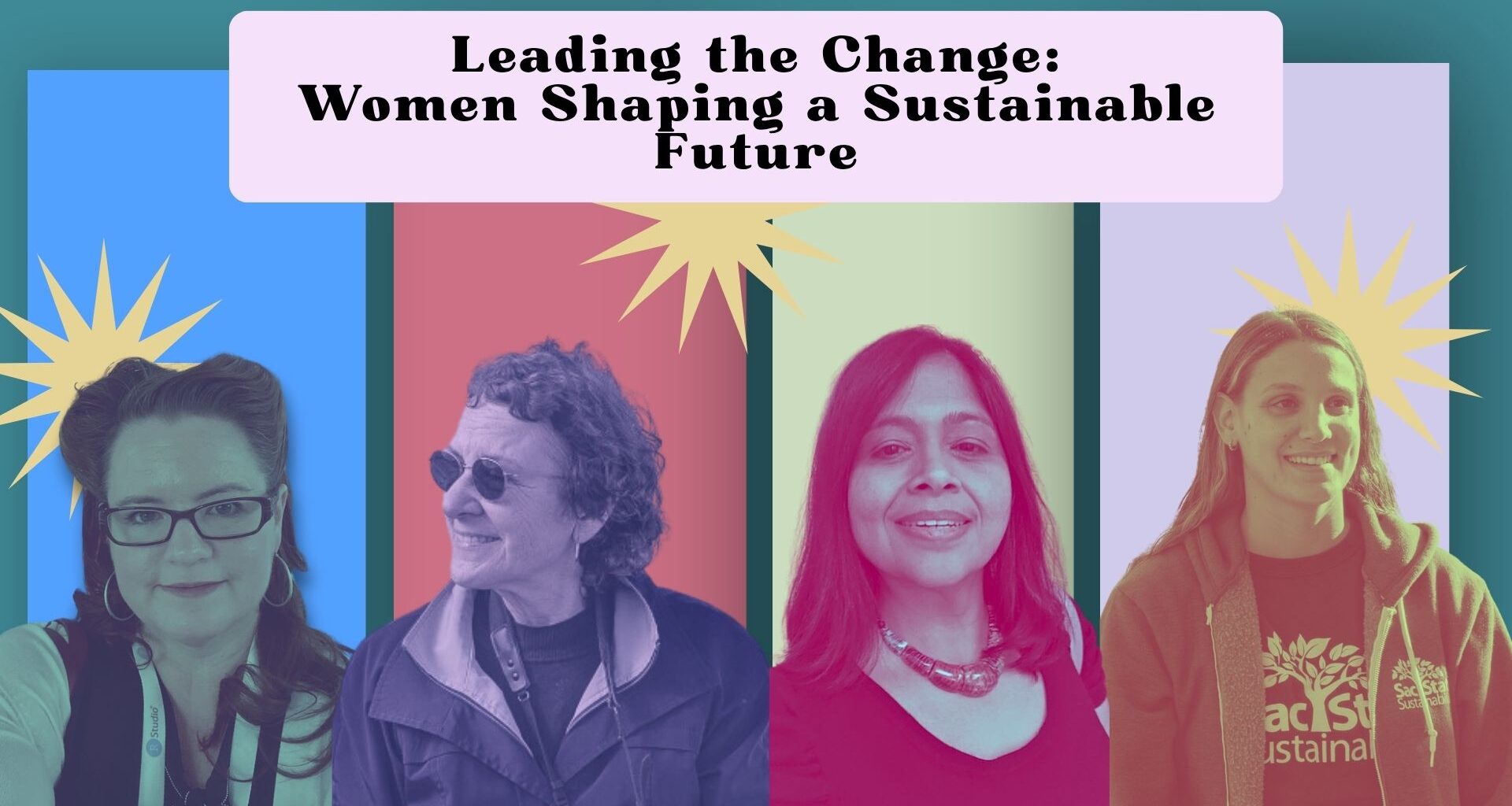
This year, the National Women’s History Alliance set the Women’s History Month theme of “Leading the Change: Women Shaping a Sustainable Future.”
The NWHA was founded in 1980 by a group of California women who also launched the first Women’s History Week in Sonoma. Their stated goal was to bring women’s history into broader public awareness.
Laura Gonzalez-Ospina is a waste and sustainability analyst at Sacramento State. She said her office aims to reduce waste, energy use and greenhouse gas emissions on campus and find solutions for generated waste.
“We have a goal to be zero waste by 2030, which means that 90% of our waste needs to be either recycled, reused or composted by them. So I create programs that help us get there,” Gonzalez-Ospina said. “I also help educate the community on how to use waste as a resource instead of just throwing it out.”
Gonzalez-Ospina said she is happy to hear the 2026 theme, and she is encouraged by women’s progress in sustainability. Notable women in the sustainability field include Greta Thunberg, Rachael Carson and Jane Goodall.
“I get inspired by my grandmas to get where I am. I grew up with that example, with that energy,” Gonzalez-Ospina said.
RELATED: California Commission on the Status of Women and Girls hold networking open house
Gonzalez-Ospina said she is proud of Sac State’s efforts to support women entering sustainability fields.
“We offer a lot of volunteer opportunities, internships, sometimes we have work pay or College Corps fellows,” Gonzalez-Ospina said. “I personally have the great opportunity to work with amazing women interested in the field.”
Kristin Van Gaasbeck is an economics professor and director of both liberal studies and social science programs, as well as a member of the California State University Academic Senate. She said Sac State supports women leaders by providing a range of resources.
“Compared to other places where I’ve been, there’s a real deliberate desire and attempt to help everyone feel welcome,” Van Gaasbeck said. “So if a woman on campus feels unsafe, there are resources that she can use. If she wants to move into leadership, there are mentors that we can reach out to.”
Van Gaasbeck said, as a professor and CSU Academic Senate member, she helps make learning more inclusive. She said that she shapes the curriculum for future teachers in her director role.
“One thing that I’ve tried to do in both curricula is modernize them a little bit by incorporating coursework from ethnic studies, women and gender studies, because those really do have the social justice focus,” Van Gaasbeck said.
Van Gaasbeck said sustainability is interdisciplinary and ubiquitous, affecting communities locally as well as countries with fewer resources than the United States.
“I view social justice as not separable from environmental justice,” Van Gaasbeck said. “I think that the issues with sustainability disproportionately harm those who are marginalized in society.”
Michelle Stevens, an environmental studies professor, leads students in fieldwork through the Bushy Lake Restoration Project. The project uses traditional ecological knowledge to restore native plants and species.
“It’s involved myself, other Sac State faculty and hundreds of students just bringing a lot of the people out, students out, who are helping us do the management,” Stevens said.
Stevens said she has seen many changes at Sac State, including growth in restoration ecology.
“We’ve been trying to protect wetlands in the U.S. since the 1980s, [using] traditional knowledge and incorporating the knowledge of Indigenous and California Native peoples,” Stevens said.
Stevens said that when she started at Sac State, there was no sustainability department. She said that she saw few women as professors, deans or in leadership positions.
“Just the numbers of women have gone up a lot, and I’m so proud of our university with our inclusion,” Stevens said. “We’ve really embraced diversity, women and sustainability. When I see what the rest of the country is doing, I’m pretty happy to be in California and at Sac State.”
Sujatha Moni is a women and gender studies professor. Like Stevens, Moni has been on campus for many years and has seen the large-scale changes made.
“I’ve been on this campus more than 20 years, and I’ve not seen this form of leadership — these images of women — in previous university administrations,” Moni said. “Seeing these women leaders, our students are going to gain the confidence that they can also lead.”
Moni said it is important for students to see professors who reflect their identities, and that the campus has made a deliberate effort in recent years to recruit faculty of color.
“Those of us who have been doing this for a long time, we don’t feel so alone and isolated in the world,” Moni said.
While praising the women’s movement’s achievements, Moni cautioned against slowing progress.
“We have to really evaluate how far we have come and what is the world that is left for us,” Moni said. “The fight has never been more intense than it is right now in this moment.”