
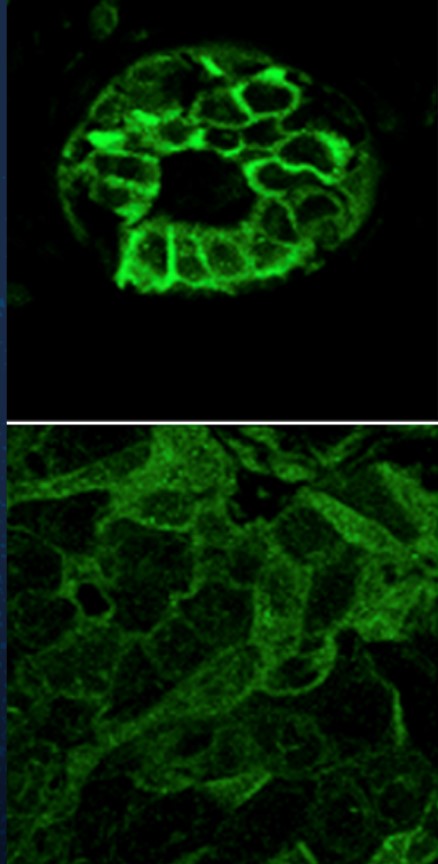
Researchers at UC San Diego in La Jolla say they have found a new way the body can stop the spread of breast cancer, possibly making it easier to treat the disease.
According to a study released March 31, scientists discovered a new role for an inflammatory protein called TYK2 in mechanotransduction, the process by which cells sense and respond to their physical environment.
“Understanding mechanotransduction can provide insights into how cancer spreads and provide new avenues for treatment,” the researchers said.
The study, published in the scientific journal Nature, reports that:
• TYK2 acts to suppress breast cancer in response to stiffness in material surrounding and connecting cells.
• If stiffness is at a low rate, TYK2 is found on the cell membrane, where it stops cancer cells.
• For high stiffness rates, TYK2 is inactivated and found throughout the cell, resulting in an invasion of cancer cells.
• In tests on mice, inhibiting TYK2 with drugs “promoted breast cancer invasion and metastasis.”
Drugs that inhibit TYK2 are being looked at as treatments for autoimmune diseases, according to UCSD researchers. They added that their study “highlights the need to consider these drugs’ impact on breast cancer progression.”
Zhimin Hu, a project scientist at UCSD’s Moores Cancer Center and the study’s lead author, said the findings reveal “how extracellular matrix stiffness regulates breast cancer metastasis through TYK2 and provides new insights into how physical cues in the tumor microenvironment control cancer progression.”
The study shows “significant implications for the clinical use of TYK2 inhibitors and underscore the importance of considering the mechanical microenvironment in cancer therapy,” said Jing Yang, a pharmacology professor in the UCSD School of Medicine and a corresponding author of the study.
The research was funded in part by the National Cancer Institute and the American Association of Cancer Research. ♦