
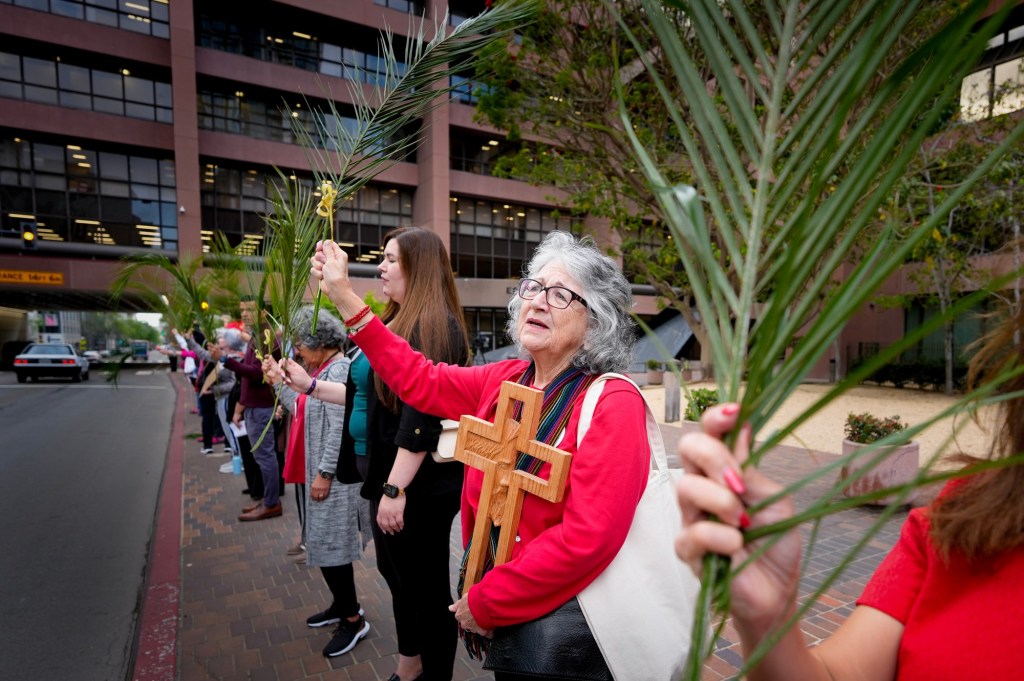
Standing on the sidewalk outside the Edward J. Schwartz Federal Building on Wednesday, as vehicles and pedestrians passed by, dozens of volunteers and religious leaders alike waved palm branches.
Some of the group members routinely accompany immigrants to the downtown San Diego federal building for court hearings or check-ins with Immigration and Customs Enforcement. But on this day, a bigger group was outside the building, holding the branches as Easter approaches.
“We chose this Wednesday of Holy Week as a way of saying that we also placed palms on the sidewalk here, to really show honor and respect for immigrants who come here (…) to let them know they’re not alone,” said Rev. Scott Santarosa from Our Lady of Guadalupe Church in Logan Heights.
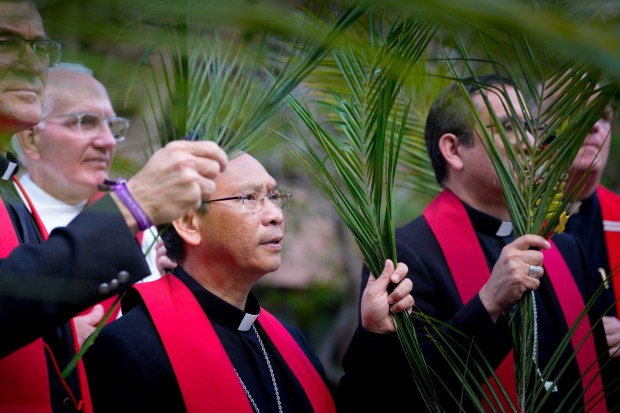 Bishop Michael Pham (middle) and Auxiliary Bishop Felipe Pulidoamong (right) with the Roman Catholic Diocese of San Diego were among the peaceful demonstrators carrying palm branches outside the Edward J. Schwartz Federal building in downtown San Diego on Wednesday. The demonstration was to show support for migrants arriving for immigration court. (Nelvin C. Cepeda / The San Diego Union-Tribune)
Since August, volunteers from the Faithful Accompaniment in Trust and Hope, or FAITH, program have been present every weekday inside the building as cases were reported of immigrants being detained after their hearings or check-ins.
But on two consecutive days in late February, some of the volunteers who regularly pray or observe the building’s hallways were being issued citations alleging they had failed to comply with posted signed or security personnel’s directions, which indicated loitering was not allowed. For a moment, some volunteers wondered if it was worth continuing given the restrictions. But after a meeting attended by several members, it became clear that there was still strong commitment to the effort, said Santarosa.
On Wednesday, Bishop Michael Pham of the Roman Catholic Diocese of San Diego reiterated the program’s commitment to staying put.
“Despite these challenges, we are here today to publicly proclaim that we are not going away,” said Pham. “We are not afraid, we will be intimidated to stop doing what we do. We will stand, we will pray, we will not loiter, instead we bear witness to the dignity of our sisters and brothers.”
Santarosa said that volunteers have continued to show up at the building. He added that they have not heard of any new citations since late February.
In early March, a Federal Protective Service spokesperson said that the regulations were not new and had been in effect since November. “Obstructing access in federal buildings is a crime. It is against federal law to obstruct the use, enjoyment, or access to federal property, including foyers, lobbies, and corridors. Noncompliance with lawful commands from federal law enforcement is a crime,” the spokesperson said at the time.
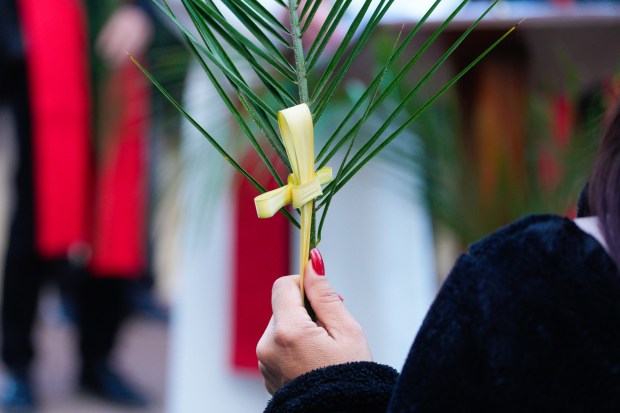 Demonstrators carried palm branches just outside the Edward J. Schwartz Federal Building in downtown San Diego on Wednesday, April 1, 2026. The demonstration was to show support for migrants arriving for immigration court. (Nelvin C. Cepeda / The San Diego Union-Tribune)
Volunteers have disputed that there were any obstructions in the hallways.
The FAITH program is managed by the Roman Catholic Diocese of San Diego, the Our Lady of Guadalupe Parish and the San Diego Organizing Project, a network of faith-based organizations. Volunteers from the Detention Resistance collective also regularly accompany immigrants at the federal building.
Since the FAITH program launched last summer, over 700 volunteers have undergone training to participate.
Francina Vivier from the Sister Servants of the Blessed Sacrament congregation has been a regular presence at the federal building since the beginning. She shared that, two weeks ago, she introduced herself to an immigrant woman who was using a walker and offered to accompany her into the courtroom for her hearing.
She was not allowed to join her inside, and was told to stay in a waiting room. However, she told the woman that she was going to pray for her while her hearing was taking place. Moments later, the woman’s granddaughter approached Vivier in the waiting room.
Vivier recounted through tears that the girl said her grandmother, who had been given another court date, sent her only to thank her. Vivier said she was moved the gesture.
Having heard the anecdote, Pham, a refugee himself, said that it exemplifies the spirit of the program.
“That’s who we are about,” he said. “We need to treat one another with dignity, values and respect.”