
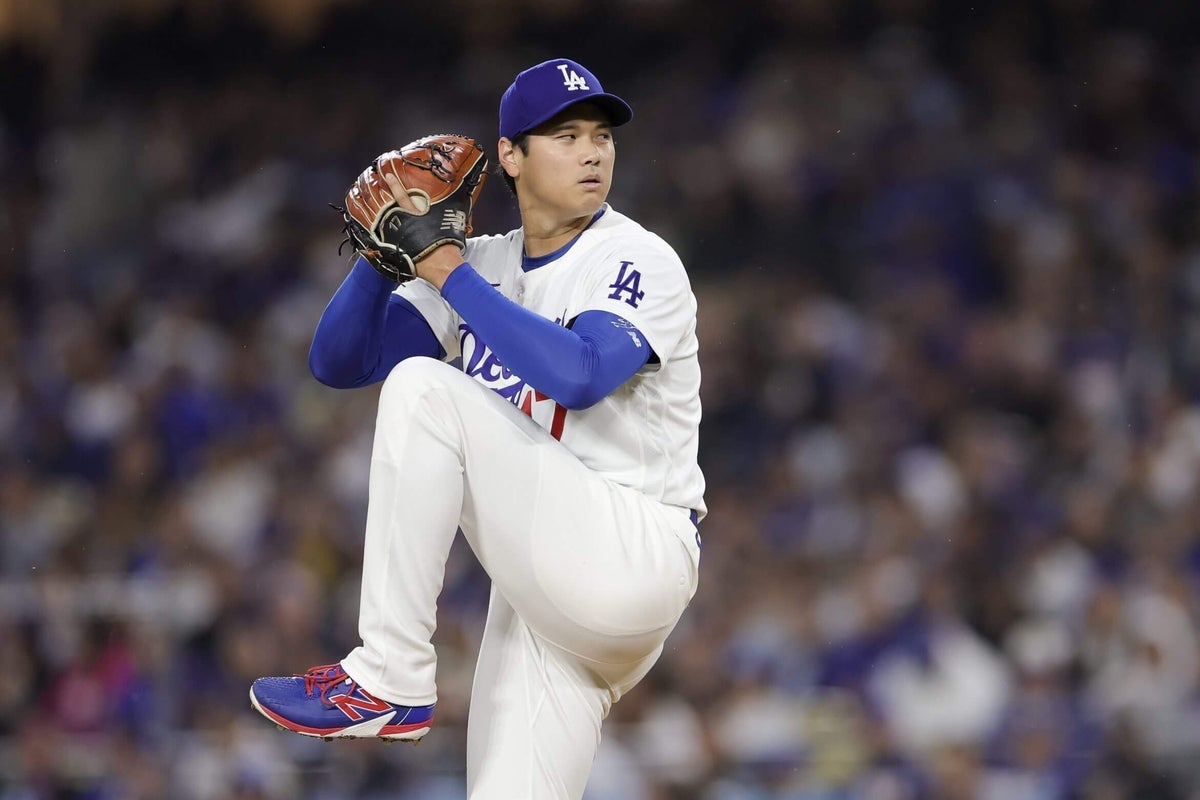
LOS ANGELES — Shohei Ohtani’s calling card is doing what no player on the planet can do as a two-way superstar. But pitching will always be the lens through which he views himself. The man who sees his consecutive 50-home run seasons at the plate part of his day job is fully actualized on nights like Tuesday, where he hopes to prove a singular point.
He is not just the best player in the sport. He’s hoping its best pitcher, too. As if there’s anything else to his list of accolades.
Sometimes even Ohtani can lose himself in it, even if it’s just for a moment. He briefly forgot about the other part of his duties on Tuesday night. After the fifth of his six scoreless innings against a hapless Cleveland Guardians offense, he strolled toward the dugout — only to remember he was set to lead off the inning.
The greatest pit change in baseball history ensued, after he’d already done one after a scoreless first inning. Out went his hat and glove, which he set on the dugout rail as interpreter Will Ireton offered encouragement and a bat boy offered a towel to dry off the rain. On came every piece of protective gear imaginable before Ohtani drew a leadoff walk.
Shohei forgot he was leading off the inning 🤣 pic.twitter.com/zTuRChpnVV
— MLB (@MLB) April 1, 2026
It’s a sequence that belongs singularly to him. Only one player could write Tuesday’s script, where a leadoff hitter who reached three times also looked dominant over 87 pitches in a 4-1 Los Angeles Dodgers win. Ohtani’s two-way exploits may never feel normal, but this is part of the show. His season pitching debut was just a reminder of that.
Ohtani is still trying to show something new. He isn’t just pitching again. He might be an even better pitcher than he’s ever been.
“That’s my intention every year — to be a better pitcher, better player,” Ohtani said through Ireton. “And I hope that at the end of the year my intention is to be able to look back and say that was a really good pitching season.”
His fastball surprised Dodgers officials last summer, not just by how hard he threw it on average (it touched 99.2 mph and sat 96.8 mph Tuesday) but his ability to grasp his command so quickly after a second major elbow procedure. It is the rest of his arsenal that makes him lethal, though he didn’t feature it nearly as much as he built up his workload in big league games last fall. It took until just before the postseason for him to make full-fledged starts. Still, he had a 2.87 ERA in the 47 innings he threw.
His first time pitching in October ended on a sour note: He took the baseball on short rest in Game 7 of the World Series and exited in the third inning with a three-run deficit after a Bo Bichette home run. Surely, that ate at him.
Now free from the monotony of rehabilitation, Ohtani the pitcher can be unleashed. Against Cleveland, he showed how fearsome that can be for opposing lineups.
In his season debut, that included 21 curveballs — more than in all but one of his 100 previous starts. That pitch itself varied throughout his outing, as Ohtani twisted the dials on its velocity to register it anywhere between 69 and 82 mph.
His splitter drew five swings and misses and five different pitch types resulted in a whiff. The diversity of his mix allowed each time through the order to feature a different primary offering, from the fastball to his cutter to his splitter, all while mixing in a sweeper, slider and sinker.
“He had a good mix,” Cleveland manager Stephen Vogt said. “It really had no pattern to it.”
Every issue that popped up had multiple solutions. He could beat the Guardians with power as well as craft. He had nearly as different looks for Cleveland’s lineup as he had facial expressions from the mound. It was him in his element.
just put a camera on shohei ohtani and leave it pic.twitter.com/Zp0EpIchdd
— Codify (@CodifyBaseball) April 1, 2026
“His demeanor when he’s pitching is different than when he’s just hitting,” Dave Roberts said.
Ohtani’s affection for pitching is no secret. Now, his body is cooperating. His delivery is more in sync. Ohtani said he is feeling “more loose and easy” this go-around than when he first made his way back to a big-league mound last year. A second major elbow surgery can be a death sentence for pitchers. Ohtani continues to provide evidence that it’s foolish to expect the expected from him.
“I only think he’s getting a little better,” said Will Smith, who caught him.
The Guardians had little answer. Their lone hit over Ohtani’s six innings came when Rhys Hoskins got his bat to a sweeper on the outer half of the plate, floating it high and far and fair enough to drop in for a double. Three walks presented the lone real threat against Ohtani, who now has not allowed a run over his last 22 2/3 regular-season innings dating back to August. His biggest issue may have been a wet mound that made for difficult footing, so much so that Roberts at one point called for the grounds crew to attend to it.
Ohtani hardly noticed. When the work was done, he immediately resumed his form and struck out Hoskins on another sweeper to end his night.
“He’s just unflappable,” Roberts said. “Not a whole lot kind of affects his mind.”
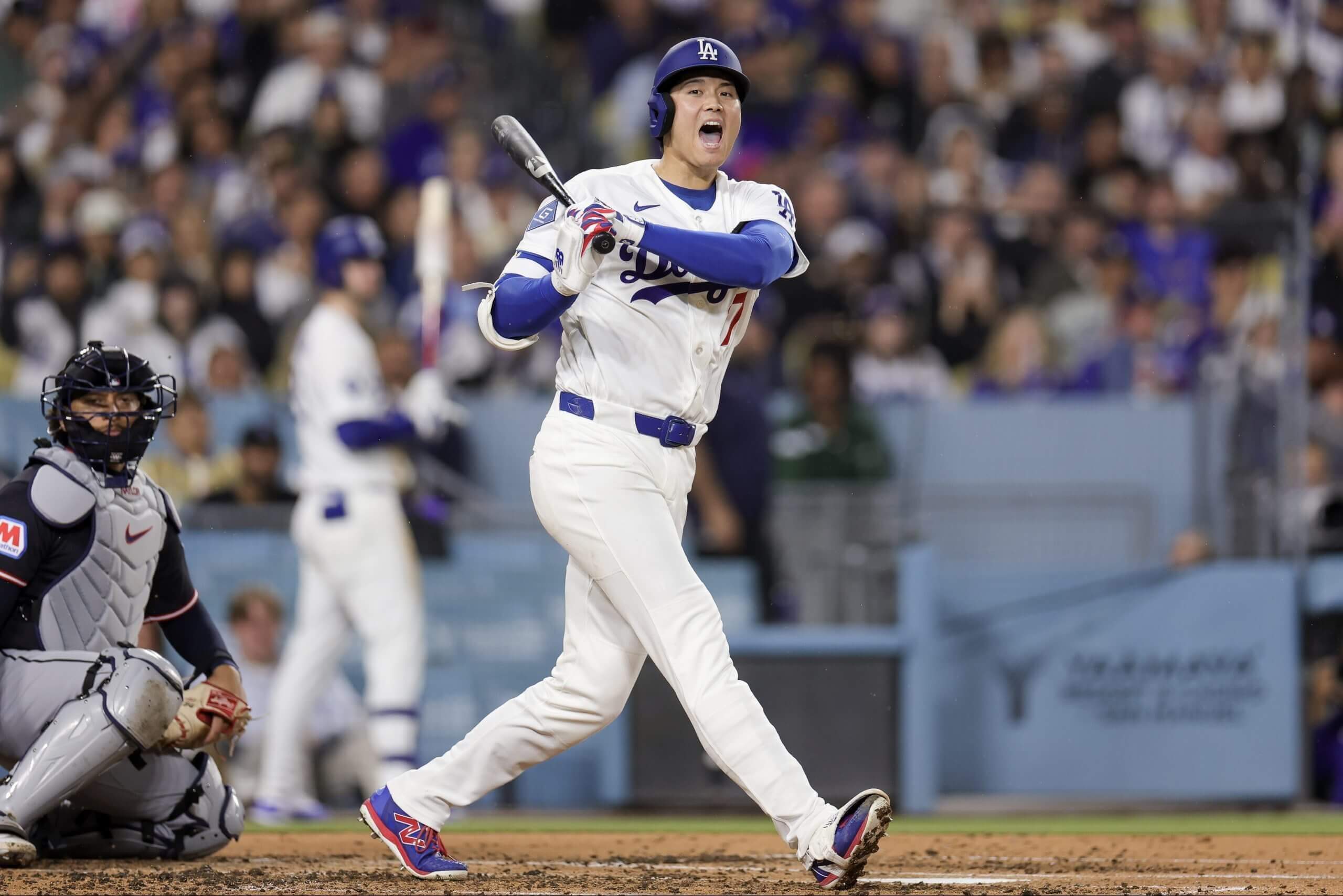
Ohtani also went 1-for-3 with a pair of walks in the win. (Ryan Sirius Sun / Getty Images)
The Dodgers know Ohtani can be as nasty as anyone. He did not necessarily break ground with one electric performance against a team that scored the fewest runs in the American League last season and lost its only home-run hitter so far in 2026, rookie Chase DeLauter, to an injury on the second at-bat of the game. No one was expecting anything other than this.
Still, this is a signal of Ohtani’s intentions. It has been a poorly kept secret around these parts that Ohtani wants to become the first Japanese-born pitcher ever to win the Cy Young. His own two-way prowess could be his biggest inhibitor, limiting his workload against a collection of talented peers that includes reigning winner Paul Skenes, and his own teammate, Yoshinobu Yamamoto, among others.
“It does seem absurd, but I think if anyone can manage the designated hitter role and be as productive as he’s been and still chase that elusive Cy Young for a Japanese pitcher, I think that he can do it,” Roberts said.
He sure looked the part. The circumstances of Ohtani’s schedule have increased the difficulty of this endeavor, putting a premium on efficiency. Ohtani came away pleased Tuesday that he was able to get through six innings while remaining under his set pitch count of 90. This, after having an unorthodox ramp-up this spring that featured him hitting (and not pitching) for Japan in the World Baseball Classic, and only pitching into two spring training games. His first four games of the season were spent doing his day job as a designated hitter, a preamble to his own favorite activity.
“When you watch him go about his work every single day,” Max Muncy said, “he’s really bought into everything with pitching, his mechanics, how to attack hitters. He just focuses on it so much. You can really, really tell that he loves it.”
That passion could unlock something special.
“I expect nothing short of almost a Cy Young out of him,” Muncy said.