
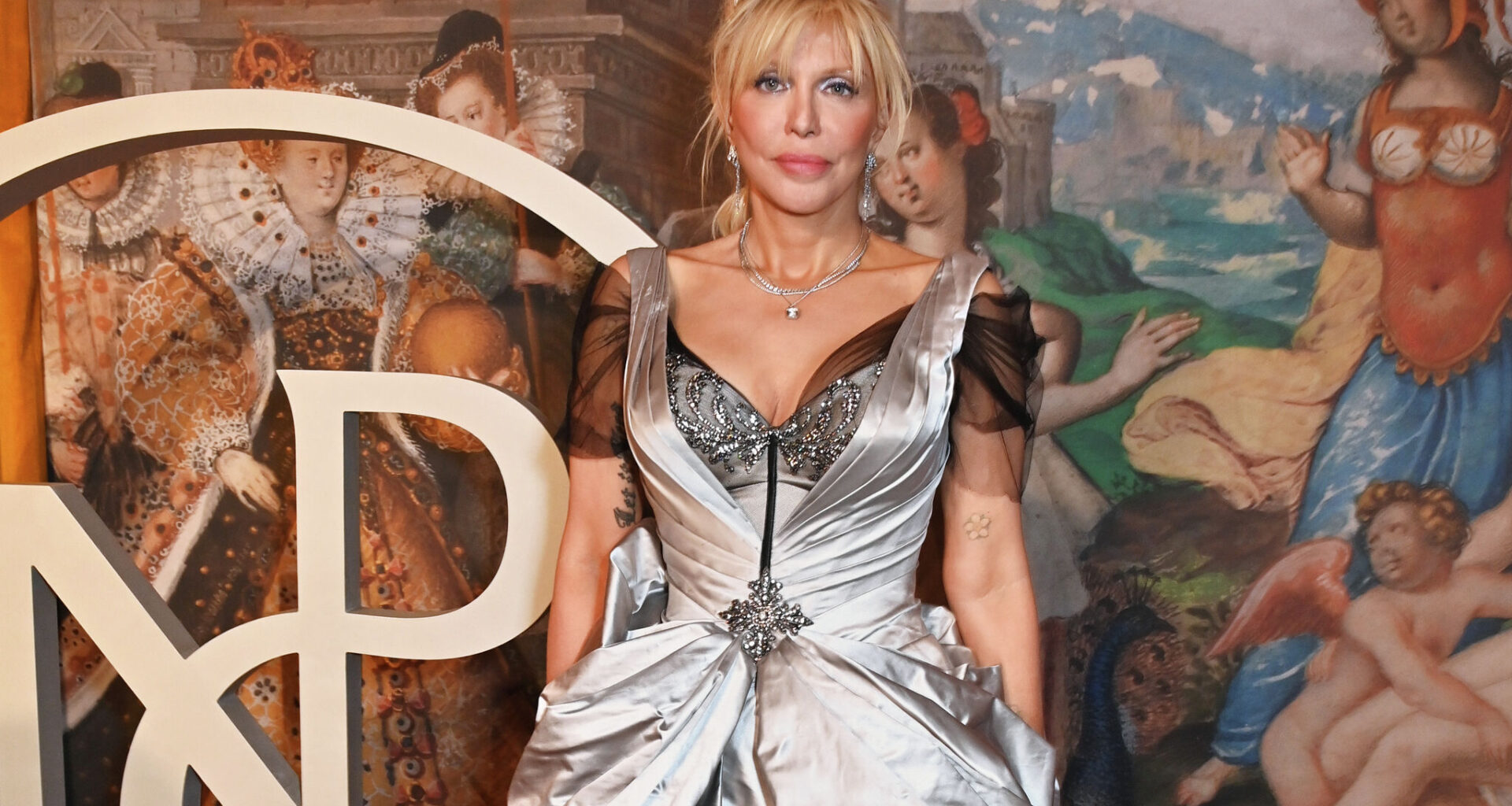
Courtney Love at the National Portrait Gallery’s Portrait Gala on March 19, 2024 in London, England. Love revisits her claim that she was given LSD as a toddler while growing up in San Francisco’s Haight-Ashbury in a new podcast interview with Billy Corgan.
Dave Benett/Dave Benett/Getty Images for Nat
Courtney Love is revisiting her San Francisco childhood — and debunking one of the city’s most enduring myths.
In a new episode of “The Magnificent Others,” a podcast hosted by Smashing Pumpkins frontman Billy Corgan that features long-form interviews with artists and cultural figures, the Hole singer describes growing up in Haight-Ashbury not as a flower-power idyll but as something far darker.
She also alleges that her father, former Grateful Dead associate and author Hank Harrison, gave her LSD repeatedly when she was a toddler. The two were long estranged before his death in 2022.
Article continues below this ad
“People think the Haight was this really great place,” Love said. “My memory of the Haight-Ashbury, other than my father giving me acid from about 3 to 6 until my mother noticed and he got his custody taken away, is that it was dank and dirty and awful, and people were on heroin and early meth.
“So the whole ‘Summer of Love’ thing — they just use the same footage over and over, like two days in Golden Gate Park. I’m not kidding. It was the opposite. The whole Fillmore thing was dark.”
San Francisco Chronicle Logo
Make us a Preferred Source to get more of our news when you search.
Add Preferred Source
Historians have documented how an influx of runaways, overcrowding and the spread of hard drugs, including heroin, reshaped the Haight by the late 1960s, even as its legacy was softened in popular culture. Love’s version leans squarely into that reality, denouncing decades of romanticized imagery — tie-dye, free concerts, a generation in bloom.
The Chronicle could not independently verify Love’s account.
Article continues below this ad
Born Courtney Michelle Harrison in San Francisco in 1964, Love has long spoken about an unstable upbringing. She described her father as drifting between identities.
“In the Grateful Dead world and then in the Irish holy grail world, and in the giving LSD to his child at the Haight-Ashbury world, you know, he’s got a hero’s journey, as lame as he was,” she said.
Harrison has previously denied the allegation, saying in a 1995 Chronicle interview that he did not give his daughter LSD.
In the interview, she also draws a stark contrast between her parents’ worlds — one immersed in counterculture, the other shaped by wealth. Her mother, Linda Carroll, was a therapist who guided ’60s radical fugitive Katherine Ann Powers into surrendering to authorities in 1993.
“They were really rich. They lived at 999 Green St. in the entire penthouse — doormen, uh, maids. My mother had a maid when she lived in the Avenues named Modell,” she said.
Article continues below this ad
Billy Corgan and Courtney Love at the Gagosion Gallery on April 15, 2006 in Beverly Hills.
Patrick McMullan/Patrick McMullan via Getty Image
That privilege, she suggested, did not translate into stability.
“I was scared most of the time,” she said. “I was really abandoned in that family. I knew I didn’t like my mother. I knew it was a bad match … and I just wanted to get away.”
At times, Love zooms out, framing her experience as part of a broader generational pattern.
“As I like to say, we grew up with those boomer parents who were more — my joke is they were more obsessed with cocaine and yoga or weed and yoga,” she said. “I’m saying we all were kind of the byproducts of this. Yeah, like latchkey kids or kids whose parents watched too much ‘Gilligan’s Island.’”
Article continues below this ad
The episode, part of the latest run of “The Magnificent Others,” also finds Love and Corgan revisiting their shared history in the 1990s alternative rock scene and the tensions that shaped it.
Both criticize what they describe as “gatekeeping” in indie music at the time, arguing that rigid ideas about authenticity often stifled ambition.
Love points to longstanding conflicts within that scene, including her fraught relationship with Sonic Youth’s Kim Gordon and the broader Riot Grrrl movement.
The conversation ranges widely, from memories of Kurt Cobain to reflections on fame, class and survival. Love recalls her early, unapologetic drive to succeed, born out of a formative fight in middle school that she said shaped her sense of self.
Article continues below this ad
“I was confident after that — I got cocky,” she said.